Loading...
en

Solana DePIN Protocols Generate $2.4M in February 2026 as Growth Shifts Across Sectors

Revenue stabilizes while wireless and new protocols continue to shape the ecosystem.

Solana’s decentralized physical infrastructure network (DePIN) sector continues to expand with Syndica’s February 2026 Solana DePIN Deep Dive highlighting both stabilization in revenue and shifting momentum across key verticals.

DePIN projects use blockchain technology to coordinate real-world infrastructure such as wireless networks, compute resources, and mapping systems, rewarding participants for contributing data, bandwidth, or hardware.

Revenue Trends Show Stabilization

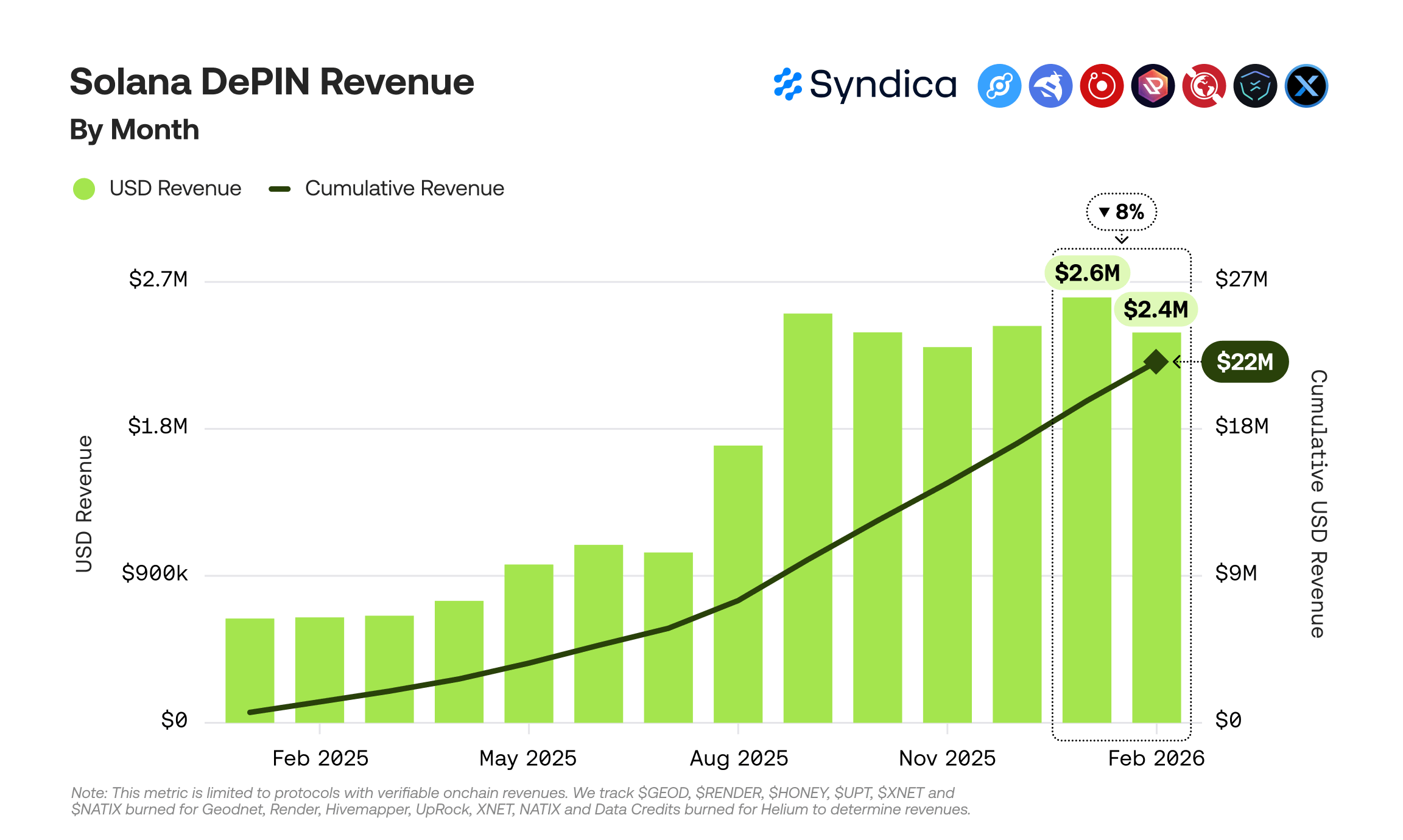
In February 2026, leading Solana-based DePIN protocols including Helium, Render, Hivemapper, UpRock, NATIX, XNET, and GEODNET collectively generated $2.4 million in revenue. This figure represents a modest 8% decline from January, suggesting a period of consolidation after stronger growth earlier in the year. Despite the slight pullback, cumulative revenue across tracked protocols has now surpassed $22 million since January 2025.

He Me Dolxqair Uo7

These revenues are derived from onchain activity, including token burns such as $HONEY, $UPT, and $NATIX, as well as Data Credits used within Helium’s ecosystem.

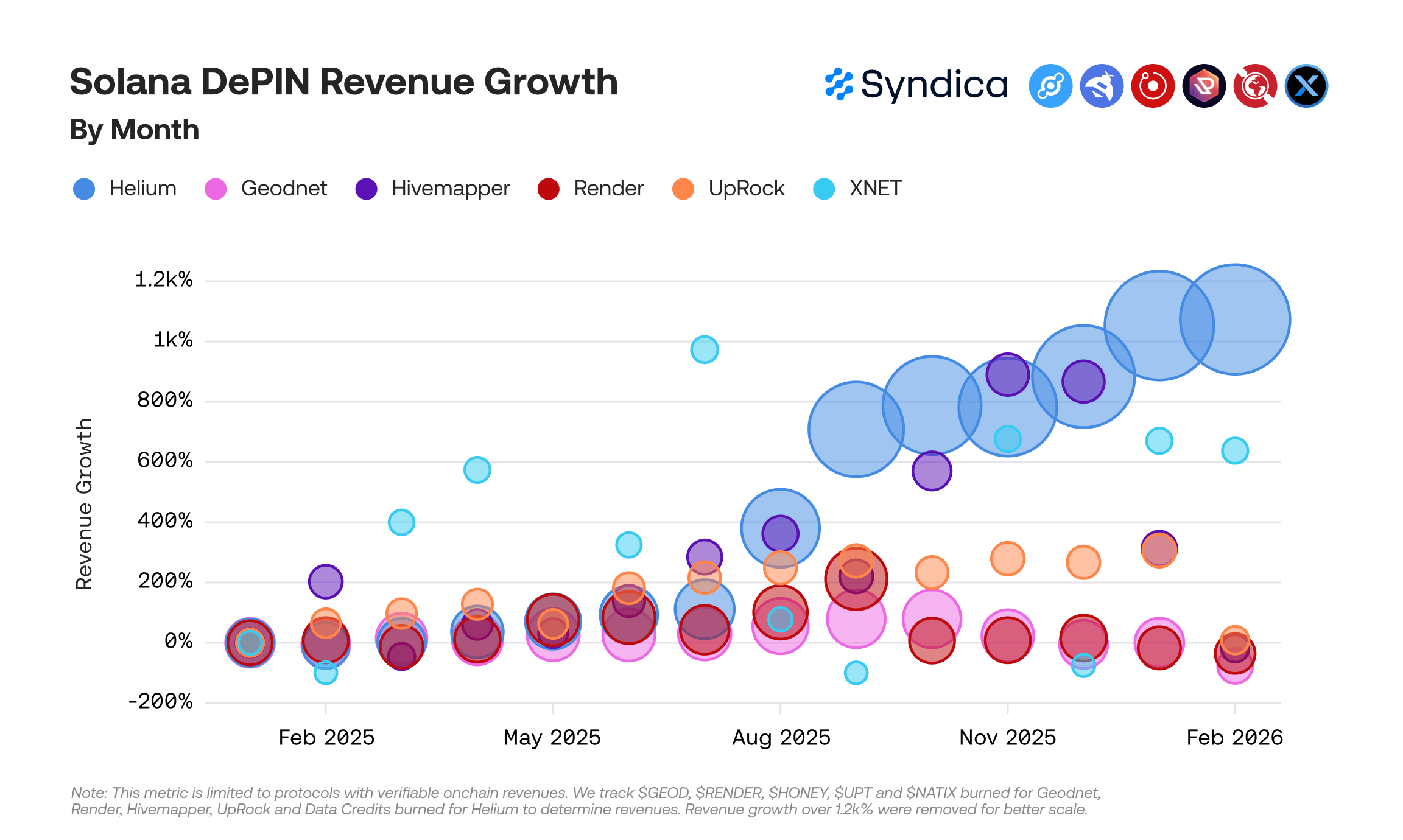
Revenue performance across Solana DePIN protocols indicates a more stable phase following periods of higher volatility. While only Helium and XNET recorded more than 100% growth compared to January 2025, most other protocols experienced declines.

He Me K Bka Iaa Z3w

At the same time, deployer rewards continued a downward trend that began in August 2025. In February, total rewards distributed across protocols such as Render, io.net, GEODNET, NATIX, Sallar, and UpRock fell below $2 million for the first time in several months. This decline may reflect tightening incentives or a shift toward more efficient network participation amid the general market downturn.

Wireless Sector Hit New ATH in Data Offloading

Wireless-focused DePIN protocols remained the dominant contributors to network activity and growth. In February 2026, Dabba Network, Helium Mobile, and XNET collectively delivered 37,000 terabytes of offloaded data, marking a new all-time high and a 12% increase from January’s previous peak of 33,000 terabytes.

Helium Mobile continued to generate consistent revenue, reporting $2.2 million for the second consecutive month. This brings its cumulative revenue since January 2025 to $14 million.

The network’s data offloading activity reached new highs. Average daily data offload increased by 36% to 101 terabytes, while daily offload subscribers rose to 2.5 million. This growth shifted the composition of revenue, with offload carrier fees accounting for 54% of total revenue in February, surpassing subscriber fees after both categories were nearly equal in January.

Subscriber growth, however, showed signs of slowing. Helium Mobile added 12,000 new subscribers in February, bringing total sign-ups to 656,000. Despite the slowdown, the protocol received industry recognition through a nomination for Best Mobile Network Infrastructure at the GLOMO Awards.

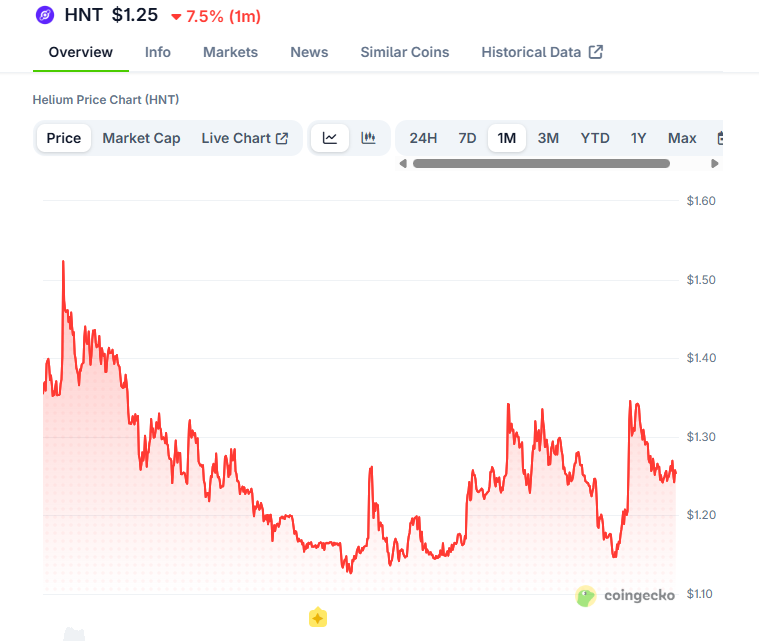
According to CoinGecko data, $HNT declined by 7.5% over the past month, aligning with the moderation in subscriber growth despite strong usage metrics.

Screenshot (99)

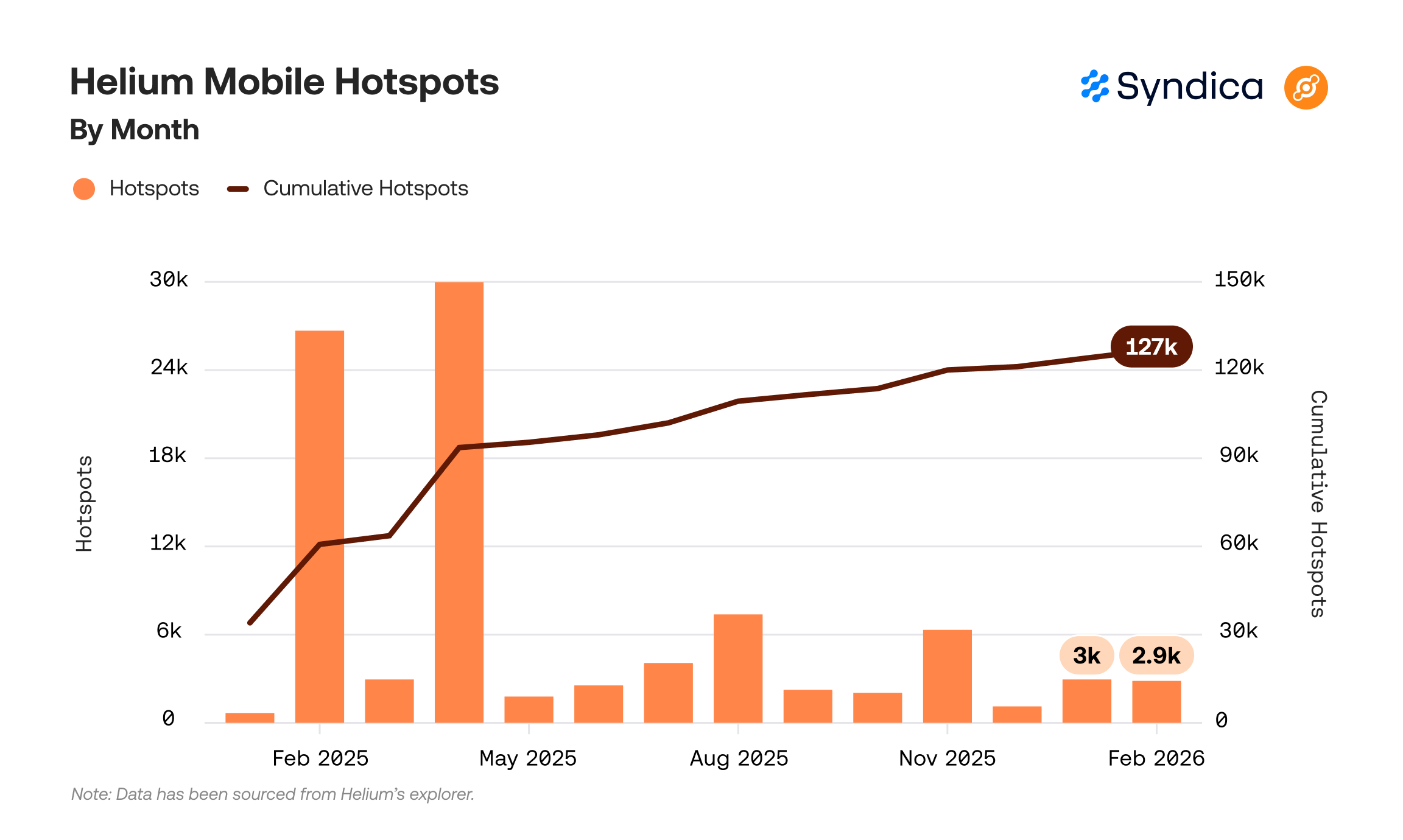
Hotspot deployment remained stable, with 2,900 new installations in February, closely matching January’s 3,000. The network has now deployed 127,000 hotspots since January 2025.

He Mec Fp Xs a A1 Tyk

Dabba Network extended its growth trajectory, with data consumption increasing 10% to 34,000 terabytes in February. Cumulative data consumption has reached 123,000 terabytes since January 2025. However, new hotspot deployments slowed significantly to 8,000 for the month, representing a 70% decline, bringing total deployed hotspots to 109,000.

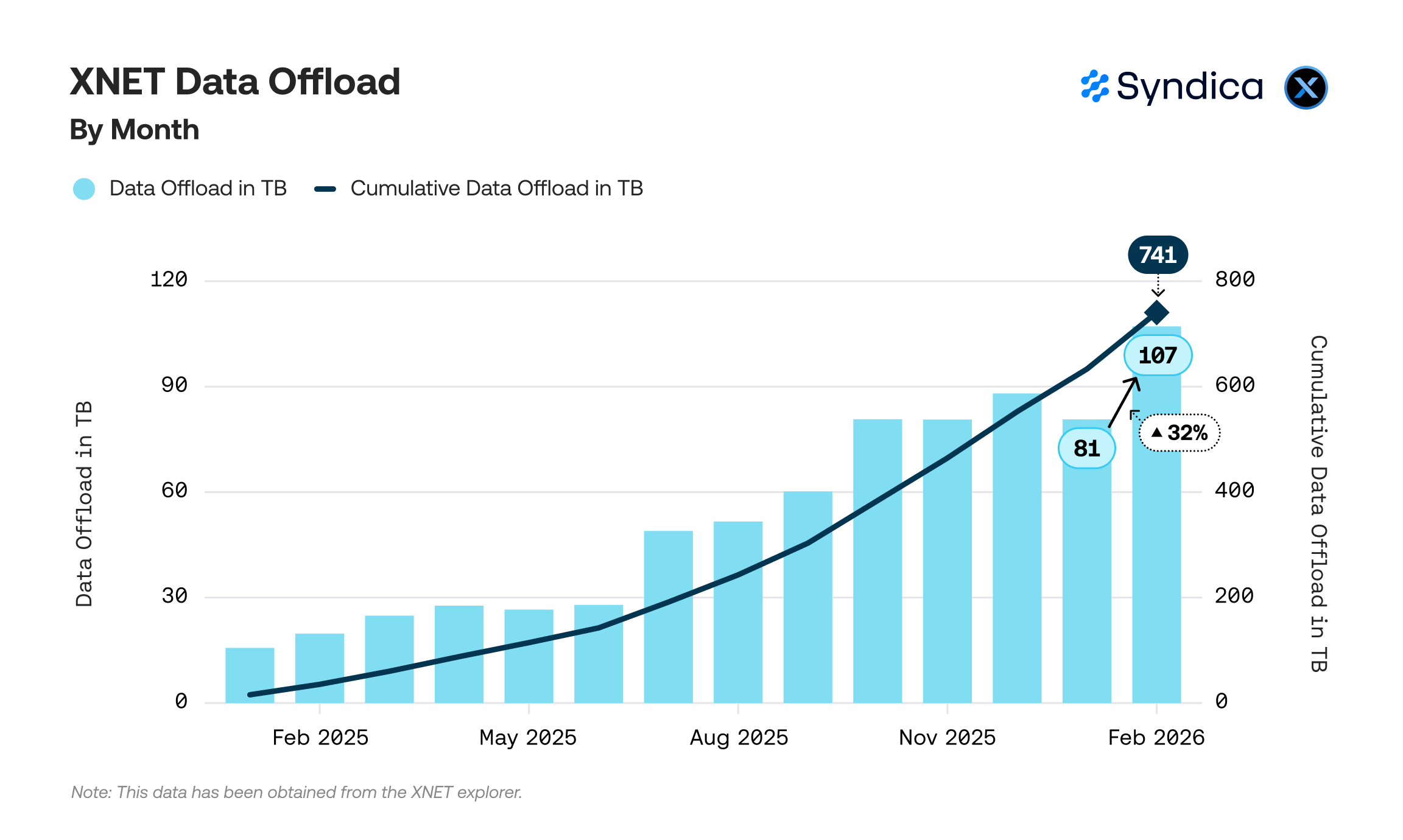
XNET also reached a new milestone, with data offload increasing 32% to 107 terabytes, marking its first time exceeding 100 terabytes in a single month. Despite this operational growth, revenue declined by 28% to $3,688 following a stronger January.

$XNET token performance showed a sharper correction. The token fell 32.4% over the month, indicating weaker market sentiment despite improved network throughput.

He Me0zu Xw Aan V6g

Mapping and Location Networks Face Volatility

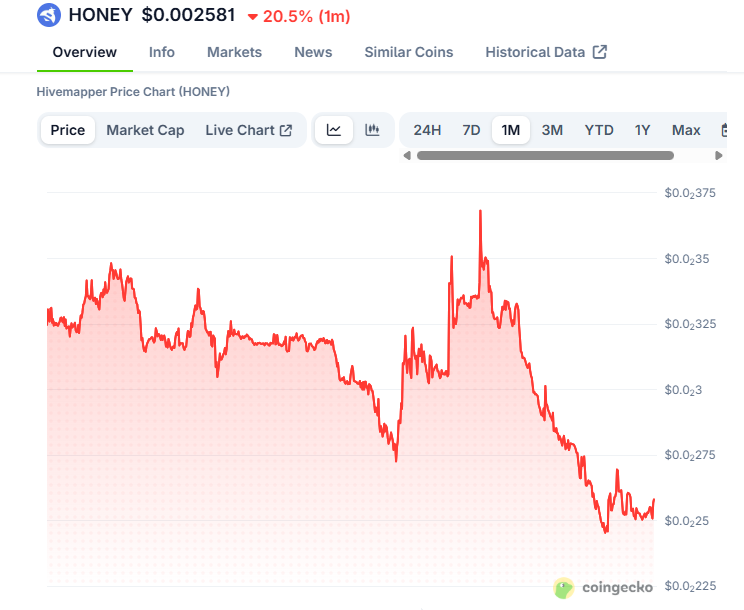
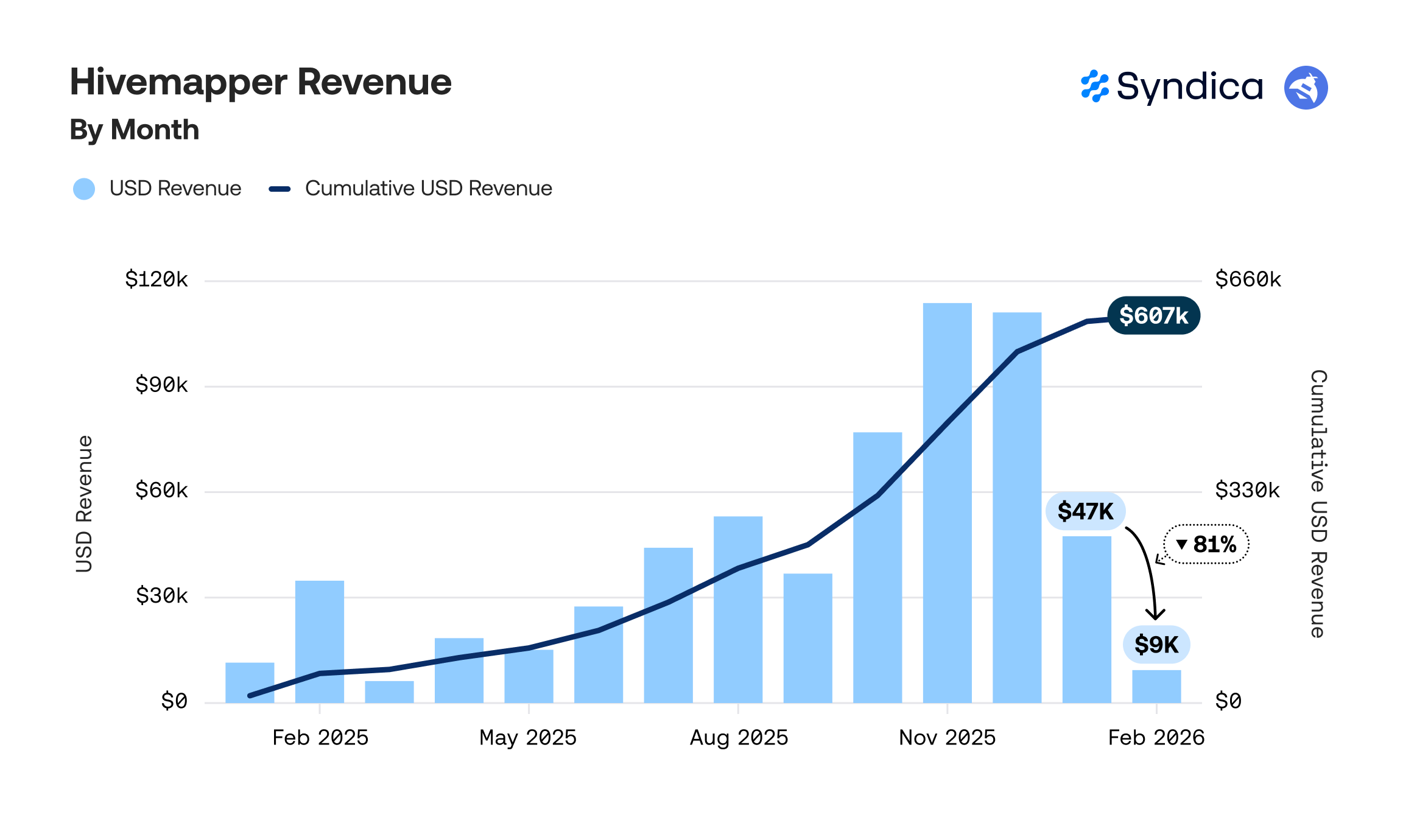
Mapping-focused DePIN protocols experienced a notable slowdown in February. Hivemapper saw a sharp decline as it generated only $9,000 in revenue, representing an 81% drop from January’s $47,000 as $HONEY token burn decreased. Network activity also declined, with kilometers mapped falling 53% to 8 million in February. Token performance reflected the downturn in activity. $HONEY declined 20.5% over the past month, mirroring the drop in revenue and network contribution.

Screenshot (96)

Despite the drop, cumulative mapped distance since January 2025 reached 308 million kilometers.

He Me8ep Xg a El Xr0

The team continued to develop its product suite, enhancing Bee Maps with real-time features and positioning it as a more dynamic alternative to traditional mapping services such as Google Street View. The introduction of a purpose-built Edge AI device aims to improve data quality and capture efficiency.

NATIX also showed signs of cooling. The number of new drivers declined by 33%, while map data events collected dropped 43%.

The $NATIX token declined by 18% over the past month, consistent with reduced contributor activity and slower data generation. Even with reduced activity, the project continued to expand its ecosystem through a partnership with Nomadic ML, focusing on video data analysis.

Compute, AI, and Data Protocols Show Mixed Trends

Compute-focused DePIN protocols delivered mixed performance in February. Nosana saw demand decline further, with completed jobs falling 15% to 160,000. The protocol continues to build its ecosystem through a partnership with Alio, targeting agentic AI security within its GPU cloud infrastructure.

UpRock maintained relatively strong revenue, generating $33,000 from uptime monitoring services, slightly below January’s $37,000. The project increased its presence in Asia through targeted campaigns, supporting regional engagement. $UPT rose 16.1% over the month, suggesting positive sentiment despite a slight dip in revenue.

Render’s revenue declined by 22% to $94,000, falling below the $100,000 mark. This trend reflects ongoing fluctuations in demand for decentralized GPU computing services.

Meanwhile, Shaga launched its Playroll Windows application, enabling users to earn rewards based on time spent playing Steam games. The platform recorded 317,000 hours played across 76 countries, with 366 active players contributing to AI training datasets.

New Protocols Expand the Ecosystem

Several new protocols entered the Solana DePIN ecosystem, highlighting continued innovation.

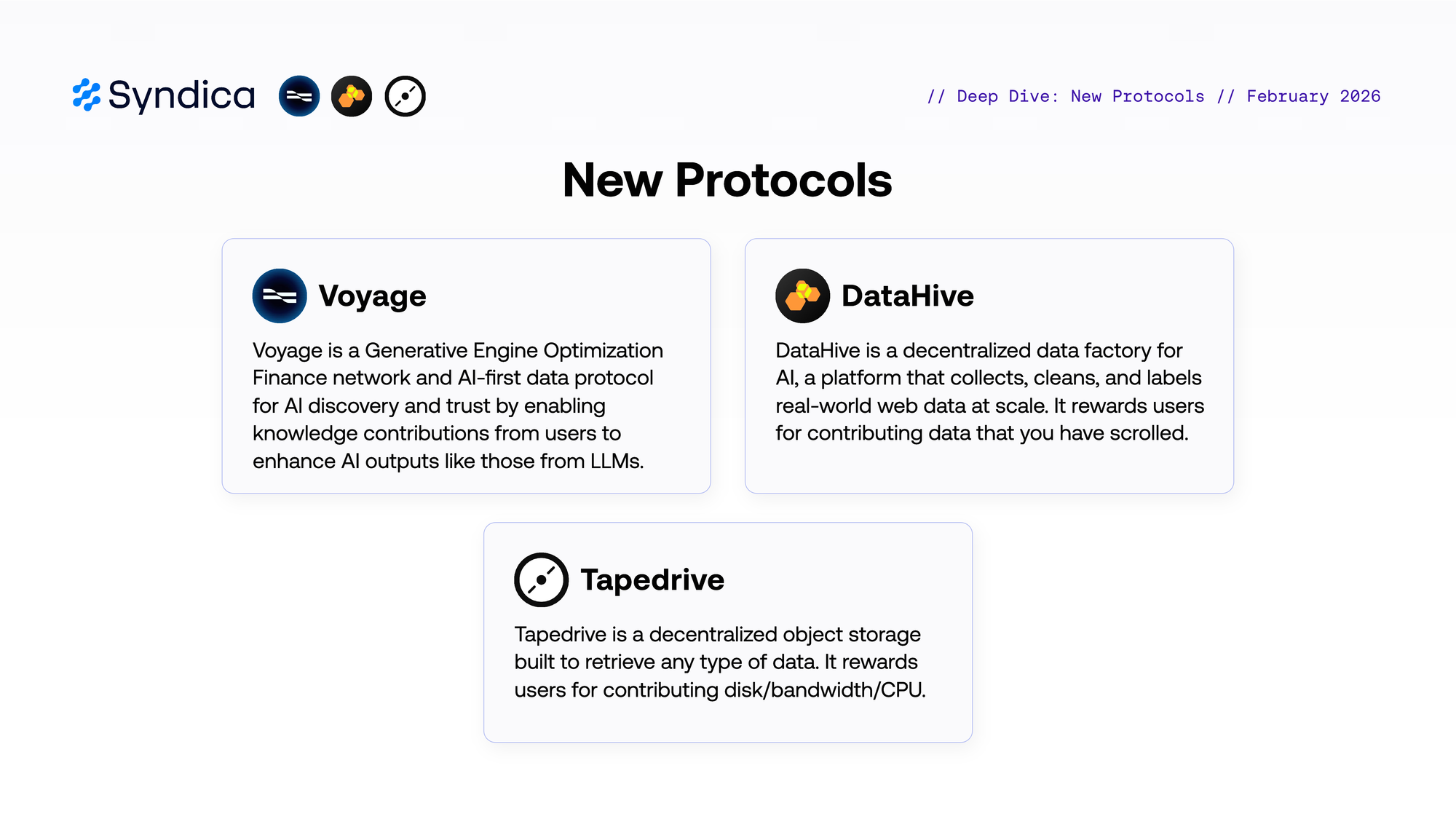
Voyage focuses on generative engine optimization, while DataHive operates as a decentralized data factory for finance and AI applications. DataHive collects, cleans, and labels web data, rewarding users for contributing knowledge and improving AI outputs.

Deep Dive   Solana De Pin February 2026  1  024

Tapedrive introduces decentralized object storage, allowing users to contribute disk space, bandwidth, and compute resources in exchange for rewards.

Institutional Support and Regulatory Clarity

Beyond onchain activity, external developments continue to shape the DePIN landscape. In December 2025, Fuse Energy raised $70 million in a Series B funding round led by Lowercarbon Capital and Balderton Capital, valuing the company at $5 billion. DAWN also secured $13 million to expand decentralized broadband infrastructure.

Regulatory clarity has also improved. In 2025, the United States Securities and Exchange Commission issued no-action letters to DoubleZero and Fuse Energy respectively, confirming that their individual token models do not constitute a security under current rules. This decision reinforces the view that DePIN tokens function as utility-based incentives tied to real-world infrastructure rather than speculative instruments.

Solana’s Role in DePIN Growth

Solana continues to play a central role in enabling DePIN adoption. Its high throughput and low transaction costs support the constant microtransactions required for rewarding contributors across networks. Projects such as Helium, Render, and Hivemapper demonstrate how blockchain infrastructure can support real-world applications at scale.

Industry research suggests that DePIN could grow into a multi-trillion-dollar sector. Estimates from the World Economic Forum project the market could reach $3.5 trillion by 2028, driven by demand for decentralized wireless, compute, and data infrastructure. As DePIN projects expand their real-world utility and refine their economic models, Solana remains a key platform supporting the next phase of decentralized infrastructure development.

Read More on SolanaFloor

Can Stripe’s MPP and Colosseum’s Frontier Hackathon Revive Solana’s Agentic Economy?
Backpack’s $BP Airdrop Triggers Mixed Community Response

TradFi Giants Are Coming to Solana

Solana Weekly Newsletter

Related News