Yesterday, March 23, Backpack launched its native token, $BP, on the exchange and on Solana through Wormhole’s Sunrise platform, distributing the asset directly into onchain liquidity and making it immediately tradable across Solana’s DeFi ecosystem.
Within 24 hours of TGE, $BP reportedly generated over $10 million in DEX volume on Solana, a figure more than half the volume on Backpack Exchange and more than double that of the next largest CEX.
Tokenomics Put Users at the Center
At launch, 25% of the supply unlocked and went entirely to users. Backpack stated that no founders, team members, or investors would receive direct token allocations. The exchange also committed to locking the treasury for at least one year after its planned IPO, creating a connection between the token and the company’s longer-term performance.
From an execution standpoint, some community members praised the airdrop as smooth and secure. Supporters described the airdrop as one of the cleaner token launches in recent memory, pointing to auto-staking, the absence of suspicious claim links, and the lack of obvious liquidity issues during the initial rollout.
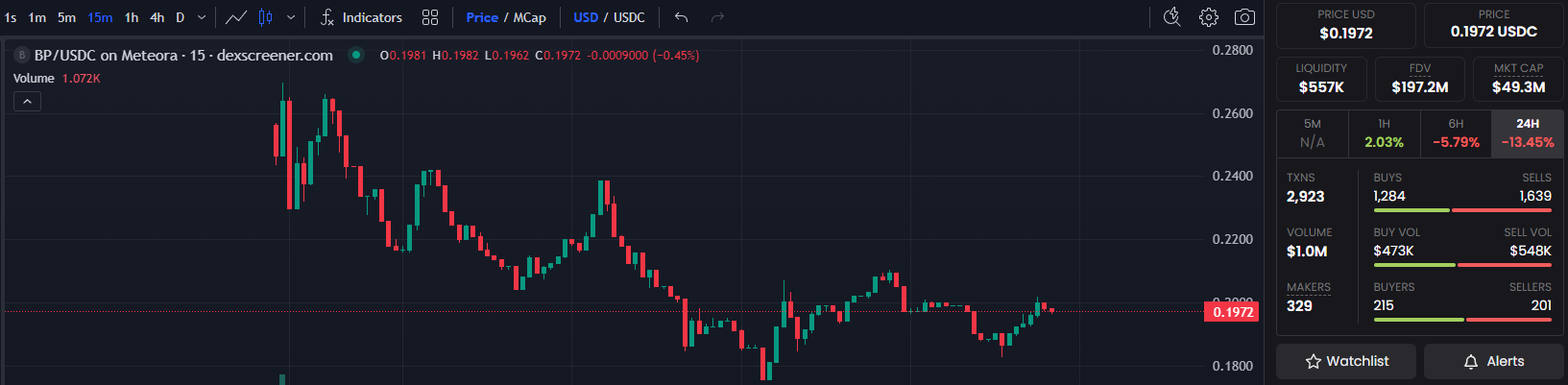
As at the time of writing, $BP is currently trading below $0.2.
Community Reaction
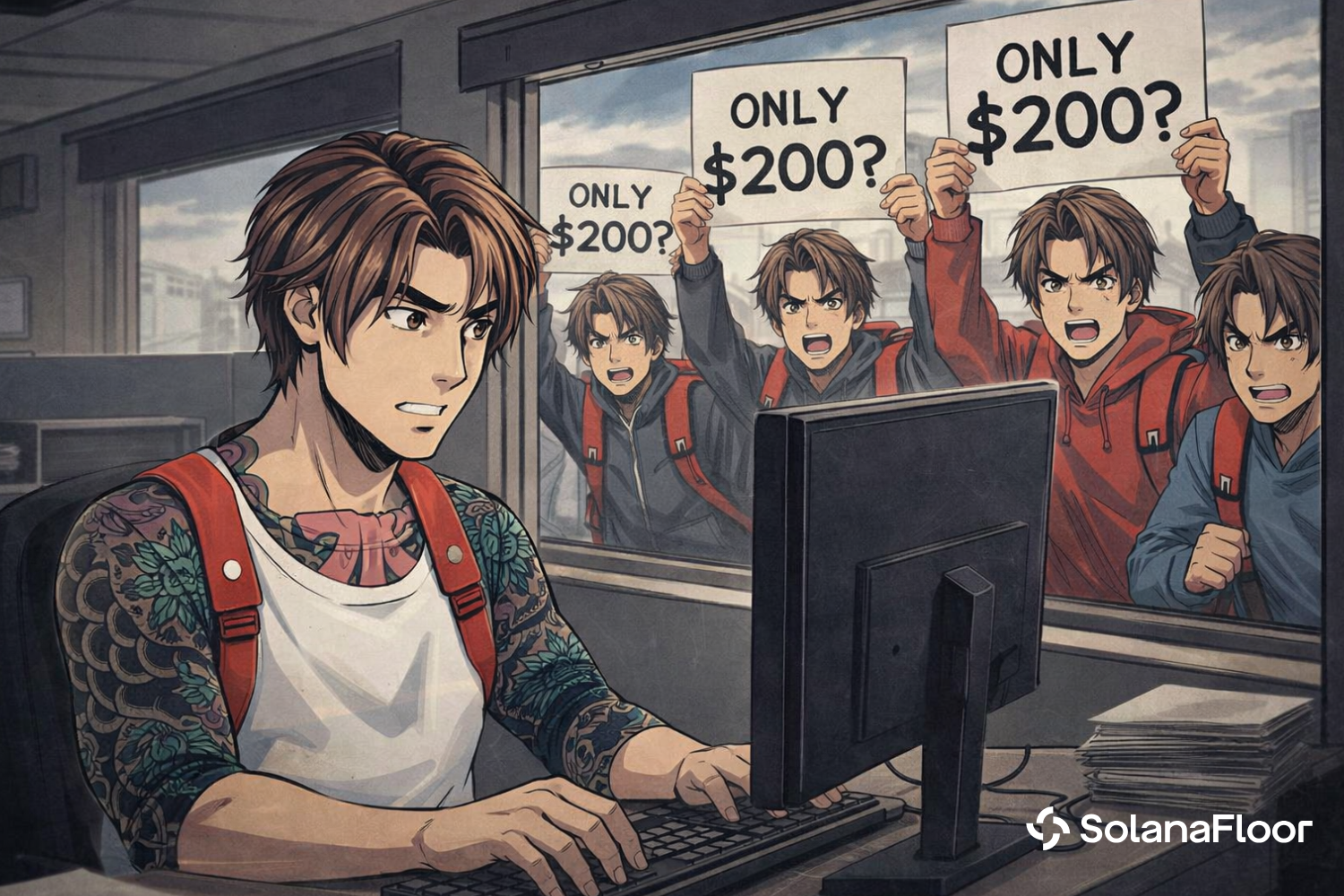
Despite the technical success of the launch, the airdrop quickly became the center of debate. Backpack’s anti-Sybil process appears to have excluded a portion of users who believed they had qualified based on prior participation, points, and exchange activity. Some users who had traded since pre-season reported that they were not eligible despite accumulating large point balances.
That immediately raised questions about how Backpack weighed volume, account behavior, and long-term loyalty.
The frustration was especially visible among MadLads NFT holders, many of whom had expected stronger recognition because of the collection’s close association with Backpack’s brand and early community growth. Some holders reported allocations of about 1,000 $BP tokens, which several users considered underwhelming relative to expectations and past support.
The disappointment appears to have spilled into the NFT market, where Mad Lads’ floor price fell by more than 40% after the airdrop.
The criticism went beyond token amounts. Some users argued that Backpack and its surrounding ecosystem had encouraged exchange activity for months through a points-based campaign that tied volume to expected rewards.
In practice, that system drew in traders, content creators, and referral-driven traffic that treated the airdrop as a major future payout. When the checker went live, many of those users discovered that their expectations did not match the final eligibility criteria.
Anti-Sybil Rules Draw Chinese Backlash
The strongest backlash came from users who believed Backpack’s anti-Sybil enforcement overreached. Critics argued that the project applied a strict one person, one account policy in a way that swept up legitimate users, particularly in Chinese-speaking communities. Some posts described the process as a witch hunt and accused Backpack of using device and IP heuristics too aggressively.
Claire, a Backpack team member active in the Chinese-speaking community, said internal discussions had continued through the night after the controversy intensified. She explained that the compliance-focused team treated one person, one account as a non-negotiable standard, but acknowledged that Chinese-speaking users were affected more heavily because of differences in user behavior. She also said Backpack planned to open an appeals channel and proposed a rule under which devices that had operated three or fewer flagged accounts could recover more than 50% of their points after manual review. According to her statement, Backpack also planned a special compensation program funded through secondary market buybacks for qualifying users.
Backpack Founder & CEO Armani Ferrante also addressed part of the backlash by stating that Mad Lads who failed to link their NFTs to the exchange before the snapshot would receive another drop, provided they met the original eligibility requirements. He added that users must have held during the snapshot to qualify, encouraged holders to connect their accounts, and noted that tokens for unsupported regions remain reserved and will be distributed as new regions open.
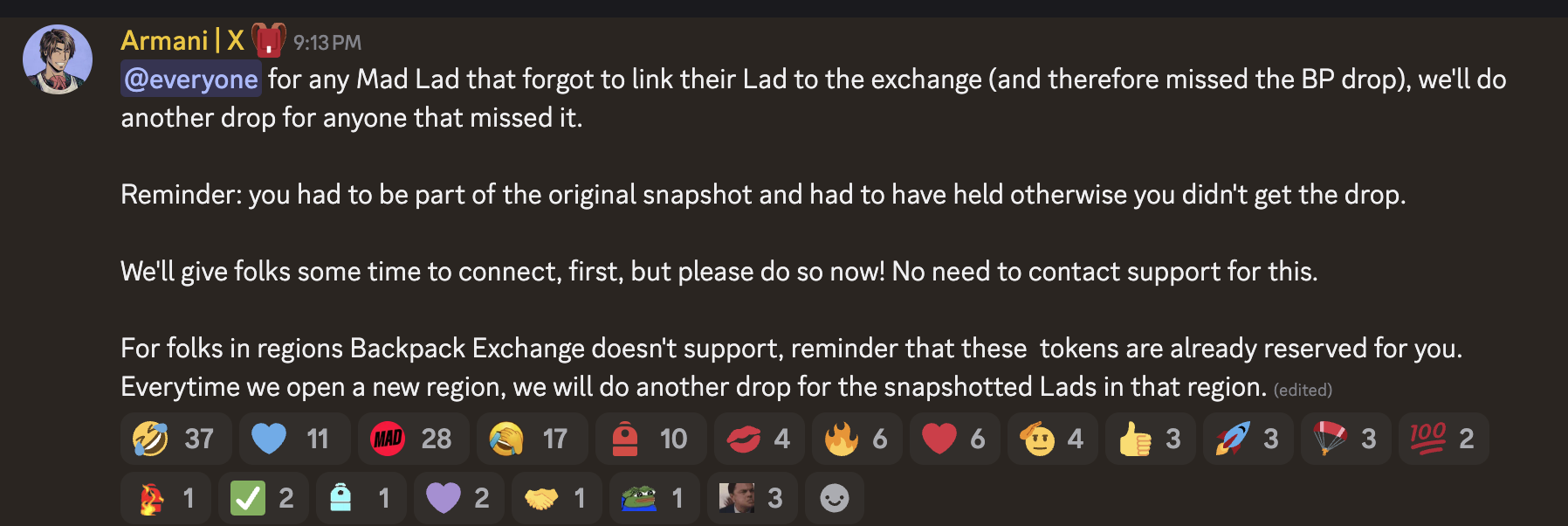
That response may ease some anger, but it also confirms the scale of the issue. Once a team announces appeals, partial point restoration, and targeted compensation shortly after launch, it signals that the original screening process likely caught more than obvious abusers.
The reaction to the airdrop remains mixed rather than uniformly negative. Some users praised the launch mechanics and the effort to punish sybils. Others focused on the gap between months of trading, loyalty, or NFT holding and the value they actually received. The most critical responses framed the airdrop as a case where users funded growth through fees and activity without receiving a proportionate return. Sentiment also appears influenced by pre-launch expectations, as Polymarket data showed a roughly 73% probability that $BP would exceed a $300 million FDV shortly after launch. The token’s actual early FDV falling well below that level has added to the sense of disappointment among participants.

That divide now defines the early story around $BP. Backpack succeeded in launching a regulated exchange token directly into Solana DeFi with immediate liquidity and significant onchain trading activity. However, expectations around the airdrop were likely shaped by Backpack’s rumored raise at a reported $1 billion valuation, which may have led many participants to anticipate more substantial rewards. In contrast, the token’s early fully diluted valuation near $197 million and subdued post-launch price action highlight a gap between perceived and realized value.
As a result, the community conversation has focused less on the novelty of the infrastructure and more on who qualified, who did not, and whether the allocation matched the expectations that Backpack helped create.
Read More on SolanaFloor
Mastercard, Worldpay, and Western Union Named as Solana Developer Platform’s First Builders
“We Might Actually Be Back”: BONK.fun Overtakes Pump.fun in Revenue On First Day After Relaunch
TradFi Giants Are Coming to Solana