Ranger Finance Winds Down After Delayed Funding, Treasury Liquidation & Drift Exploit
“Ranger Finance is Winding Down, And I Will Be Moving On” - Ranger Co-Founder Barrett Williams
- Published:
Ranger Finance is shutting down after months of financial strain, governance turmoil, and mounting criticism surrounding its token launch and treasury management. Co-founder Barrett Williams confirmed the wind-down in a public statement, acknowledging that employees, contributors, and vendors would not be fully repaid.
The closure marks the latest chapter in one of Solana’s most debated governance experiments. Ranger Finance launched through MetaDAO’s futarchy-based governance system earlier this year, raising millions of dollars in an ICO. Just months later, tokenholders voted to liquidate the project’s treasury and redistribute remaining funds back to holders.
Team Admits Ranger Could Not Sustain Operations
In a detailed public post, co-founder Barrett Williams said Ranger Finance expanded beyond what it could realistically support financially. According to Williams, the company struggled with declining cash reserves while waiting for additional funding through MetaDAO.
Williams stated that founders injected personal capital into the business in an attempt to maintain operations and continue product development. Some team members reportedly stayed on despite delayed payments because they expected incoming funding to stabilize the company.
However, the planned raise was delayed. Williams explained that Ranger had only roughly two months of runway after the raise closed, before treasury funds were ultimately returned to tokenholders following the liquidation vote. During that short period, the company attempted to distribute payments fairly among employees and vendors, but the remaining funds proved insufficient. “The outcome is that people went unpaid,” Williams wrote.
Williams pointed to the liquidation of Ranger’s treasury as a major factor that disrupted the company’s financial planning. According to him, the liquidation significantly impacted budgeting decisions tied to staffing, vendor agreements, and growth initiatives.
The situation worsened further after the Drift Protocol exploit, which Williams said eliminated remaining momentum and personal capital that had supported continued operations. Vault users affected by the Drift exploit are expected to receive Drift recovery tokens once the Drift team distributes them.
Context on Ranger’s Treasury Liquidation
The Ranger Finance treasury liquidation became one of the most controversial governance decisions on Solana this year. In March 2026, $RNGR token holders voted to liquidate Ranger Finance’s treasury via MetaDAO’s futarchy-based governance system. The proposal emerged after a group of tokenholders accused the Ranger team of materially misrepresenting business performance metrics before the fundraise.
Critics also questioned the long-term sustainability of Ranger’s business model. Some argued that much of the platform’s activity depended on airdrop farmers and short-term mercenary capital rather than organic usage.
Following the vote, more than $5 million $USDC was removed from Ranger Finance’s treasury and liquidity pool for redistribution to $RNGR tokenholders. The event immediately divided opinion throughout the Solana ecosystem.
Ranger’s ICO Struggled Almost Immediately After Launch
The project completed an $8 million raise through MetaDAO in January 2026, surpassing its $6 million minimum target. Total commitments reportedly exceeded $86 million during the four-day sale period.
Despite that demand, $RNGR quickly traded below its $0.80 ICO price after launch. At one point, the token traded roughly 27% below the sale price, while Bubblemaps data indicated that approximately 80% of presale buyers were underwater.
The project attempted to stabilize trading through a buy wall funded by $2 million in excess capital raised during the sale. The mechanism aimed to provide bid-side support near the ICO price for 90 days.
The strategy failed to prevent continued downside pressure. Critics questioned several aspects of the token launch, including Ranger’s valuation, treasury structure, and spending policies. Some also raised concerns over a late surge in sale commitments during the final minutes of the ICO.
Meanwhile, supporters highlighted Ranger’s relatively long vesting schedules and lack of immediate team unlocks as positive structural decisions. Even after the difficult launch, Ranger publicly maintained that it planned to expand its perpetual DEX aggregation platform and vault products.
Following Williams’ shutdown announcement, community members questioned why Ranger proceeded with a token launch if financial conditions were already deteriorating.

Williams responded that the token launch aimed to extend the company’s runway and accelerate growth.
Drift Exploit Added More Pressure
In March 2025, Ranger Finance integrated Drift Protocol to improve liquidity and trading efficiency. That relationship later became another source of difficulty.
Williams cited the Drift exploit as a major event that damaged Ranger’s remaining momentum and exhausted additional capital available to sustain operations.
The exploit resulted in approximately $285 million in losses across the broader ecosystem and created further instability during an already difficult period for Ranger.
In the hours after Williams confirmed that Ranger Finance was winding down, $RNGR declined sharply. TradingView data showed the token falling from around $0.12 to approximately $0.10 before partially recovering.
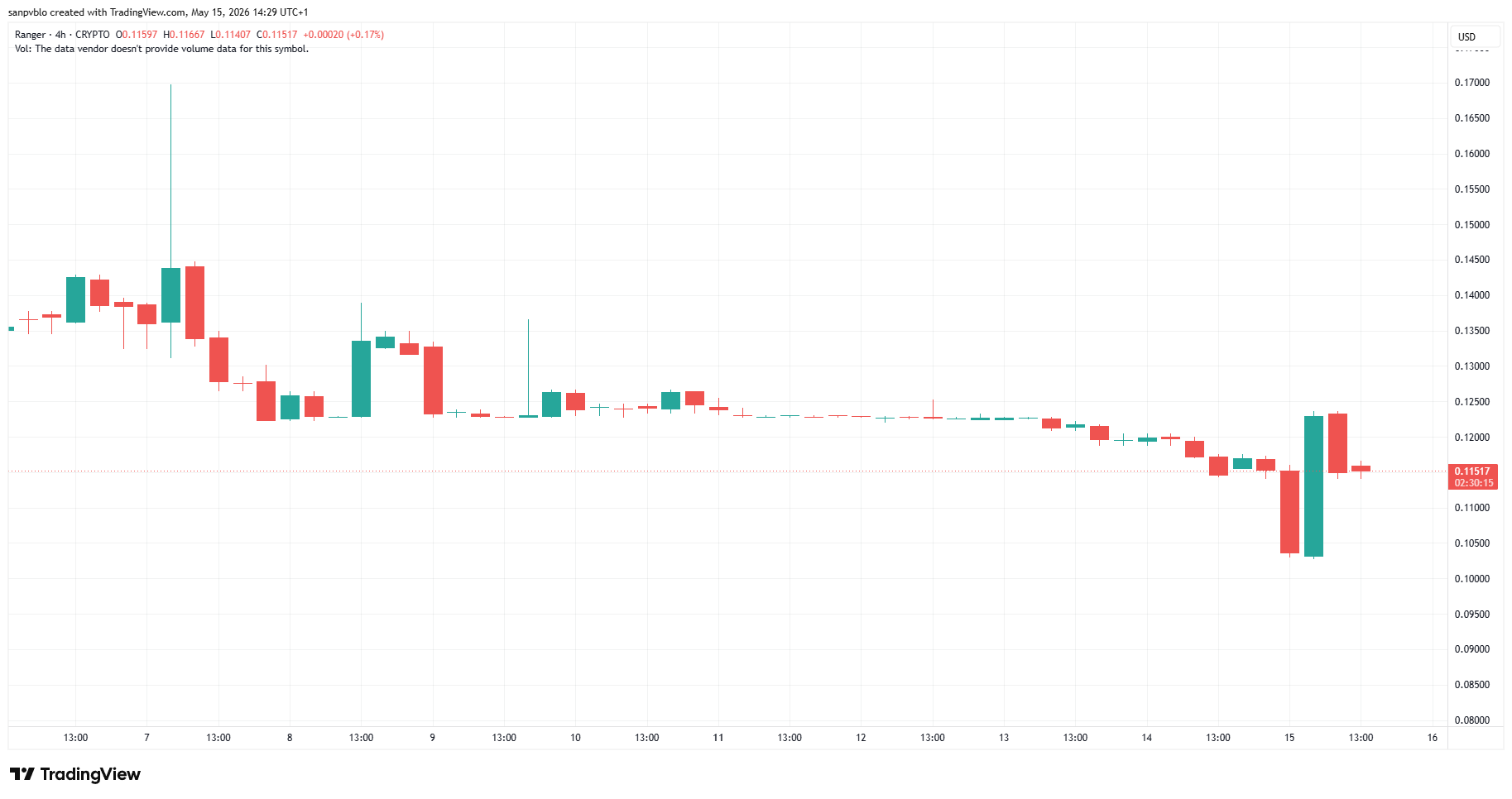
The chart reflected continued volatility as traders reacted to the shutdown announcement. At the time of writing, $RNGR traded near $0.115.
Read More on SolanaFloor
The CLARITY Act Just Cleared the Senate Banking Committee - What Happens Next?
Solana’s New P-Token Upgrade Just Reduced Transfer Compute Costs by More Than 95%
How Will Solana React To The Rising Demand For Privacy?