$USDC Dominance on Solana Falls to 44% as Rival Stablecoins Surge
$USDC remains Solana’s largest stablecoin, but $USD1, $USDGO, $PYUSD, and other new dollar-backed tokens are rapidly expanding the market.
- Published:
- Edited:
$USDC's share of Solana's stablecoin supply has fallen to 44.03%, according to DefiLlama data. That represents a 17.1% decline over the past 6 months and a 45.2% drop from its 80.3% all-time high in February 2025.
The decline looks even more striking because Circle has minted approximately $1.25 billion $USDC on Solana over the past 2 days, while it has minted more than $92 billion in 2026 so far. However, redemptions have been occurring at a faster pace, meaning the recent mints have not translated into equivalent growth of $USDC supply.
$USDC still holds roughly $7 billion on the network and remains the largest individual stablecoin. The difference is that Solana's stablecoin market has expanded much faster around it.
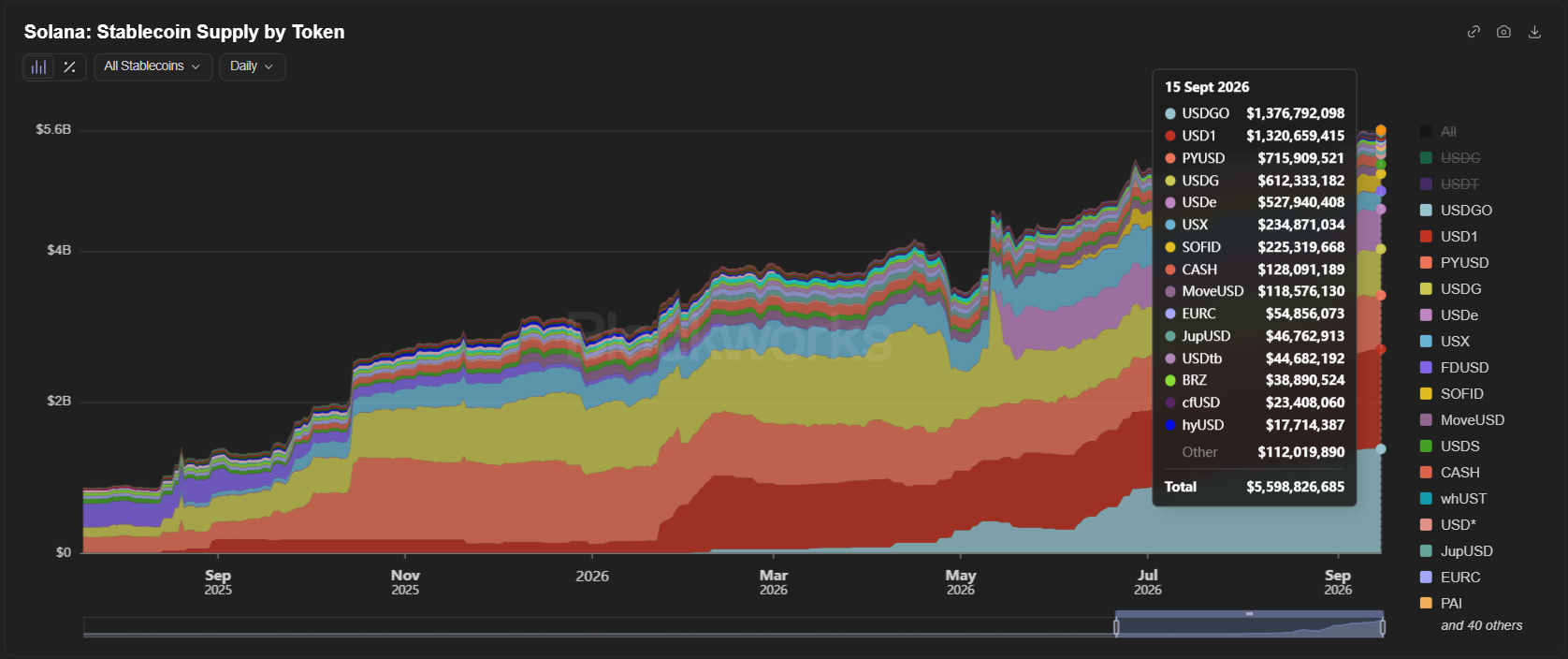
Solana's total stablecoin supply has climbed above $16 billion, while non-$USDC/$USDT stablecoins have reached a record $5.59 billion.
Newer Stablecoins are Changing the Market
The biggest change comes from the proliferation of newer institutional stablecoins. World Liberty's $USD1 has reached approximately $1.32 billion supply on Solana, while Paxos's $USDG has grown to about $612 million. Anchorage Digital's $USDGO has expanded from an initial $50 million mint to $1.37 billion in 7 months.
PayPal's $PYUSD, Western Union's $USDPT, and BlackRock's tokenized dollar product have also added new stablecoin liquidity to the network. Solana has increasingly attracted these issuers because its high-throughput infrastructure can support large-scale settlement. Several issuers have chosen Solana as an initial or early launch venue. The result looks less like $USDC losing billions of users and more like Solana adding competing dollar rails around it.
Yield Gives Alternatives An Advantage
Incentives also help explain the shift. Several newer stablecoins offer rewards or yield on holdings. For example, Anchorage's $USDGO and PayPal's $PYUSD rewards programs offer daily yield to eligible holders.
$USDC, by comparison, offers essentially no native onchain yield to someone simply holding the token on Solana.
That difference can matter for institutional and DeFi users deciding which dollar asset to hold. Users may choose between stablecoins based not only on liquidity and reputation, but also on yield, issuer, regulatory framework and intended use.
Mixed Reaction to Circle’s Regulatory Stance
The shift also follows the April 1 Drift exploit, which triggered criticism of Circle across parts of the Solana ecosystem. Attackers reportedly moved more than $230 million through Circle's Cross-Chain Transfer Protocol. Some ecosystem participants subsequently encouraged DeFi users to move from $USDC into other stablecoins in protest, arguing that Circle should have frozen the stolen funds.
Circle CEO Jeremy Allaire defended the company's position, saying Circle would not intercept funds without legal precedent and stating that the company had a “very, very clear performance obligation under the law.” The episode added friction to an ecosystem where Circle had long enjoyed a largely uncontested position and affected the stablecoin issuer’s brand image. $USDC’s share of the Solana stablecoin market has fallen 33% since then.
Circle now has its focus set elsewhere aside from Solana with yesterday’s mainnet launch of Arc, its own $USDC-based Layer 1 blockchain, which gives the company another settlement environment. Arc uses $USDC for transaction fees and has BlackRock, Visa, Mastercard, DTCC, and other institutions among its founding validators.
For Solana, more stablecoins bring additional institutional capital, payment networks, and developer options, but they also introduce fragmentation and counterparty risks. For now, $USDC remains the major settlement asset on Solana, but the network no longer depends on a single dollar-backed rail. If current growth continues, Solana's stablecoin market could surpass $20 billion in the near future, with an increasingly diverse mix of $USDC, $USDT, $USD1, $USDGO, $PYUSD, and other assets.
Read More on SolanaFloor
Solana Leads All Chains in $ZEC Trading Volume as Onchain Supply Hits All-Time High
U.S. Bank Column Makes Solana the Default Network for Stablecoin Banking
Vibhu Norby Joins The Big Picture