Tether Leads $150M Drift Recovery Plan After Circle Refused to Freeze Stolen Funds
Drift protocol to direct future revenues towards making users whole
- Published:
- Edited:
15 days after Drift Protocol lost over $285M in one of the largest exploits in Solana DeFi history, depositors finally have some good news.
Tether, issuers of crypto’s biggest stablecoin, $USDT, has stepped forward to repair the damage, leading a $150M recovery effort in collaboration with the Solana Foundation and other contributors.
With Tether’s support, Drift Protocol will relaunch under tightened new security guidelines, allocating protocol revenue towards repaying users who lost funds in the exploit.
The $150M recovery plan comes as Circle, Tether’s biggest rival, faces staunch criticism from the Solana community for refusing to intercept stolen funds during the incident, which the firm claims posed a “moral quandary".
Drift Protocol to Relaunch With Improved Security Practices
After two weeks of excruciating silence, Drift Protocol has finally answered the prayers of its users. In collaboration with Tether, the Solana Foundation, and other unnamed partners, Drift has outlined the beginnings of a recovery plan, which aims to use a “substantial portion” of future revenue to make users whole.
All users affected by the April 1st exploit will be issued a dedicated Drift recovery token, which represents the holder's share of the recovery pool and remains separate to the app’s existing governance token, $DRIFT.
Alongside plans to refund user losses, Drift has committed to restructuring its security stack. Before relaunching to the public, Drift will need to complete two independent audits, with Ottersec and Asymmetric Research shoulder-tapped to review codebases and operational security practices.
Additionally, Drift Protocol will introduce a community-governed multisig comprised of fellow leaders from across the Solana ecosystem. Multisig signers will be required to use dedicated signing devices, and all administrative actions will be subject to timelock, with real-time alerts to protect contracts from anomalous proposals. Durable nonces, one of the technical mechanics used by the attackers, will also be disabled for all signers.
Seth Hallem, CEO of Certora, a reputable blockchain security firm has commended Drift's new security measures, but asserts that more can still be done to safeguard the protocol upon relaunch. Hallem argues that Drift's new security structure would benefit from an independent, post-signature review process during the timelock period to further bolster the protocol against social engineering attacks.
"Drift has taken a major step forward by implementing basic security measures to protect protocol administration. Dedicated signing devices, independent transaction verification, mandatory timelocks, and a decentralized signing committee are great steps in the right direction. However, the best practice in multi-sig implementation goes one step further - dividing protocol governance into discrete business processes and evaluating signers and timelock parameters in the context of those processes takes security to the next level. For example, including trusted security providers in an upgrade multi-sig makes business sense as does including trusted risk curators in a market making multi-sig. Introducing an independent, post signature review process during the timelock period would add an end to end safeguard against a malicious transaction, and would further complicate any social engineering efforts to compromise the multi-sig. Governance design requires the same, careful threat analysis that protocol design requires, and an end-to-end security partner is an invaluable resource in designing and implementing a secure governance process that can adapt to changing business conditions for a protocol." - Seth Hallem, CEO of Certora
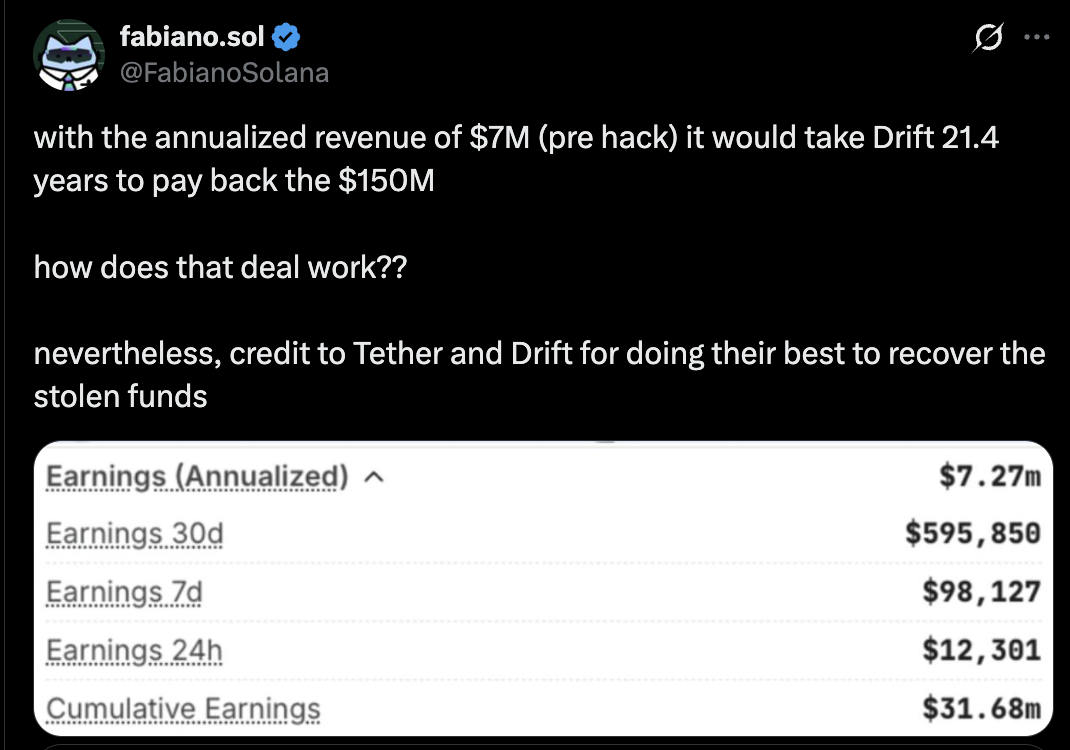
While Solana DeFi users across the ecosystem are unanimously relieved by the outcome, commentators have questioned the likelihood that Drift will ever be able to generate enough revenue to repay users. Others have noted that this is not the first time that Drift has been “bailed out” after a hack. In May 2022, Drift lost $14.5M to a withdrawal bug.
As part of the recovery plan, Drift will use Tether’s $USDT as its settlement layer, migrating away from Circle’s $USDC.
Tether Steps In to Lead Drift Recovery
While the Drift exploit was undoubtedly one of the darkest days in DeFi history, the hack offered a unique window of opportunity for an unexpected knight in shining armor. In one grand gesture, Tether, arguably the crypto industry’s most successful business, has won the collective heart of the entire Solana ecosystem.
“Tether’s role in the digital assets ecosystem is to provide a platform for individuals and institutions alike that is ready to step forward to help the industry in the moment of darkness. This collaboration reflects our confidence in Drift and its role in the DeFi ecosystem. The focus is on restoring user confidence and supporting a strong relaunch, with a structure that aligns recovery with real activity and long-term growth.” - Paolo Ardoino, CEO of Tether
In the wake of the April 1st exploit, Circle found itself on the wrong side of fierce criticism from the Solana community. Despite repeated calls for action, Circle refused to intercept stolen funds as attackers shifted over $230M through Circle’s Cross Chain Transfer Protocol (CCTP).
When challenged on Circle’s decision not to freeze the stolen funds, CEO Jeremy Allaire stated the firm would not intercept funds without legal precedent, citing that the incident posed a “moral quandary”.
By stepping in to support one of Solana’s oldest DeFi apps in a time of great need, Tether has won the favor of manlets across the network. Ecosystem participants are ubiquitously calling for DeFi users to switch their $USDC for $USDT.
From an economic standpoint, one could argue that Solana should’ve steered away from $USDC a long time ago. A portion of Circle’s revenue goes directly to Coinbase, which in turn is used to fund Base, a rival blockchain.
Could $USDT Replace $USDC Dominance?
Despite Solana’s newfound love of Tether, the stablecoin issuer still has a long way to go before it can dethrone Circle’s dominance. According to Blockworks data, $USDC commands over 55% of stablecoin market share on Solana, constituting more than double the supply of $USDT.
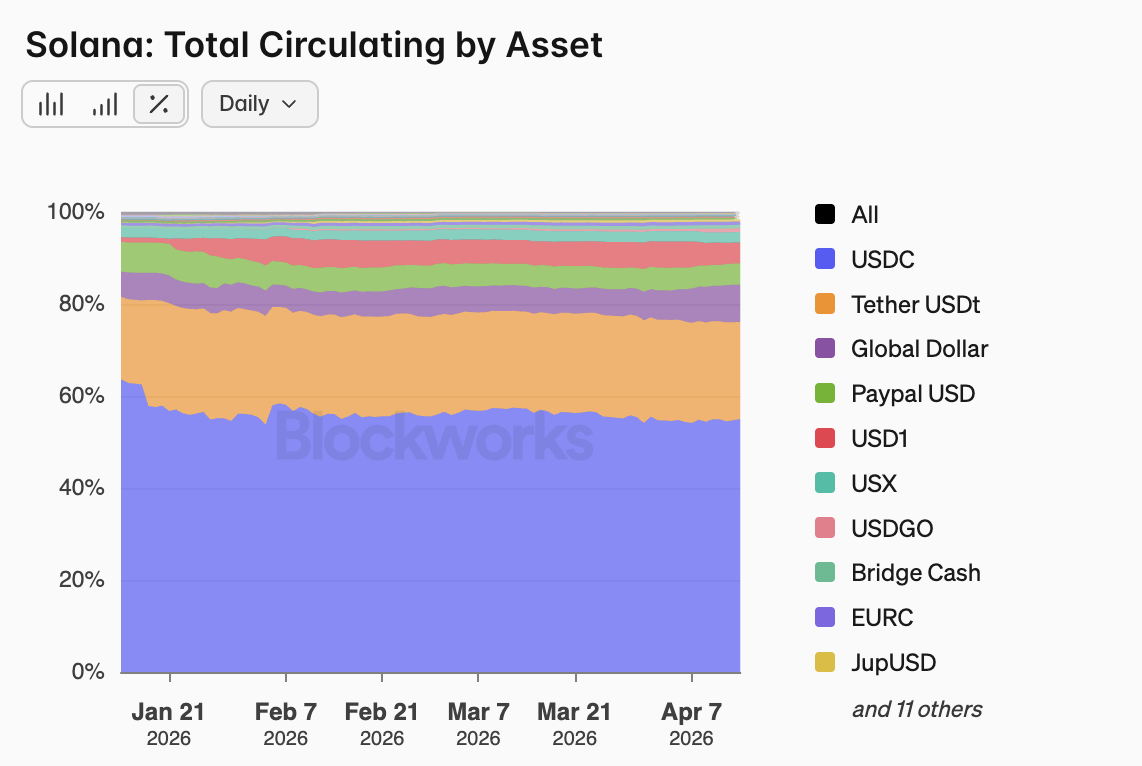
For better or worse, $USDC is currently Solana’s de-facto stablecoin. Despite its ubiquitousness on rival chains, $USDT adoption is an afterthought on Solana, with many DeFi apps not even bothering to integrate the stablecoin.
However, that may all be about to change. Off the back of Circle’s decision not to intercept stolen funds, Tether’s support of Drift’s recovery plan could serve as the springboard that helps $USDT become the chain’s stablecoin of choice.
Read More on SolanaFloor
Are Prop AMMs the future of finance?
Solana PropAMMs Better Than CEX in 99.3% of Retail Swaps
Almost $1B leaves Solana DeFi in wake of Drift Exploit