
Strategy Sells 1,637 $BTC to Bolster USD Reserves
Saylor assures markets that Strategy “expects to remain a net buyer of Bitcoin”
- Published:
Bitcoin’s biggest public holder has once again trimmed its bag, with Michael’s Saylor’s Strategy reducing its portfolio by 1,637 $BTC.
Selling $BTC and its common stock, $MSTR, Strategy has repurchased $81M worth of $STRC, extending its cash dividend runway to 2.3 years.
Meanwhile, Bitcoin’s most devout believers have been rocked by a cold storage exploit, and institutional activity falls flat as investors await the next catalyst.
Saylor Sells $BTC, $MSTR, Buys $STRC
Michael Saylor and Strategy are leaning deeper into their financial alchemy blueprint, with the $57B firm unloading more of its 842k $BTC stack into crypto markets. Framing the transactions as a measure to increase Strategy’s USD reserves to the tune of $250M, Saylor’s latest sales represent a remarkable twist in the firm’s activity.
After consistently showing up as the biggest purchaser of $BTC, Strategy is now on track to record three consecutive months of net selling.
The changes come following Strategy’s June announcement of its $BTC monetization program. In the face of diminishing cash reserves, which were required to fund $STRC dividends, Strategy began liquidating its $BTC holdings. Since the introduction of the program, Strategy has sold 5,258 $BTC, worth roughly $372M.
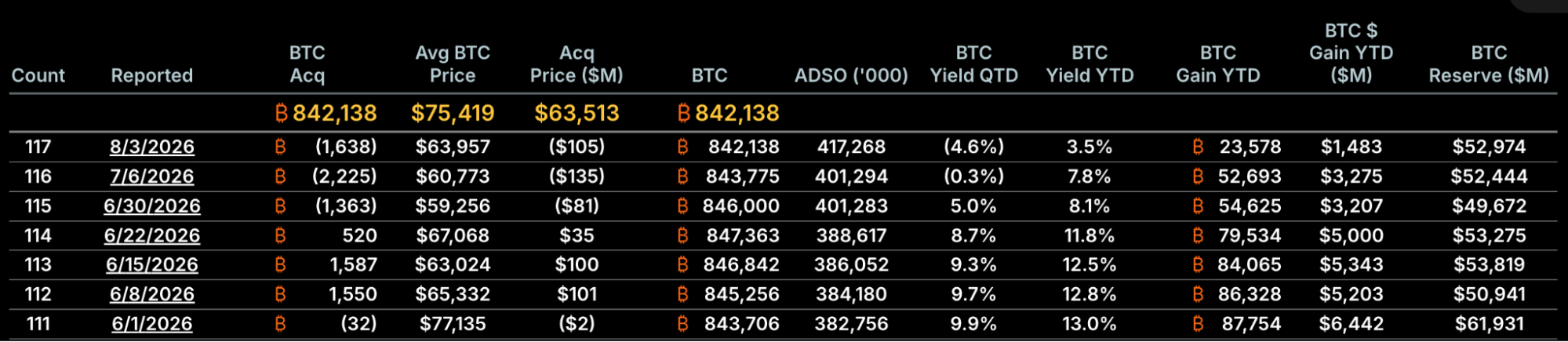
At an average acquisition price of $75,419, Strategy is currently down approximately $5.9B on its $BTC holdings.

Despite what recent market activity would suggest, Saylor has asserted that the firm “expect[s] to remain a net buyer” of $BTC and reaffirmed that Strategy “never had a ‘never sell’ policy”.
After facing criticism from detractors for breaking his “never sell” promises, Saylor reminded naysayers that he is a separate entity from Strategy, assuring fellow bitcoiners that he hasn’t sold a single sat from his personal supply.
$BTC ETF Flows Flatten
While Saylor shores up Strategy’s cash reserves, institutional players appear to be reluctant to allocate funds to crypto ETF markets. According to Sosovalue data, spot Bitcoin ETF trading activity has stagnated, recording $172M in monthly net flows in July, the smallest variance from 0 net flows since August 2024.
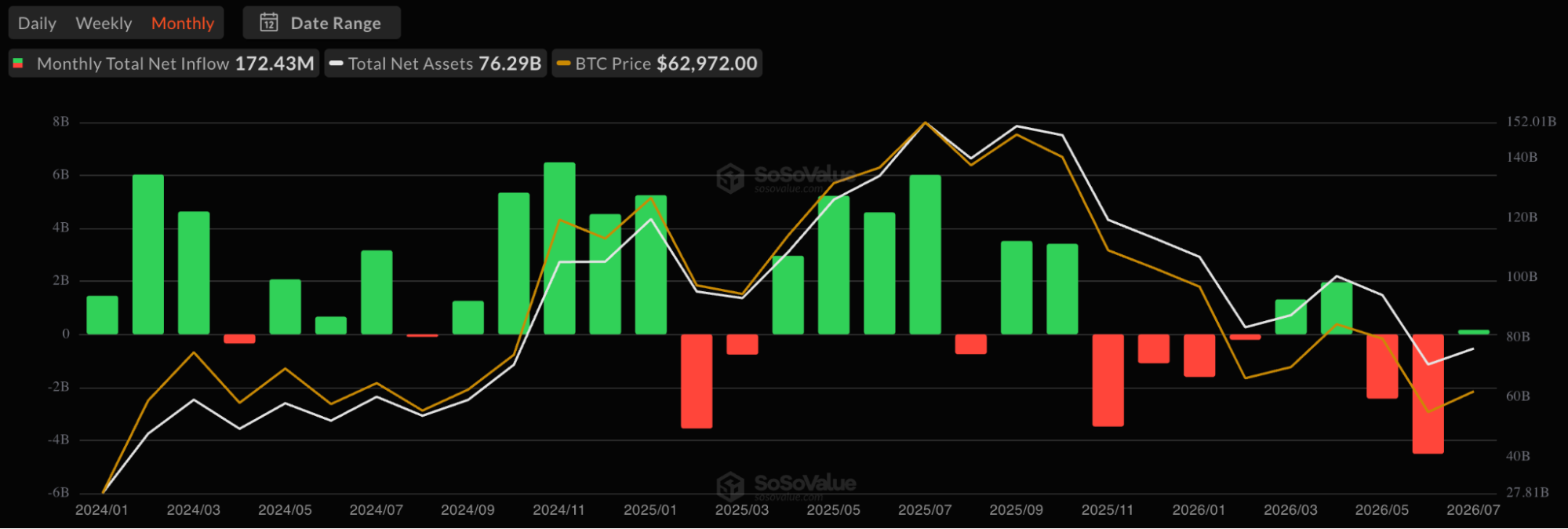
While flows flipped positive for the first time since April, the lack of volatility and dwindling trading volume suggests that institutional allocators may be unwilling to take new positions, or exit existing ones.
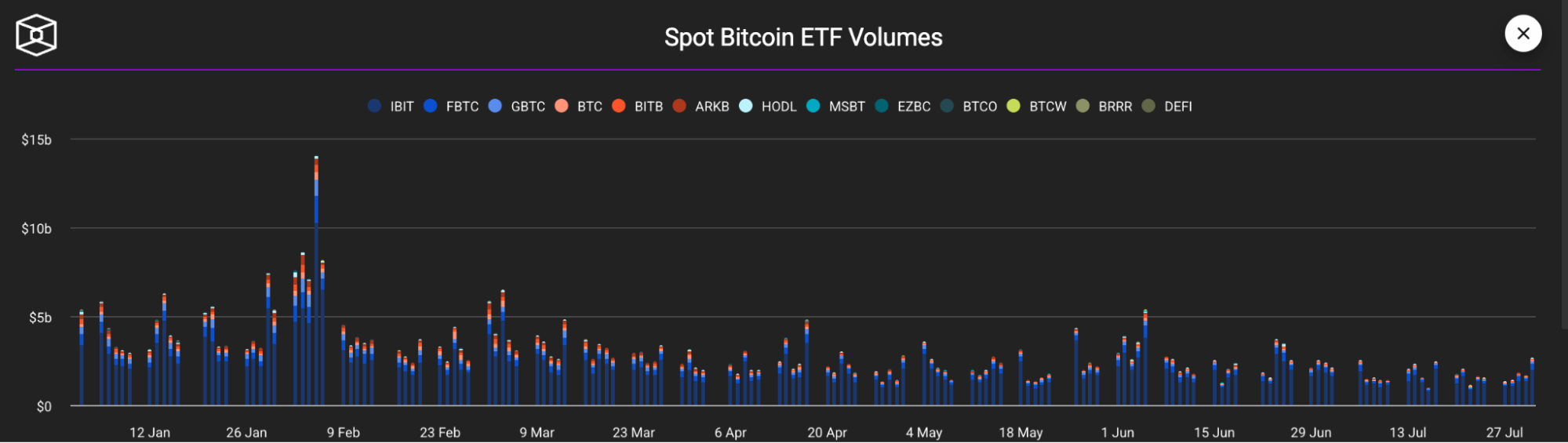
Social commentators argue that crypto markets have now trended into ‘apathy zone’, a low-flow and low-activity period in which traders and investors await the next great catalyst, such as the Bitcoin halving.
Bitcoin Holders Rocked by Coldcard Exploit
Meanwhile, self-custody enthusiasts have been dealt a difficult blow with the August 1st Coldcard exploit resulting in the loss of over $88M among long-term $BTC holders.
The attack came after hackers discovered a vulnerability in the way in which Coldcard seed phrases were generated. Using AI tools, the hackers were able to launch a brute force attack to discover the various seed phrases of hundreds of cold-storage wallets that never even touched the internet.
The attack has reignited debate across the crypto space over the reliability of self-custody practices. While self-custody is one of the fundamental tenets of the crypto movement, the risk of losing funds to malicious actors or personal error is becoming exceptionally high.
With even the most crypto-native users considering moving funds to centralized venues, Solana Foundation Head of Ecosystem Engineering Ilan Gitter argues that industry builders have a “fundamental responsibility” to reimagine self-custodial architecture to facilitate familiar and secure recovery.
Read More on SolanaFloor
Two of Solana’s biggest ever governance proposals go live this week
SIMD-0550 & SIMD-0553: Everything You Need to Know About This Week’s $SOL Tokenomics Votes
Solana’s Prediction Markets are Breaking Out