
Solana is projected to move Alpenglow, which Anza describes as its biggest consensus upgrade in history, into public testnet this week.
In a Tuesday post, Brennan Watt, CEO of Anza, hinted that the upgrade would go live on testnet in Epoch 1042, expected in less than 2 days according to Solana Beach data.
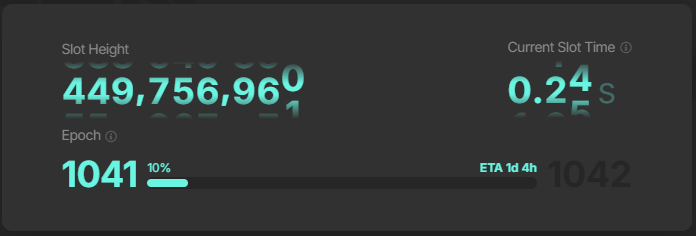
The move marks the first formal step in a migration that will eventually replace TowerBFT, Solana’s existing consensus system, with Alpenglow. The upgrade has already run for more than 4 months on a dedicated community cluster, where operators have repeatedly rehearsed the migration process.
From 12.8 Seconds to 150 Milliseconds
Alpenglow’s main change involves how quickly Solana reaches finality, the point at which the network considers a transaction irreversible under its consensus rules.
Anza estimates that Alpenglow can reduce finality from roughly 12.8 seconds to around 100 to 150 milliseconds. That could change how exchanges, bridges, and merchants handle Solana transactions, since these services often wait for finality before crediting deposits, releasing assets, or confirming payments.
The upgrade replaces TowerBFT with Votor. Instead of recording consensus votes as blockchain transactions, validators exchange votes directly. Votor can finalize a block through 1 of 2 voting paths. One path completes after 1 round when 80% of stake participates, while another uses 2 rounds when participation reaches 60%. Removing onchain voting also frees blockspace currently consumed by consensus traffic.
How Solana Will Switch Consensus Without Stopping
Alpenglow does not require a new chain, network restart, or token migration. Solana will switch consensus while the live network continues operating.
The migration follows 4 steps. First, the Alpenglow feature gate activates at an epoch boundary. Nothing migrates immediately.
Then, 5,000 slots later, the migration boundary arrives. Blocks stop carrying user transactions and contain only votes. This creates a safe rollback point because validators can discard blocks after the boundary without losing user transactions.
Validators continue running TowerBFT until 1 block receives votes from 82% of stake. The last ancestor of that block before the boundary becomes the Alpenglow genesis block.
Validators then sign a BLS genesis vote. Once 82% of the stake contributes, the genesis certificate forms.
Finally, validators roll back everything after the genesis block, hand consensus to Votor, and resume processing user transactions. TowerBFT retires, while Alpenglow takes over from the genesis block forward.
Agave 4.3 Leads the First Test
Validators participating in the testnet migration need to run Agave v4.3.0. Anza recommended Agave v4.3 for all Mainnet-beta validators on Sept. 21 after a staged rollout that first covered operators representing 10% of stake and then 25%.
Anza's current schedule lists September 28 as a tentative date to activate features included in Agave 4.3 on Mainnet-beta. However, that does not represent a confirmed Alpenglow mainnet launch date.
Firedancer Not Supporting Alpenglow Migration
Firedancer and Frankendancer currently do not support the Alpenglow migration. Testnet operators running either client need to switch to Agave v4.3.0 before the feature gate activates.
The situation has also raised concerns about client diversity. Mike MacCana, developer relations at QuickNode, expressed concern about the network relying on a single client during the migration.
The Firedancer team plans to end Frankendancer support when Alpenglow reaches Solana mainnet, expected with v4.3, citing its maintenance and security burden. The team will instead focus on the full Firedancer client.
Solana Foundation validator relations lead Timothy Garcia described the testnet activation as the end of an era for Frankendancer, while crediting the client with having a significant impact on the ecosystem.
What Comes Next
After testnet, Alpenglow will move through Devnet before reaching Mainnet-beta. Each cluster must execute the same migration process before the next stage begins.
The upgrade also remains separate from Solana’s slot-time improvements. Solana’s slot time recently dropped to 250 milliseconds under SIMD-0525, while a future stage targets 200 milliseconds.
Alpenglow instead changes how quickly validators reach finality. If the migration succeeds across each stage, Solana will move toward a network where block finality can occur in roughly 150 milliseconds without changing how users send transactions or how applications execute them.
Read More on SolanaFloor
X Adds a “Trade” Button to Cashtags, Putting $BTC and $SOL One Click From U.S. Users
Cryptopunks, Boogles, and zkSnarks Record Millions in Trading Volume as NFT Markets Reawaken
How to Trade on Solana Like a Pro