Solana’s push to become a universal venue for onchain trading is showing tangible results. Recent trading data reveals that spot trading volumes for non-native assets such as Hyperliquid’s $HYPE and Zcash’s $ZEC have surged on Solana, surpassing volumes recorded on several major centralized exchanges.
The development offers one of the clearest examples yet of how Solana’s strategy to attract assets from other ecosystems is beginning to translate into meaningful market activity. It also arrives as the market capitalization of foreign tokens on Solana reaches $733 million, highlighting the growing role that non-native assets play within the network’s expanding financial ecosystem.
$HYPE Trading on Solana Surpasses Major Exchanges
At one point yesterday, May 31, Solana ranked as the third largest venue globally for 24-hour spot $HYPE trading volume.
According to market data, spot $HYPE volume on Solana reached approximately $56 million during the period. That figure exceeded activity on several tier-one centralized exchanges, including Coinbase and OKX, which recorded roughly $41.7 million and $40.1 million in spot volume, respectively.
Meanwhile, the trend has continued. At the time of writing, the 24-hour spot trading volume for $HYPE on Solana is $95.4 million.
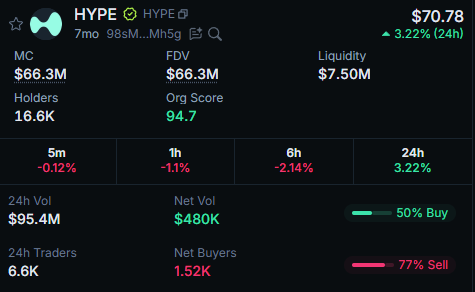
By comparison, Coinbase records $79.2 million, OKX records $56.4 million, and Kraken records $33.9 million over the same period.
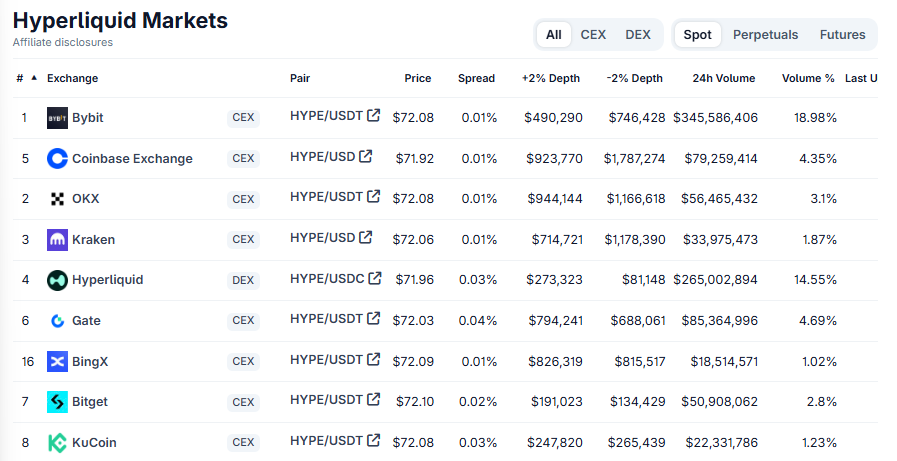
The figures suggest that a growing share of Hyperliquid trading activity now takes place directly within Solana's DeFi ecosystem rather than through traditional centralized venues.
Zcash Shows a Similar Pattern
The trend is not limited to Hyperliquid. Zcash's native asset, $ZEC, has also experienced stronger spot trading activity on Solana than on several major exchanges. Current 24-hour spot volume for $ZEC on Solana stands at $36.4 million. In comparison, OKX records $17.9 million while Kraken records $26.6 million.
While Bitcoin and Ethereum continue to dominate the foreign asset landscape on Solana, newer assets have steadily begun capturing a larger share of trading activity and market capitalization.
The Infrastructure Behind the Growth
Much of this activity traces back to Sunrise, a cross-chain gateway application launched by Wormhole in late 2025. Sunrise aims to solve a long-standing challenge for Solana. Historically, traders often needed to leave the network to access newly launched assets or participate in liquidity events occurring on competing chains. Wormhole introduced Sunrise to change that dynamic.
On November 21, 2025, Wormhole unveiled Sunrise to enable day-one access to assets from rival ecosystems. The initiative launched alongside Monad's highly anticipated $MON token generation event, allowing Solana users to access and trade the asset from launch day. Several other tokens, including $HYPE, AAVE, $SUI, and $AVAX, have also been made available for trading on Solana via Sunrise.
Foreign Assets Continue Expanding on Solana
Data shows that Sunrise has become an increasingly important source of non-native assets on Solana. The total supply value of tokens issued through Sunrise currently stands at approximately $249 million. However, Backpack's $BP, which trades natively on Solana, accounts for roughly $163.8 million of that total, making it the largest individual component.
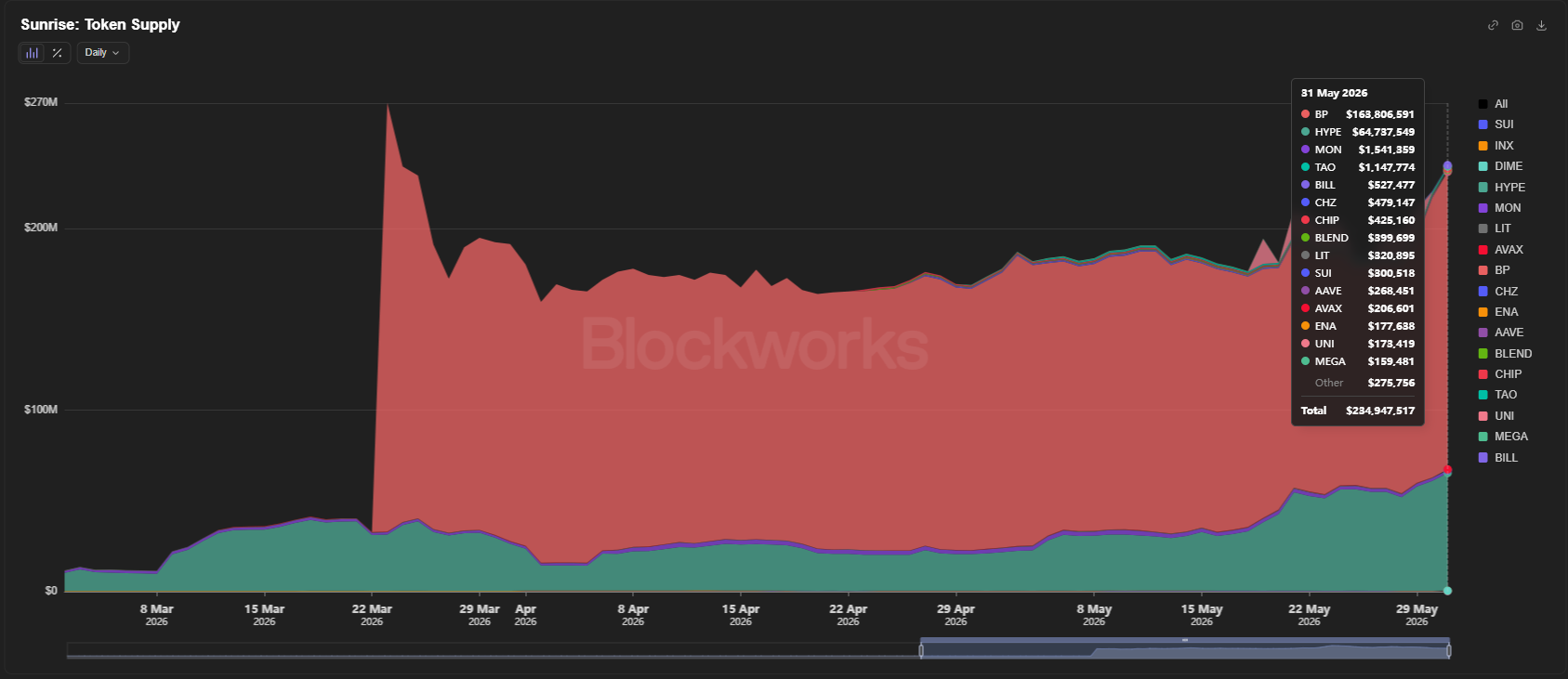
Hyperliquid is one of the largest non-Bitcoin and non-Ethereum foreign assets on Solana, with a market capitalization of approximately $63.9 million. According to Blockworks data, the broader foreign token ecosystem on Solana has now reached a market capitalization of $733 million.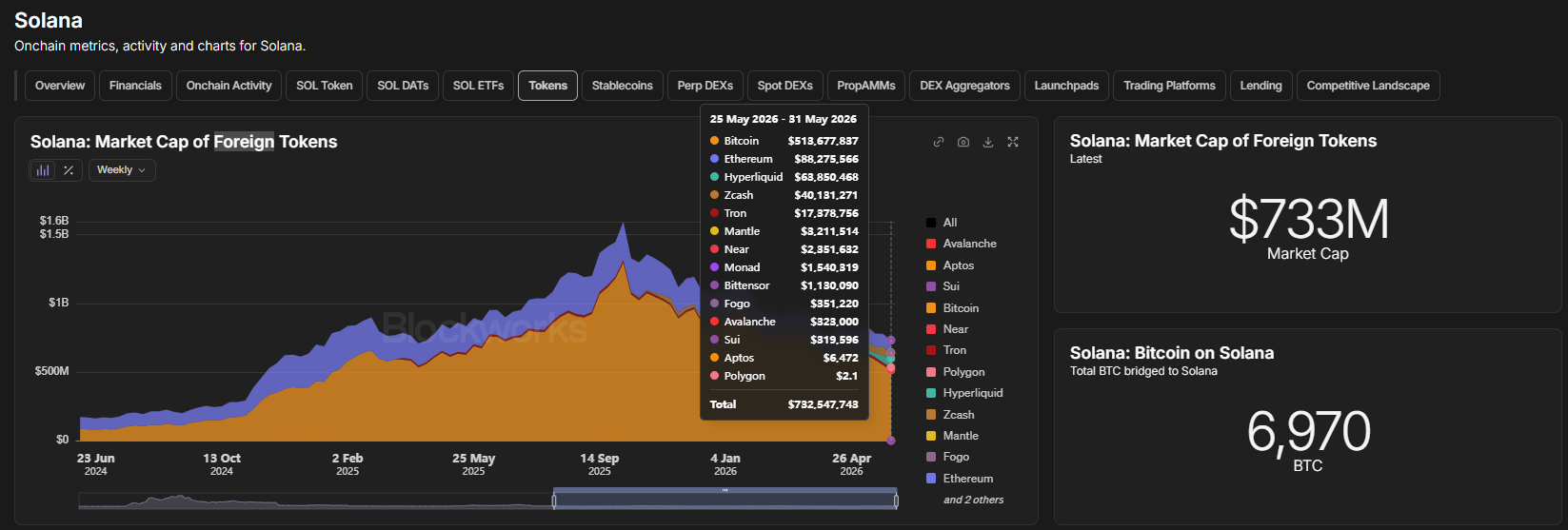
Internet Capital Markets
The growth of non-native asset trading aligns with a broader strategic objective across the Solana ecosystem. Solana's vision of becoming an "everything exchange" depends on its ability to aggregate liquidity across as many assets as possible, regardless of their chain of origin.
From a market-structure perspective, every asset unavailable on Solana creates an incentive for traders to engage in activity elsewhere. Once users begin routing trades through competing venues, networks risk losing not only individual transactions but also long-term trading activity and liquidity. Supporting foreign assets addresses that challenge by allowing traders to access a wider range of opportunities without leaving the ecosystem.
Read More on SolanaFloor
SIMD-0547: Ecosystem Rallies Around Proposed $SOL Tokenomics Change
Solstice Reaches $500M TVL One Day After TGE as Anchorage Digital Invests in $SLX
How Will SpaceX’s $2T IPO Affect Crypto?