Solana’s Double Disinflation Proposal Goes Down to the Wire, Passing by 0.33%
Solana’s Double Disinflation vote barely passed. Its fee-burn proposal did not.
- Published:
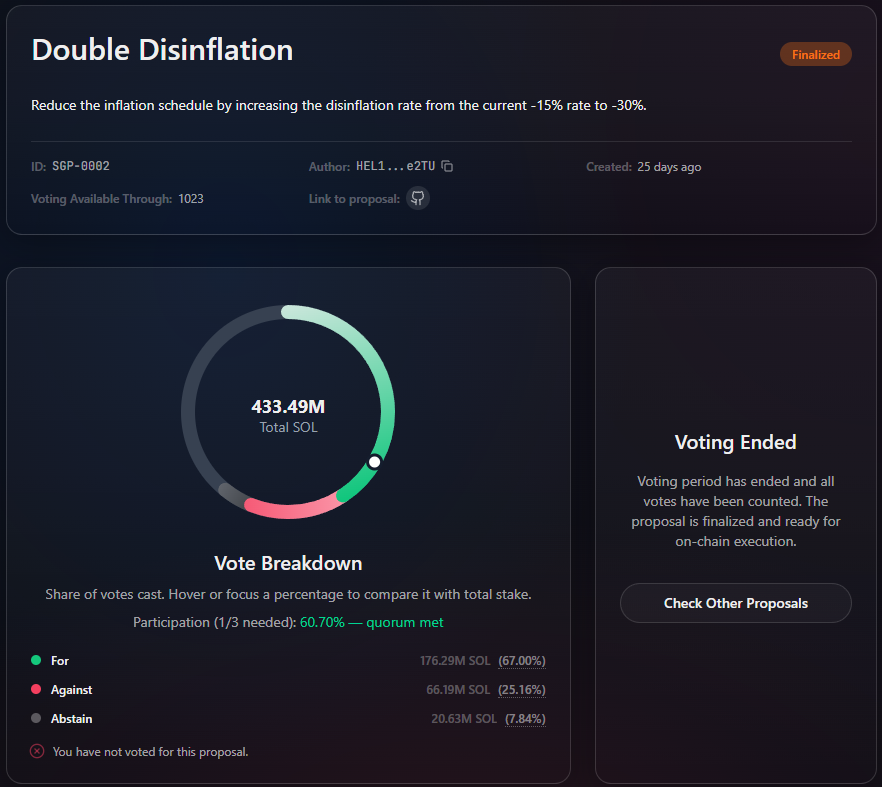
The Solana community has completed voting on 3 major governance proposals, with the network approving 2 and rejecting 1 in its first major test of the new Solana Governance Proposal system. The most closely watched vote, SGP-0002, or Double Disinflation, passed with 67.0% support, just above the 66.67% threshold required for approval.
The proposal will increase Solana's annual disinflation rate from 15% to 30%, accelerating the network's path toward its 1.5% terminal inflation rate. Instead of reaching that target around 2032, Solana should reach it around 2029, reducing projected issuance by approximately 18.9M $SOL over 6 years, currently worth roughly $1.47B.
The final result came down to the wire. About 263M $SOL, worth roughly $27.7B, participated in the SGP-0002 vote. Of that, 176.29M $SOL voted Yes, and 66.19M voted No.
Over the final hour, 15.77M $SOL moved from No or Abstain to Yes, allowing the proposal to cross the threshold. The proposal ultimately passed by only 0.33%.
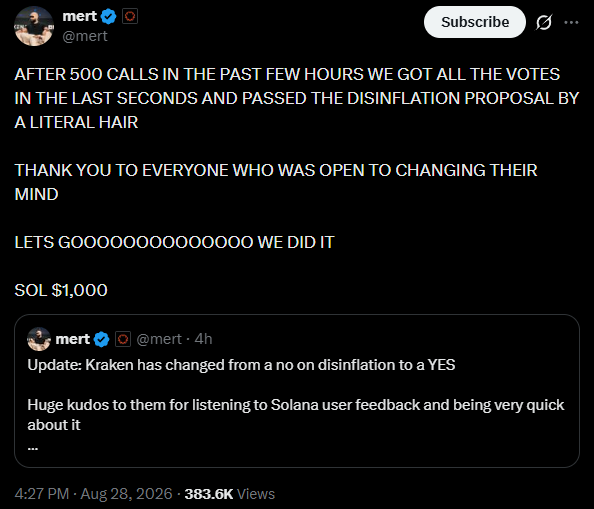
Helius CEO Mert Mumtaz said he made more than 500 calls during the final hours to help secure enough support. He also thanked participants who changed their minds, while celebrating Kraken's late decision to switch from No to Yes.
Validators and Stakers Clash Over $SOL Economics
The close result reflected a debate that divided parts of Solana's validator community from $SOL holders and other ecosystem participants.
Lower issuance should reduce the amount of new $SOL entering circulation, potentially reducing sell pressure over time. However, issuance also funds staking rewards, meaning validators and delegators will receive less $SOL from inflation as the network approaches its terminal rate.
Top validator Figment, which controls more than 17M $SOL, voted against SGP-0002. Other validators also opposed the proposal because they expect lower staking rewards and questioned whether a potential increase in $SOL's value would offset the reduction.
Yet the new SGP system gives individual stakers more control, allowing stakers to override their validator’s vote. Approximately 11.2M $SOL, or 4.25% of participating stake, voted directly from wallets rather than simply following validator positions.
Kraken also played a major role. The exchange controls about 8.92M $SOL in voting power and initially opposed SGP-0002 before changing its position near the deadline. The late reversal helped push the proposal across the line.
SGP-0001 Establishes the Governance Framework
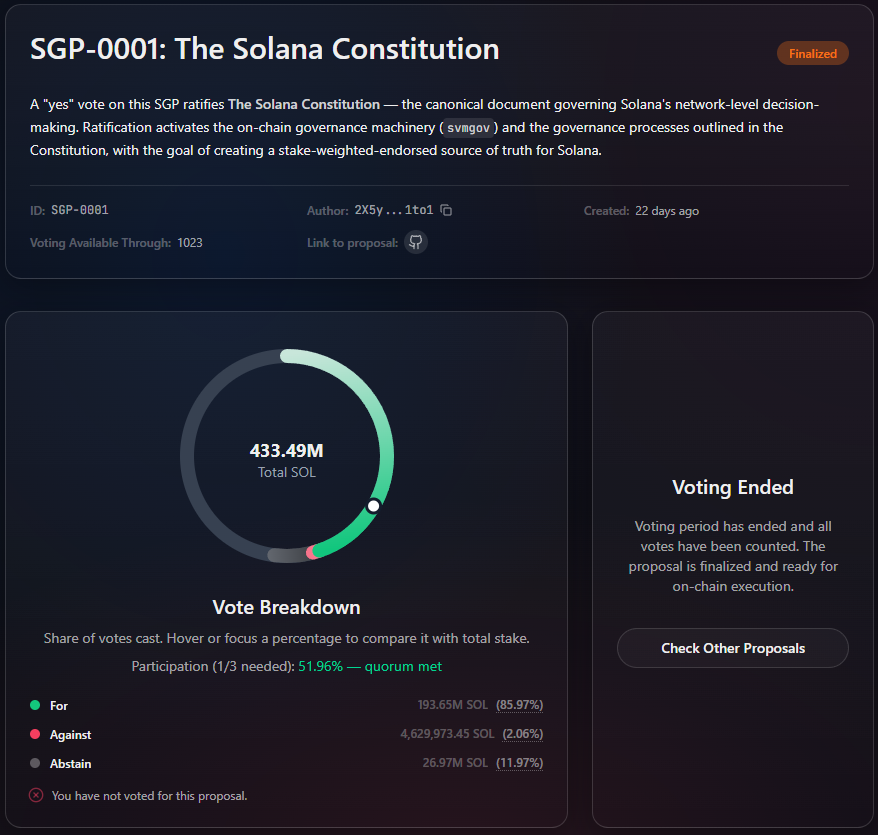
SGP-0001, the Solana Constitution, passed more comfortably. The proposal received 85.97% support, with 193.65M $SOL voting Yes against 4.63M $SOL voting No. Participation reached 51.96%, clearing the required quorum.
The vote formalizes the framework governing future SGP votes and marks an important milestone for Solana's transition toward direct on-chain stakeholder participation.
Jacob Creech, Vice President of Technology at the Solana Foundation, reported that more than 61% of stake participated across the governance process, describing it as Solana's highest-ever onchain governance participation.
SGP-0003 Fails Despite Strong Support
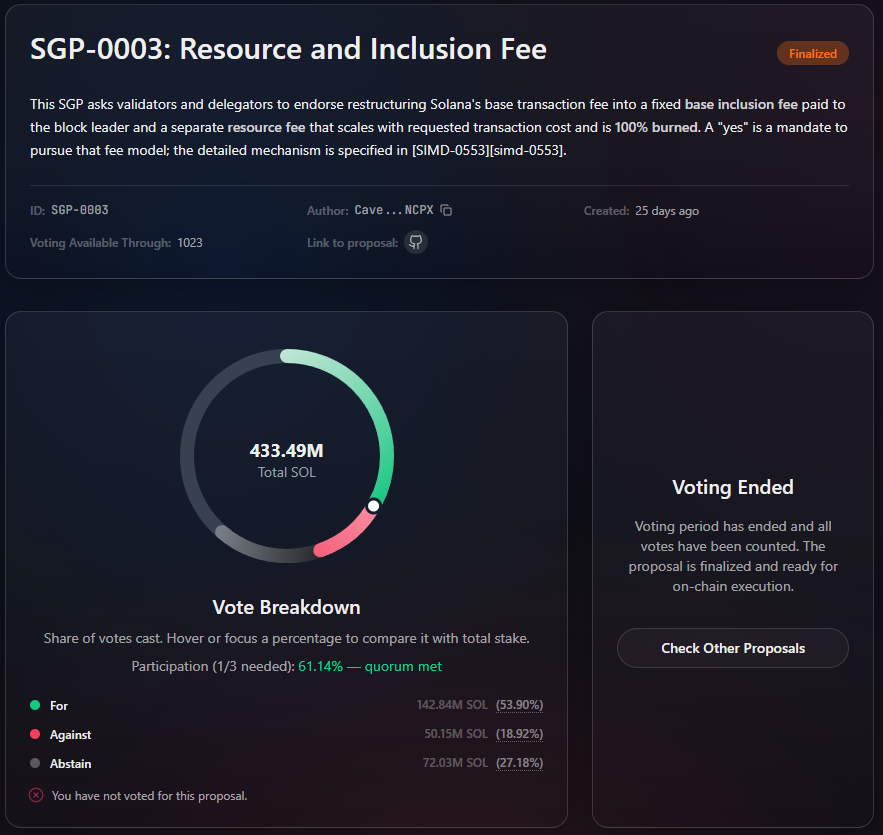
SGP-0003, the Resource and Inclusion Fee, produced the opposite result. The proposal received 53.9% support, with 142.84M $SOL voting Yes, 50.15M voting No, and 72.03M $SOL abstaining. It therefore fell well short of the 66.67% approval threshold.
SGP-0003 would have introduced a resource-based fee tied to transaction complexity and compute consumption. The network would burn the resource fee rather than distribute it to validators.
Supporters argued that Solana currently captures relatively little of the economic value generated by applications on the network. Austin Federa, cofounder of DoubleZero, summarized the argument in a post, noting that roughly 93% of Solana's broader fee economy currently sits at the application layer, while only about 7% reaches the network layer.
The proposal could have increased daily $SOL burns from roughly 650 $SOL to as much as 9,000 $SOL, depending on network activity and fee settings.
Critics, however, warned that higher costs for resource-intensive applications could discourage developers from building complex on-chain products.
In the aftermath of the vote, Solana co-founder Anatoly Yakovenko suggested that developers could separate specific goals within SGP-0003, such as a fee switch or maker discounts, rather than combining multiple economic changes into one proposal.
Governance Faces Its Own Debate
The votes also exposed disagreements over Solana's governance structure. Project0 founder MacBrennan Peet argued that major validators and custodians could hold too much influence, particularly when their interests differ from those of application developers and users. He warned that large exchanges and custodians could increasingly shape Solana's future.
Multicoin Capital co-founder Tushar Jain offered a more positive assessment, arguing that the SGP system directly addresses problems exposed by the failed SIMD-0228 vote. He highlighted predefined voting rules and the new staker override mechanism as major improvements. Jain also identified areas for further refinement, including vote privacy, clearer treatment of abstentions, and longer voting periods.
Solana Gets Faster While the Debate Continues
The governance drama arrived alongside another major network upgrade. Solana has now reduced its target slot time from 400ms to 300ms through SIMD-0525. The network reached 300ms after 2 reductions in 8 days, moving through 350ms before reaching the latest target.
2 further reductions remain before Solana reaches the proposal's 200ms target.
The change aims to improve network latency and competitiveness while also reducing the period during which a single leader controls block production. That can strengthen censorship resistance and improve fairness for validators and users.
For $SOL holders, the immediate outcome is clear: Solana will issue fewer tokens under SGP-0002. However, the community remains divided over how much economic value the network should capture from its growing activity.
Read More on SolanaFloor
$60.9M Inflows: Solana ETFs See Highest Inflows of 2026 as $BSOL Hits $1B AUM
DFDV Resumes $SOL Buying as Solana Posts Its Biggest Monthly Gain Since 2024
The Truth About Solana's Inflation Problem!