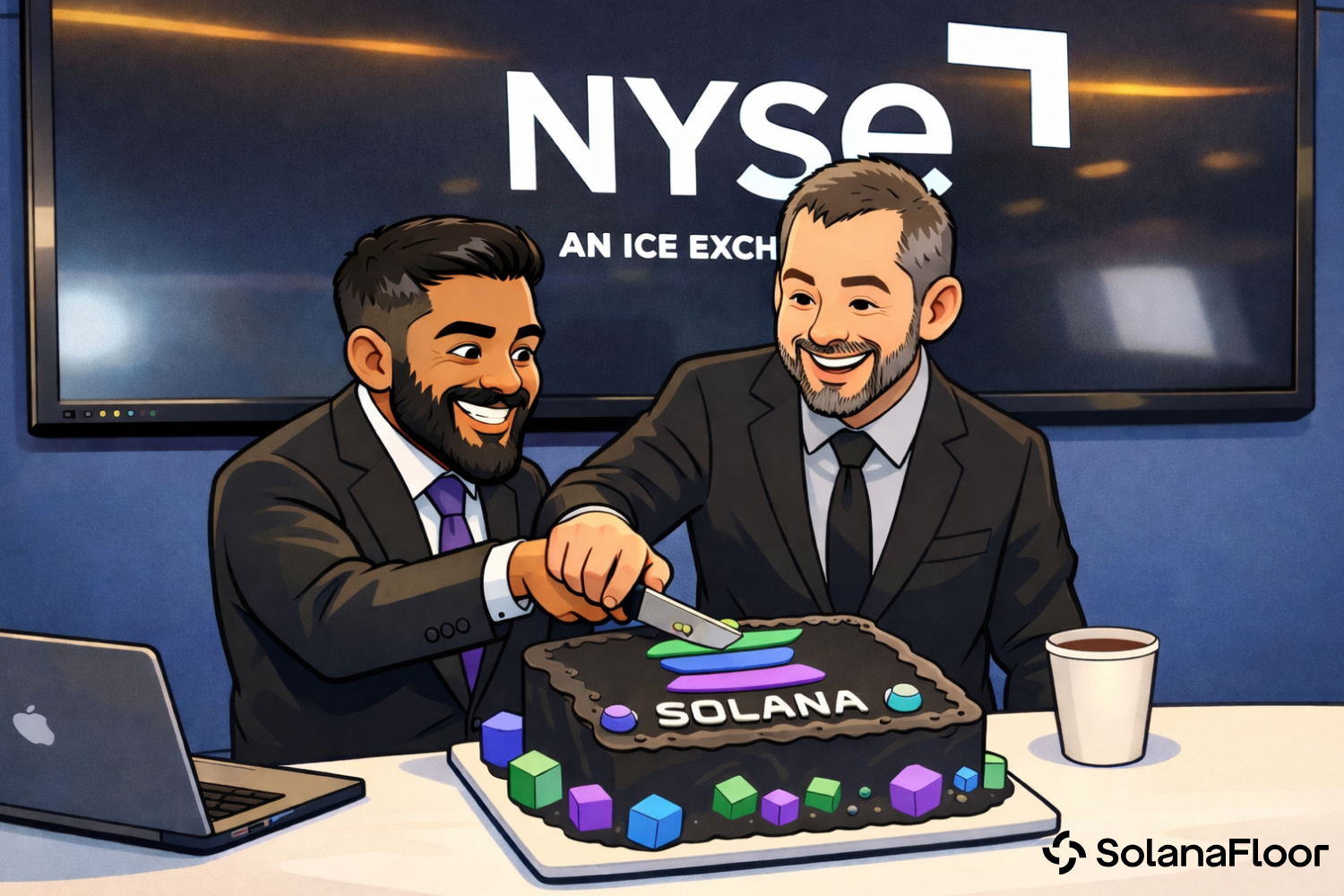
Solana marked its sixth anniversary on March 16, 2026, six years after the network produced its first block in March 2020. What began as an experimental high‑performance blockchain has evolved into one of the most widely used platforms in the digital asset industry. Today, the network leads the sector in decentralized exchange activity, transaction count, and active users while supporting a rapidly expanding ecosystem of developers and applications.
Over the past six years, Solana has experienced explosive growth, technical setbacks, security incidents, and a dramatic recovery following the collapse of one of crypto’s largest institutions.
The network’s cumulative activity highlights the scale of its expansion since launch. The blockchain has processed more than 496 billion total transactions and facilitated over $2.58 trillion in trading volume across decentralized exchanges. Stablecoins worth more than $16 billion now circulate on the network, while tokenized real‑world assets account for almost $1.7 billion in onchain value.
These figures illustrate how a project that once operated with a handful of validators has grown into one of the most active blockchain ecosystems in the world.
Origins: Vision for a High‑Speed Blockchain
Solana’s origins trace back to late 2017 when engineer Anatoly Yakovenko published a whitepaper describing Proof of History, “a proof for verifying order and passage of time
between events”. Yakovenko later partnered with former Qualcomm colleagues Greg Fitzgerald and Raj Gokal to develop the system that would become Solana.
The team raised roughly $25.5 million in private funding between 2018 and 2019 and named the project after Solana Beach in San Diego, where the founders had lived. The blockchain officially launched its mainnet beta on March 16, 2020 during the early days of the COVID‑19 pandemic.
At launch, Solana attracted only a small group of early developers and users. The network processed fewer than one million transactions per day and relied on around one hundred validators. The $SOL token traded near $0.50 and closed its first year around $1.50.
Breakout Growth and the NFT Boom
Solana’s ecosystem expanded rapidly during 2021. A $314 million funding round led by venture firms Andreessen Horowitz and Polychain Capital signaled growing institutional interest in the network.
At the same time, the rise of non‑fungible tokens helped introduce a wave of new users. The Degenerate Ape Academy NFT collection sold out in minutes during August 2021 and became one of the early flagship projects on the chain. As activity surged, the price of $SOL climbed sharply and eventually reached roughly $260 in November 2021.
By the end of that year, Solana had become one of the best performing major crypto assets. The network’s market capitalization exceeded $70 billion while dApps and trading activity expanded across the ecosystem.
Outages, Exploits, and the FTX Collapse
Despite its rapid growth, Solana also faced a series of challenges that tested the durability of the network.
Between 2021 and 2024, the blockchain experienced several widely publicized outages and periods of degraded performance. High volumes of automated transactions and software bugs occasionally disrupted consensus among validators, forcing developers to coordinate network restarts.
Security incidents also affected the ecosystem. In 2022, the Wormhole bridge exploit resulted in a $320 million loss after an attacker minted unbacked wrapped Ethereum on Solana.
Later that year, a vulnerability in the Slope wallet software exposed private keys and compromised more than nine thousand user wallets.
The most severe shock arrived in November 2022 with the collapse of crypto exchange FTX and its affiliated trading firm Alameda Research. Both organizations held large amounts of $SOL and had close ties to the ecosystem. Their bankruptcy triggered a dramatic selloff that pushed the price of SOL down more than 90% from its peak.
At the time NFT trading represented one of the dominant sources of activity on Solana. The DeGods collection stood as the network’s largest NFT project by both trading volume and market capitalization, while its companion collection y00ts also commanded significant attention within the ecosystem. As uncertainty spread following the FTX collapse, several prominent projects reconsidered their future on the network. DeGods announced plans to migrate to Ethereum while y00ts revealed a move to Polygon.
The decision signaled a turning point for the NFT community on Solana, and several other projects soon explored similar cross chain migrations. Many observers questioned whether the network could recover.
Recovery and Renewed Growth
Instead of collapsing, the Solana ecosystem gradually rebuilt momentum. Developers continued to launch applications and infrastructure upgrades improved network stability.
By 2023 and 2024 the blockchain experienced a renewed wave of adoption driven by DeFi platforms, memecoin trading, and consumer‑focused applications. Solana’s decentralized exchanges eventually surpassed Ethereum in trading volume for extended periods, highlighting the chain’s ability to support high‑frequency activity.
Enterprise partnerships also emerged. Companies such as Visa and Google Cloud began integrating Solana technology into payment settlement systems and validator infrastructure. These collaborations helped reinforce the network’s credibility during its recovery phase.
Institutional Adoption and ETF Era
Institutional interest in Solana increased significantly during 2025. Several asset managers launched exchange traded funds that track the price of $SOL, including products from Bitwise and Fidelity. These investment vehicles collectively attracted more than $1 billion in assets following their introduction.
The same year also saw the emergence of digital asset treasury companies that accumulated large quantities of $SOL as part of corporate treasury strategies. Public firms such as Forward Industries raised substantial capital and purchased millions of tokens in an attempt to mirror strategies previously used in the Bitcoin market.
While falling prices later placed many of these treasury positions underwater, the trend illustrated the growing presence of institutional capital in the Solana ecosystem.
Technological upgrades strengthen the network
Several major technical milestones have reshaped Solana’s infrastructure during recent years. The launch of the Firedancer validator client in December 2025 introduced an independent implementation of the network software developed by Jump Crypto. This additional client reduces the risk that a single software bug could disrupt the entire validator network.
Developers also approved a major consensus upgrade known as Alpenglow. The upgrade aims to reduce transaction finality to roughly 100 to 150 milliseconds, dramatically improving responsiveness and placing Solana among the fastest blockchain networks in operation.
Other improvements, such as priority fees, local fee markets, and the adoption of the QUIC networking protocol, have helped address congestion issues that once plagued the network.
Expanding Ecosystem and Real‑World Assets
Beyond infrastructure upgrades, the Solana ecosystem has broadened into new areas of onchain finance. Tokenized real‑world assets have become one of the fastest growing sectors on the network. Funds, tokenized stocks, and even collectible assets have migrated onto the blockchain, bringing billions of dollars in value onchain.
At the same time Solana’s developer community has expanded significantly. Reports indicate the number of developers working within the ecosystem has increased nearly tenfold since 2020. In 2025 alone more than 3,800 new developers joined the network, pushing the total developer base to roughly 6,000 contributors.
Solana Mobile has also entered the ecosystem with its Seeker smartphone, which aims to create a mobile‑first experience for decentralized applications and digital asset ownership.
What’s Next for Solana?
Solana’s journey over the past six years demonstrates that persistence within open source communities can shape the trajectory of an entire technology platform. Solana’s leadership continues to frame the network as a long-term technological experiment rather than a finished product. As the network enters its seventh year, the competitive landscape continues to evolve.
The network’s architects have repeatedly described a future where high performance blockchains power global capital markets, with a vision often summarized as building a "NASDAQ on Solana". The idea centers on creating decentralized financial infrastructure capable of running fully onchain order books and real time trading systems that rival traditional exchanges in speed and efficiency. If that vision materializes, the blockchain could evolve from a high throughput crypto network into foundational infrastructure for internet native capital markets in the years ahead.
Read More on SolanaFloor
Bitcoin Is Outperforming Stocks and Gold Since the Iran War Began — What Changed?
Top $TRUMP Memecoin Holders Invited to Exclusive Mar-a-Lago Luncheon, Token Pumps 50% on News
Is This The Bottom?