SIMD-0525 to Boost Solana Performance, But at What Cost?
Long-tail validators could face yet another economic squeeze if voting costs double before Alpenglow goes live
- Published:
- Edited:
Solana’s win-at-all-costs ethos has been a critical part of the chain’s success in recent years, scaling network performance to a level where spot trade execution outperforms centralized exchanges on the industry’s most desirable assets.
Increasing bandwidth and reducing latency has become Solana’s mantra, with network upgrades like Alpenglow, p-token, and block-limit increases consistently improving network performance, but at what cost?
SIMD-0525, a recent proposal to reduce slot times to 200ms, has come under scrutiny from tail-end validators. While SIMD-0525 invariably boosts network performance, its implementation threatens the livelihood of smaller, independent validators, doubling transaction voting costs for an indeterminate amount of time.
Beyond the obvious concerns associated with squeezing out the long-tail validators that help to decentralize the network, SIMD-0525 implementation has struck a sour note among community members.
Unlike other critical governance votes, the Solana Foundation and larger validators are eager to expedite SIMD-0525, pushing the update live to mainnet without giving stakeholders the opportunity to vote on the contentious proposal.
Is Solana willing to sacrifice long-tail validators at the altar in the name of IBRL?
What is SIMD-0525?
Drafted and submitted by Anza CEO Brennan Watt, SIMD-0525 aims to cut Solana slot time in half, dropping from 400ms to 200ms across four separate, 50ms steps. The update effectively drops the confirmation and finalization time of Solana transactions, boosting app performance across the network.
The majority of network participants have celebrated SIMD-0525 and its expected performance improvements, but the proposal does come with some side effects. While slot times, and consequently, epoch times are being cut in half, the $SOL issuance schedule remains unchanged. Under SIMD-0525, validator voting costs are set to double, without any change to rewards.
For larger validators, the change has a negligible impact. Industrial scale validators with large amounts of $SOL make sufficient revenue to cover the new expense, and will likely reap the benefits of a more performant network.
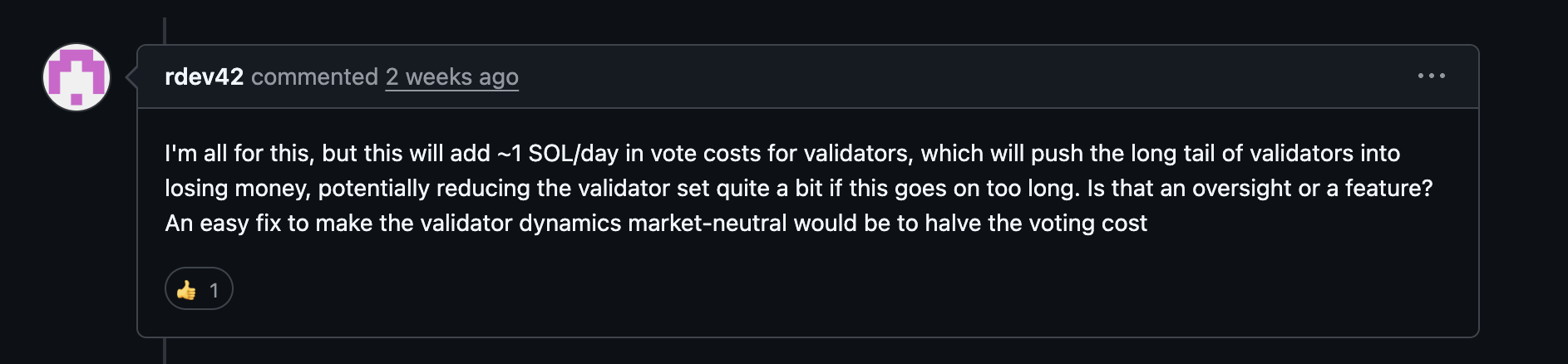
At the other end of the spectrum, long-tail validators, already embattled by high operating costs, are staring down the barrel of a considerable profitability crunch.
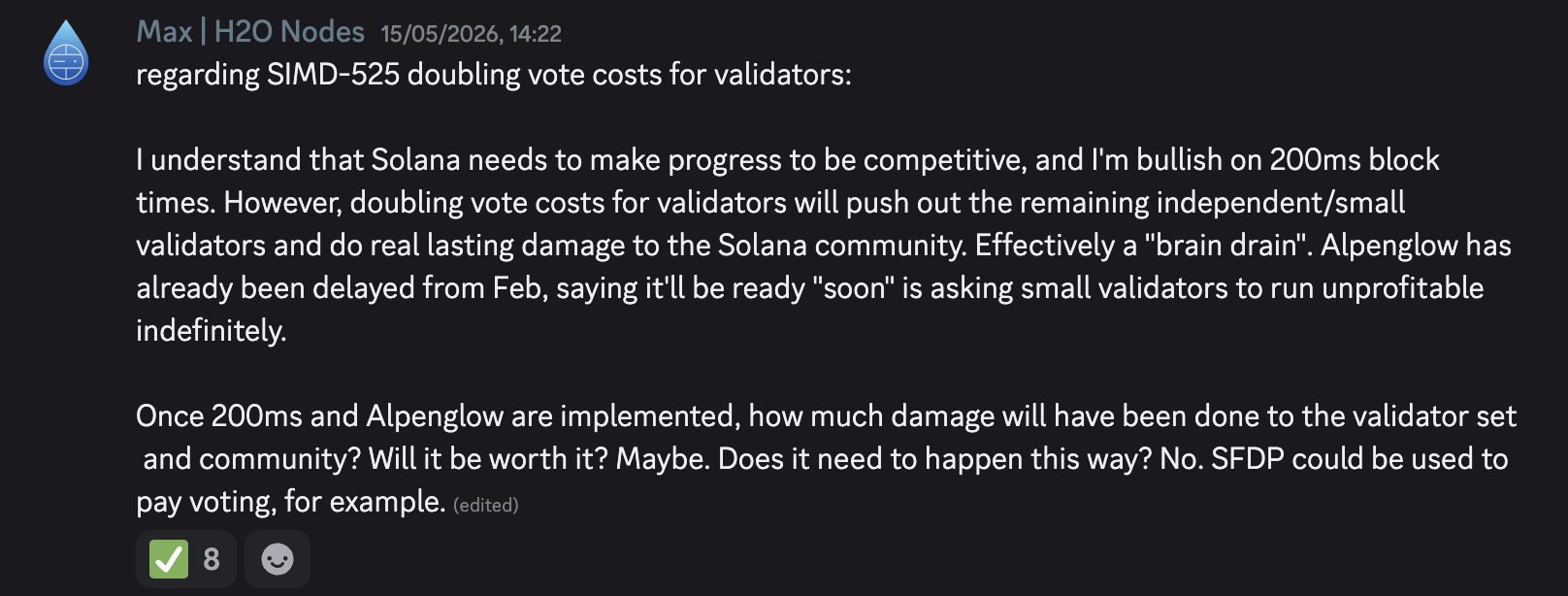
Alpenglow, Solana’s upcoming consensus upgrade, is expected to provide a definitive solution. Instead of paying voting costs on a per-transaction basis, Alpenglow will require validators to pay a 0.8 $SOL per-epoch ticket, marking a net-zero change while still facilitaing SIMD-0525 performance inprovements.

Unfortunately for smaller operators, the timeline for Alpenglow’s eventual launch is still largely undefined. While Solana Labs co-founder Anatoly Yakovenko has asserted that Alpenglow is expected to be pushed to mainnet alongside Agave v4.2, network participants have noted that the timeline for implementation has been extended before.
In an exclusive statement to SolanaFloor, H2O Nodes co-founder Max Sherwood argues that if SIMD-0525 is implemented before Alpenglow goes live, it could be a death sentence for long-tail operators.
“It will basically be a death blow for the majority of validators on Solana, ourselves included. Burning thousands of dollars per month, indefinitely, while we wait on Alpenglow to get implemented, just in the hopes of making it back to break even... it's not a situation anyone is looking forward to.” - Max Sherwood, H2O Nodes Co-founder
With the proposed changes, Sherwood asserts that pre-Alpenglow implementation could squeeze many smaller operators out of the validator economy and cause a “brain drain” across the Solana community. Sherwood also suggested that the Solana Foundation’s Delegation Program could step in as a temporary band-aid to support long-tail validators during the transition period.
Independent Validators Sacrificed for Greater Good?
Despite contention around the impacts of its implementation, network participants almost unanimously agree that reducing slot times and improving performance are in the best interests of the network.
But with smaller validators, who are often community-first builder-operators, bearing the brunt of changing economics under SIMD-0525, the ecosystem is faced with a difficult question: What is the price to be paid for Solana to reach its potential?

For Anza, and many large-scale operators, forcing an indeterminate period of financial hardship on long-tail validators is a worthwhile sacrifice. With competitors like Hyperliquid vying to become the “House of Onchain Finance”, ecosystem leaders are pushing to get SIMD-0525 implemented as soon as possible, with advocates arguing that validator economics are secondary to Solana’s competitive survival.
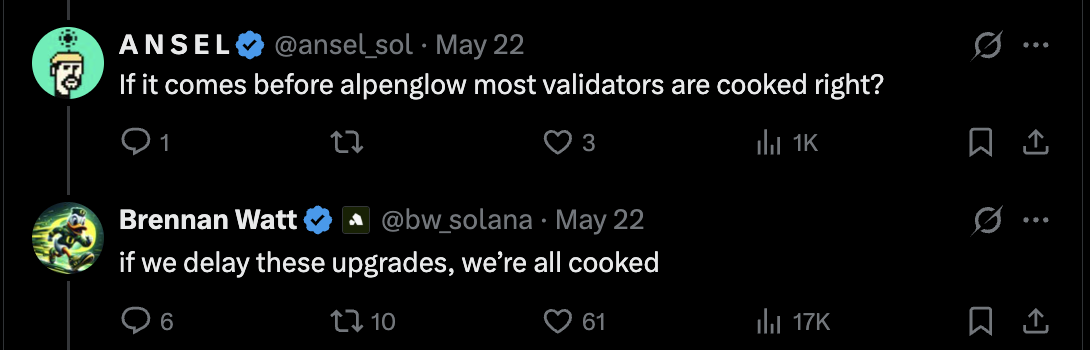
Concerns have only been further exacerbated by the discretion and speed with which ecosystem leaders are racing to push SIMD-0525 through. Speaking on the May 14 Solana Foundation Validator Discussion call, Validator Relations Lead Tim Garcia stated he’d “like to avoid a vote”, calling the transition period a “short-term hit”.
“Based on the time frame of the economic change, one to two months, I would really like to avoid a vote. I think it's really just a short-term hit for some validators that will end up being like longer term benefits. So, my preference would be no vote.” - Tim Garcia, Solana Foundation Validator Relations Lead
While being directionally-aligned, Triton’s Bryan Long challenged Garcia, asking if there were any alternative “Plan B contingencies” that could help bring SIMD-0525 to mainnet without "sacrificing validators”. Garcia acknowledged that the network may lose some validators in the interim, but asserted that it was “worth taking a shot” and assured validators that the risk was low.
“We do have a risk there and there is a chance we're taking that maybe it's three months, maybe it's four months and and validators hurt a bit more there. I think for larger validators they can absorb it just fine. I think for the medium to small validators we may lose some, and that's kind of the gambit, I think at least it's worth taking a shot at. Personally, I think if we all work hard at Alpenglow, then that sort of risk is low." - Tim Garcia, Solana Foundation Validator Relations Lead
Garcia’s position has been widely reflected among operators, who are pushing to get SIMD-0525 approved without going through a validator vote.
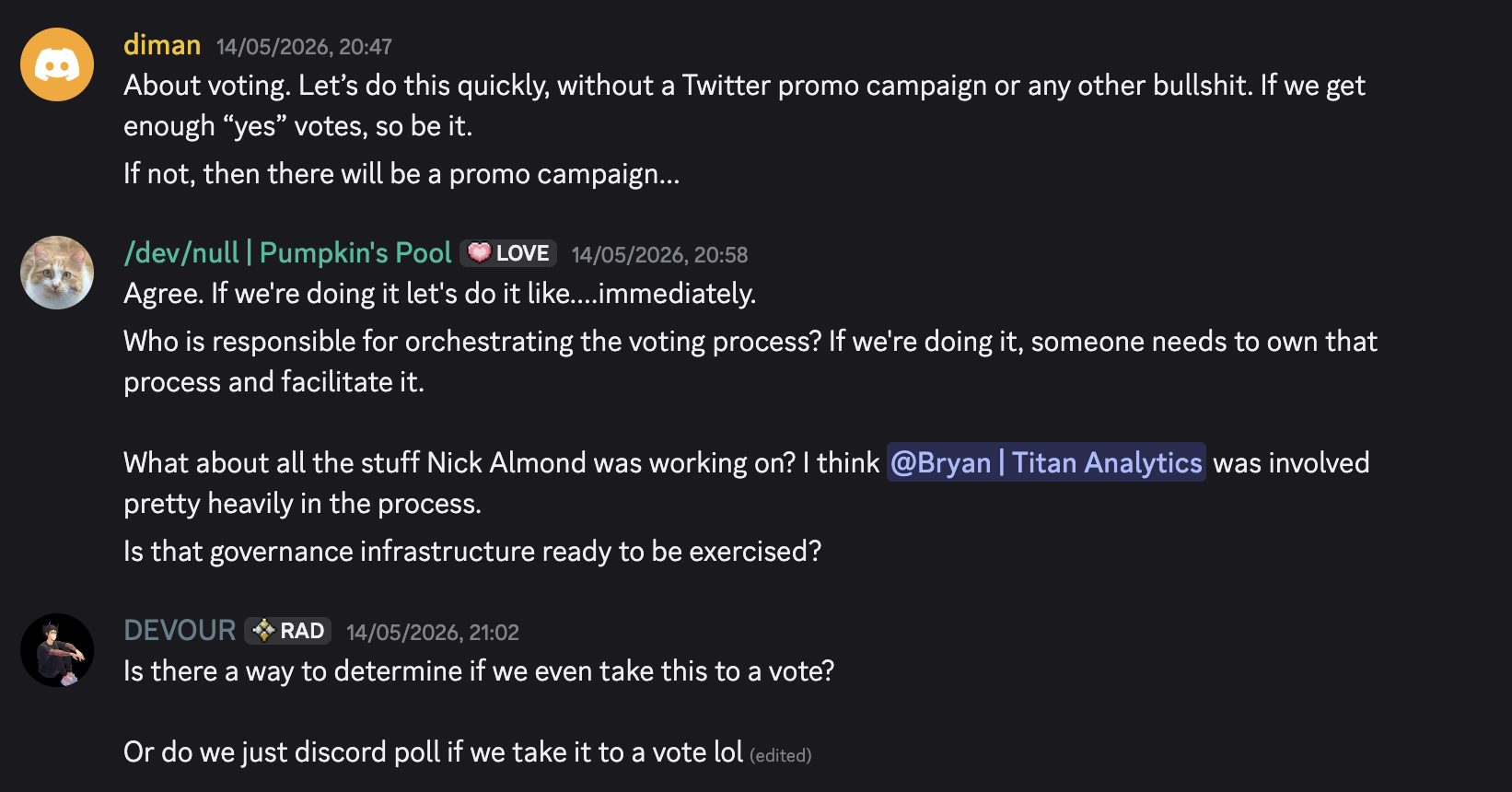
Long-tail operators aside, validators largely agree that optimizing performance is in Solana’s best interests, regardless of the impact on smaller nodes.

Beyond the profitability crunch soon to befall long-tail validators, shortened slot times will impact the dynamics of other areas within the Solana ecosystem. With shorter epochs, unstaking periods are effectively cut in half, which may diminish the value proposition of Liquid Staking Tokens (LSTs).
Solana’s Validator Decline Continues
For Solana’s long-tail validators, Alpenglow cannot come soon enough. Between high voting costs and diminishing rewards, smaller operators have been consistently squeezed out of the validator economy in recent years.
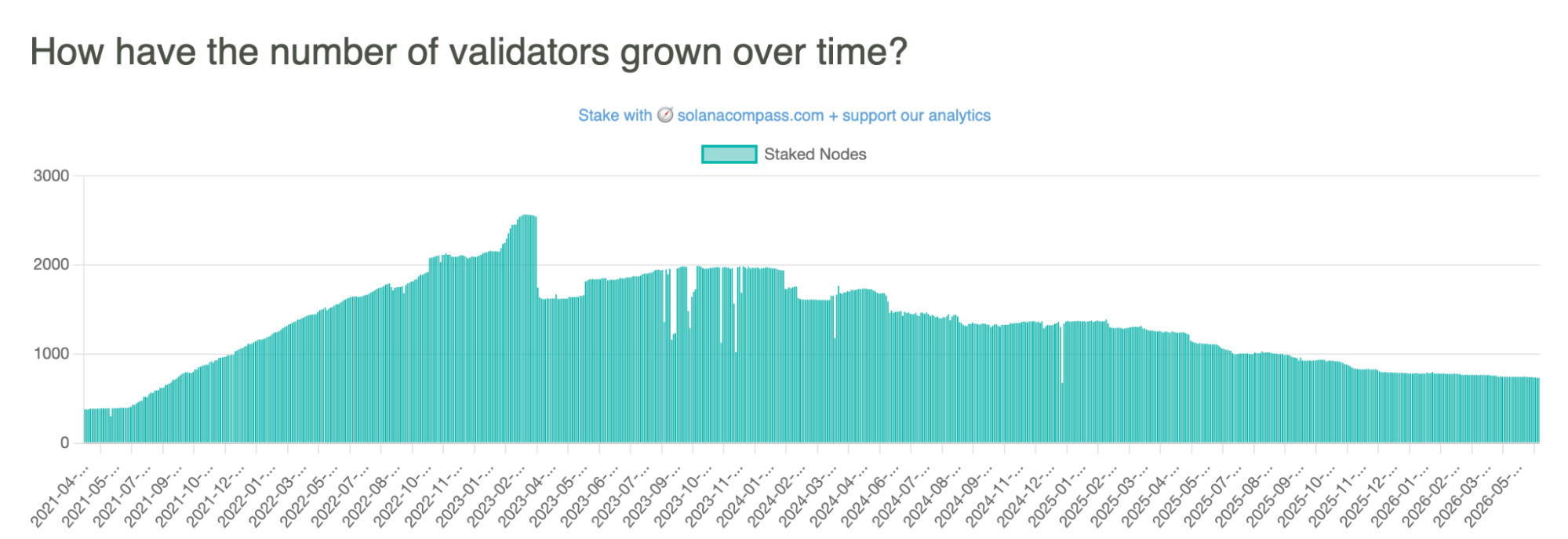
However, some network participants argue that the declining validator count is somewhat taken out of context. Ecosystem leaders like former Sol Strategies CTO Max Kaplan have previously told SolanaFloor that the decline represents a shift from widespread sybil extraction to “quality over qunatity” as a result of unwinding subsidies through the Solana Foundation Delegation Program.
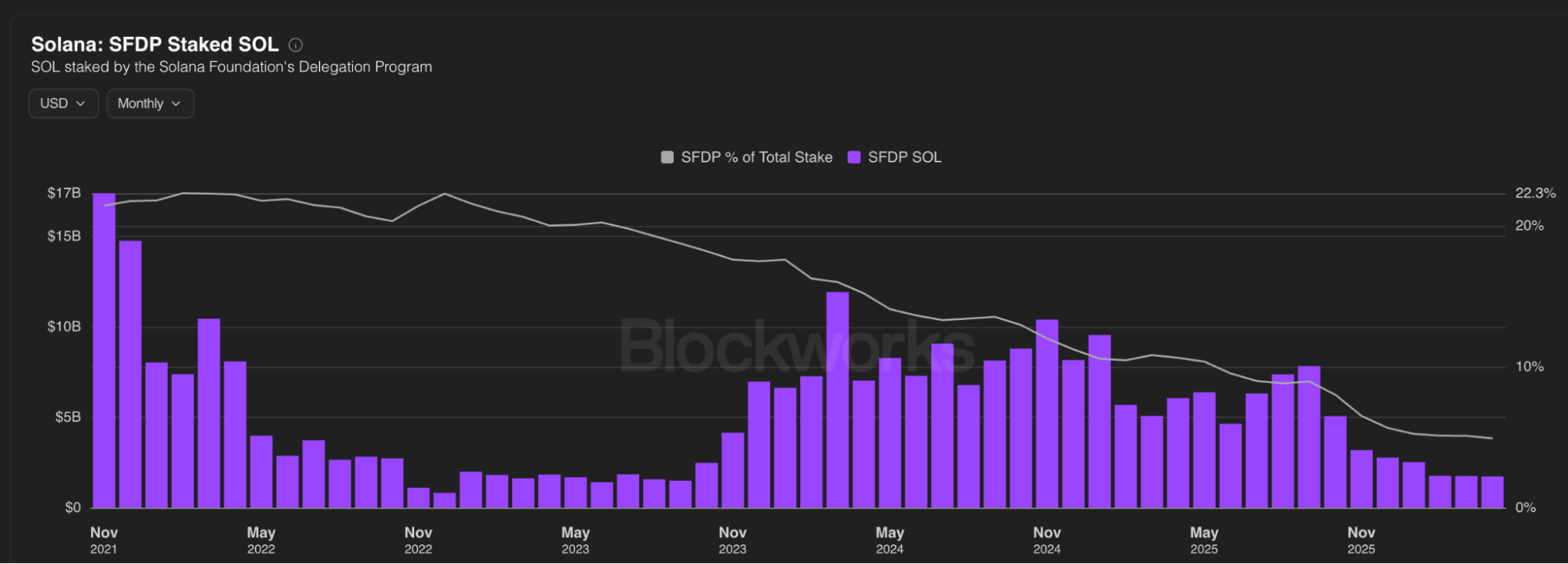
This is corroborated by Blockworks data, which confirms that the SFDP stake has continually declined since its inception, and now represents just 4.92% of the network stake.
Beyond SFDP, long tail validators seeking additional stake subsidies have several alternatives, such as the Jito BAM Early Adopter program, the Firedancer Delegation program, and various stake pool initiatives like Aeropool.
Disclaimer: SolanaFloor is a subsidiary of the Jito Network
Read More on SolanaFloor
Drift Insurance Fund Depositors Breathe a Sigh of Relief
Drift Insurance Fund to Open For Withdrawals at Protocol Relaunch
We Tested Solana’s Top 6 Perps Exchanges