
MoonPay Expands Empire With $100M DFlow Deal, Marking 6 Acquisitions Since 2025
Crypto payments giant moves deeper into trading.
- Published:
MoonPay has acquired the Solana trading infrastructure platform DFlow in an all-stock deal valued at $100 million.
The acquisition comes just 1 day after DFlow announced that it is live within Coinbase's onchain trading stack for Solana, and adds one of the fastest-growing execution layers on Solana to MoonPay’s expanding crypto stack, signaling a direct push into high-performance onchain trading.
DFlow has processed more than $50 billion in cumulative trading volume since April 2025, including roughly $12 billion in the first quarter of 2026, according to Blockworks data.
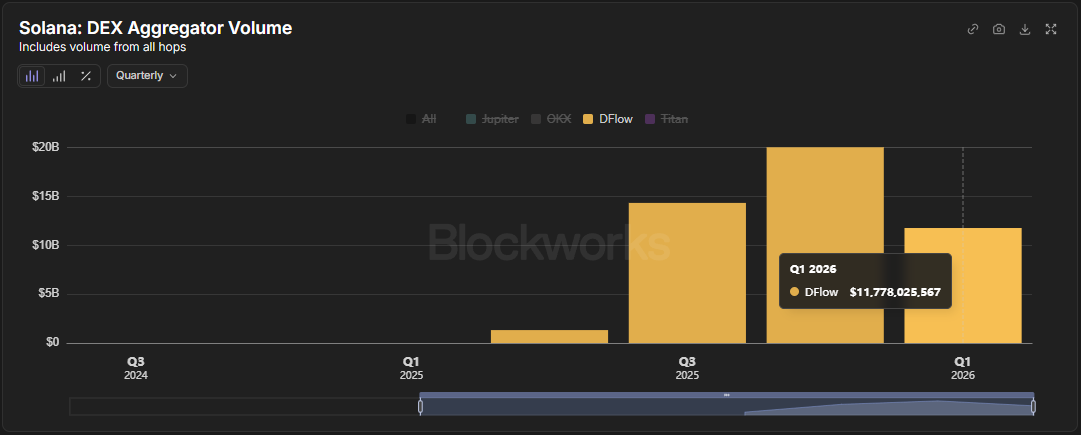
The platform serves over 1 million active traders across more than 500 applications and handles about 10 million transactions per month.
A Critical Piece in MoonPay’s Strategy
MoonPay has pursued an aggressive acquisition strategy since January 2025. The company has completed six acquisitions, including Helio, Iron, Meso, Decent, and Sodot, each adding capabilities across payments, stablecoins, infrastructure, and institutional services. With DFlow, MoonPay now adds trading as a core capability.
"DFlow has become one of the most important pieces of trading infrastructure on Solana in just a year. By bringing their execution layer into MoonPay, we're adding the speed, reliability, and scale needed to support everything from high-volume trading to the next generation of agent-driven financial applications." - Ivan Soto-Wright, Founder and CEO of MoonPay.
With the recent acquisition of Sodot, the company launched Moonpay Institutional, which is a division targeting institutional demand across trading, custody, payments, and tokenization. Former acting CFTC chair Caroline Pham, who also serves as Moonpay’s Chief Legal Officer and Chief Administrative Officer, was tapped to lead the unit.
DFlow’s Rapid Rise on Solana
DFlow has emerged as a major player in Solana’s trading ecosystem in a short time. In November 2025, it became the first aggregator to surpass Jupiter in daily trading volume on the network.
The platform also powers major applications, including Coinbase, Phantom, Solflare, and Kamino.
Market share data also reflects this growth. According to Blockworks, DFlow’s share of weekly aggregator volume increased from 5% in late March to 11% last week, driven by integrations with platforms such as Fomo and Tessera.
The Technology Behind DFlow
At the core of DFlow’s growth is its just-in-time routing system. Traditional aggregators calculate the best trade route before submitting a transaction. On a high-throughput chain like Solana, market conditions can shift rapidly, creating slippage or failed transactions.
DFlow addresses this by re-optimizing trades during execution. The system checks prices across venues at the moment of settlement and can reroute within the same transaction if conditions change. This approach improves pricing, reduces failed transactions, and maintains performance under heavy load.
Routing plays a central role in blockchain trading. A single trade may pass through multiple venues to achieve the best price. DFlow’s algorithm focuses on minimizing slippage, which is the difference between the expected price and the final execution price.
Prediction Markets and Autonomous Trading
DFlow extends beyond token trading into programmable financial markets and automated execution. Its infrastructure tokenizes Kalshi’s prediction markets on Solana, representing each position as a native token and allowing developers to integrate regulated offchain liquidity directly into onchain applications. These positions can interact with broader decentralized finance systems through standard token interfaces, and the system is expanding toward additional tokenized real-world assets.
At the same time, DFlow enables programmatic trading through its Agent CLI, which allows developers to deploy trading agents with built-in execution capabilities. Integrated with MoonPay’s fiat-to-crypto infrastructure and tools such as Claude Code, these agents can operate within automated workflows. Developers can set guardrails such as trade limits and approved assets, enabling controlled, scalable, agent-driven financial activity.
The acquisition positions MoonPay as a more comprehensive crypto platform with capabilities spanning payments, tokenization, custody, and now trading execution. The addition of DFlow could strengthen MoonPay’s appeal to both retail and institutional users, as well as investors, should the company, which raised $555 million at a $3.4 billion valuation in its Series A financing round, consider going public.
Read More on SolanaFloor
Jito Announces JTX, Directing 80% of Platform Revenue to $JTO Value Accrual
Solana Foundation, Google Cloud Unveil Pay.sh, Bringing Enterprise-Scale Infrastructure to the Agentic Economy
Should Circle have Frozen Stolen Funds?