
Independent Validators Push Back on SFDP Changes That Could Sunset Hundreds of Operators
Community validators being winding down after years of service as SFDP tightens eligibility criteria
- Published:
Upcoming changes to the Solana Foundation Delegation Program, an initiative designed to support small validators, have struck a nerve amongst independent operators.
While the SFDP has been in the process of winding down for many quarters, independent operators argue the next round of changes could be the final nail in the coffin.
Solana Foundation representatives have responded to validator’s concerns, requesting feedback from operators and implying that “small validators who make big impacts on the ecosystem will continue to thrive.”
What’s Changing in the SFDP?
Since the Solana mainnet launched in 2020, the SFDP has helped small validators hit the ground running. Through operational support and matched stake, the SFDP helped Solana’s validator count rise to as high as 2,500 nodes in 2023.
As Solana has grown and scaled, the SFDP has been steadily winding down. In a bid to curtail the sybil farmers and other extractive tactics employed by a select few bad actors, eligibility criteria has gotten tougher, with the newest round of changes crossing a tipping point that will put many of Solana’s longest-serving operators out of business entirely.
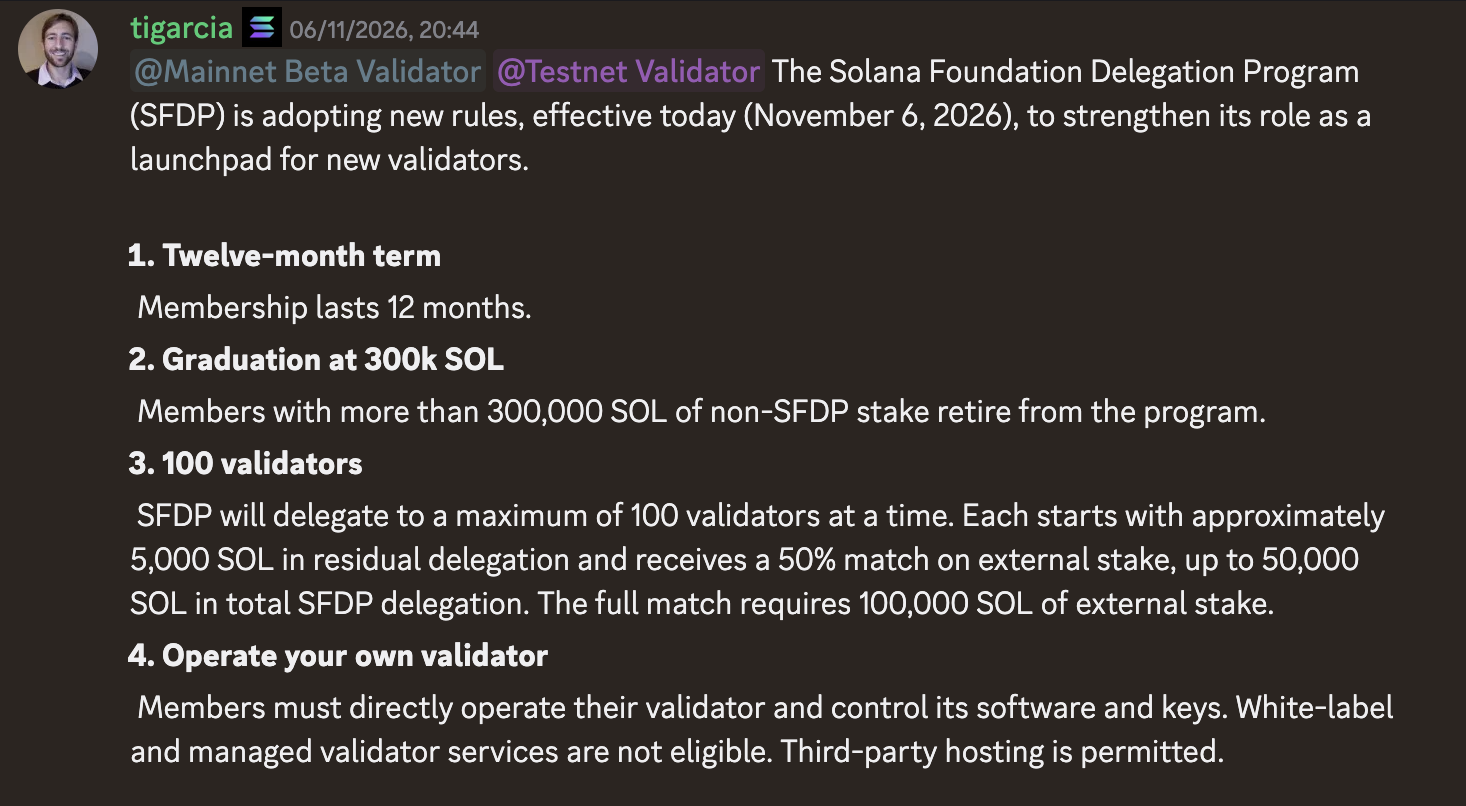
Onchain data suggests that roughly 327 validators, around 47% of the network’s total count, are currently receiving SFDP subsidies. With the number of validators supported by the SFDP dropping to a hardcap of 100, over 200 operators could find themselves without the support required to continue operations.
For many of Solana’s independent validators, these changes will be the straw that breaks the camel’s back.
Layer 33 Shares Open Letter as Operators Prepare to Pack up
Layer 33, an independent validator collective aiming to represent 33% of network stake, has published an open letter outlining its concerns with the proposed changes. Layer 33 argues that, through the changes, the Solana Foundation is being dismissive of the critically-important work of independent operators, whose efforts have been a key part of Solana’s growth.
While institutional validators have no doubt boosted Solana’s credibility, independent operators argue that the giants of Solana’s staking landscape do not actively contribute to the ecosystem. Of the network superminority, not one single validator participated in the Alpenglow community cluster, a testing environment designed to trial the largest consensus upgrade in Solana history.
Layer 33 argues that Solana needs a large, diverse, and distributed network of validators. During August’s Teraswitch failure, in which the mainnet came dangerously close to halting, Solana’s ASN (Autonomous System Number) diversity helped keep the network alive. Layer 33 reiterates that this diversity was in part due to previous SFDP requirements, which help to incentivize network resiliency.
Other mentioned concerns include the economic squeeze felt by independent validators during the network’s phased rollout of slot time reductions, which boosted operation costs in the lead up to Alpenglow.
Alongside other examples highlighting the importance of independent validators, Layer 33 has made the following requests in response to the upcoming SFDP changes:
-
Pause weekly validator retirement tranches until network contributors have been consulted and alternative measures have been discussed
-
Continue supporting validators who participated in the Alpenglow community cluster for an additional 6 months
-
Justify the 100-validator hard cap with empirical data
-
Open a formal consultation with SFDP members before finalizing rules
-
Explore the creation of a contributor model, which would assist independent validators who support network health
While Layer 33 is meeting the Solana Foundation head on, certain operators have already conceded that the writing is on the wall.
Tokomai has announced the protocol’s validator is officially winding down after 2 years of operation, with founder ANSEL lamenting Solana’s path to a validator composed entirely of financial institutions.
With frustrations towards the proposed changes mounting, Solana Foundation’s VP of Tech Jacob Creech has asserted that while the new measures are controversial, they ultimately lead Solana to “the next stage of delegation with a focus on continuing to improve network health and rewarding ecosystem contributors.”
Reinforcing Creech’s position, Solana Foundation Validator Relations Lead Tim Garcia opined that he was looking forward to hearing additional feedback from concerned validators.
SFDP Now Represents 5.46% of Stake
According to Blockworks data, the SFDP’s share of network stake has consistently trended down over the years. After representing over 20% of stake in the network’s infancy, the SFDP now commands a mere 5.46% of staked $SOL spread across roughly 327 validators.
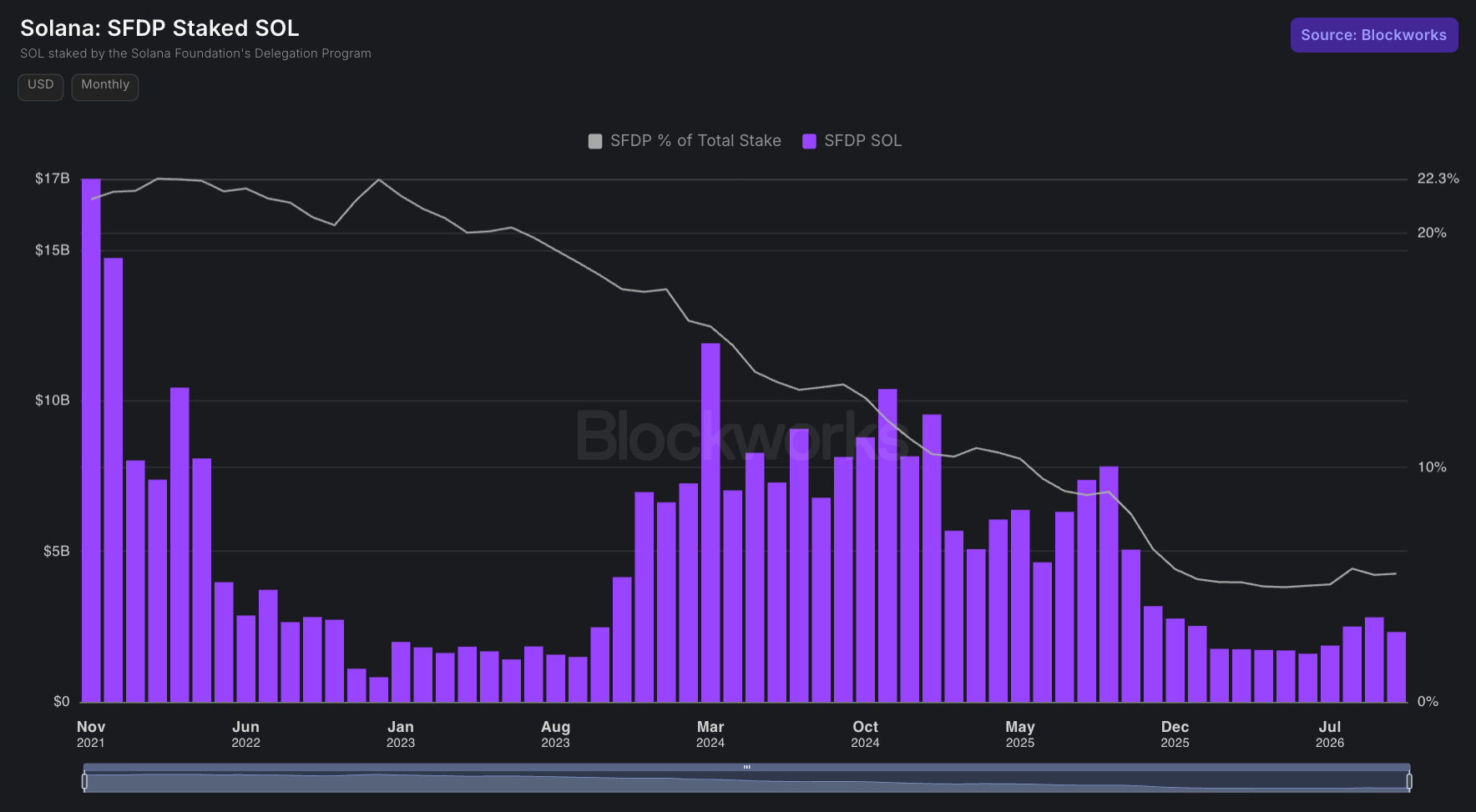
While this may seem small at first glance, the SFDP still delegates over $2.3B worth of $SOL among participants.
Read More on SolanaFloor
Another day, another $1B liquidation
$1.1B Liquidated from Crypto Markets As Nvidia CEO Scandal Sparks Volatility
Crypto is Dead? Again?