
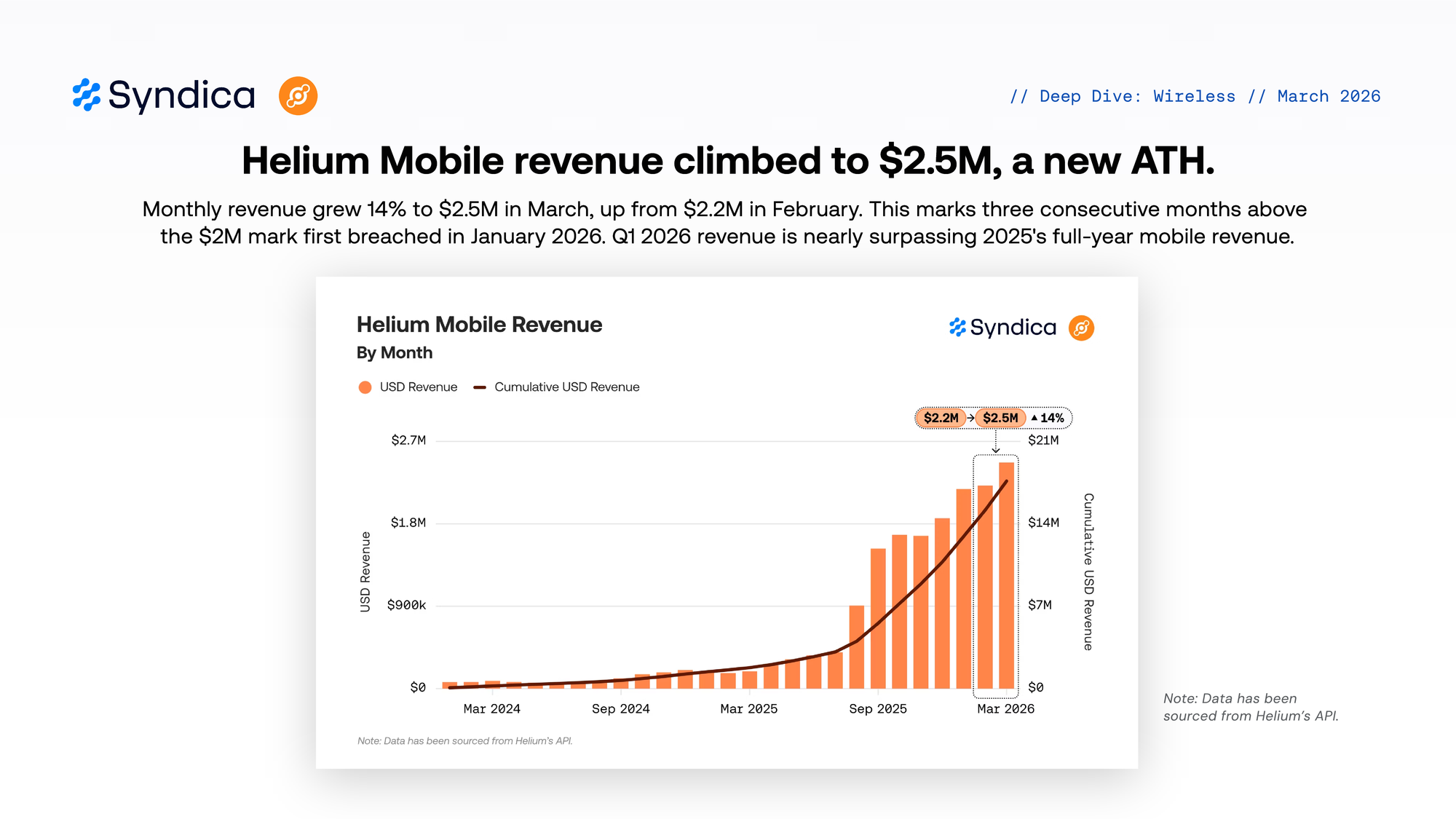
Solana-based DePIN protocol Helium Mobile reached a new milestone in March 2026, recording $2.5 million in monthly revenue, its highest level to date, as reported in Syndica’s latest DePIN report. The decentralized wireless network, built on Solana, continues to shift toward a usage-driven model, with carrier offload and network utilization playing a larger role than new infrastructure deployment.
This latest performance places first-quarter 2026 revenue close to surpassing Helium Mobile’s entire mobile revenue for 2025, signaling an acceleration in real-world adoption and monetization.
Subscriber Growth and Product Expansion
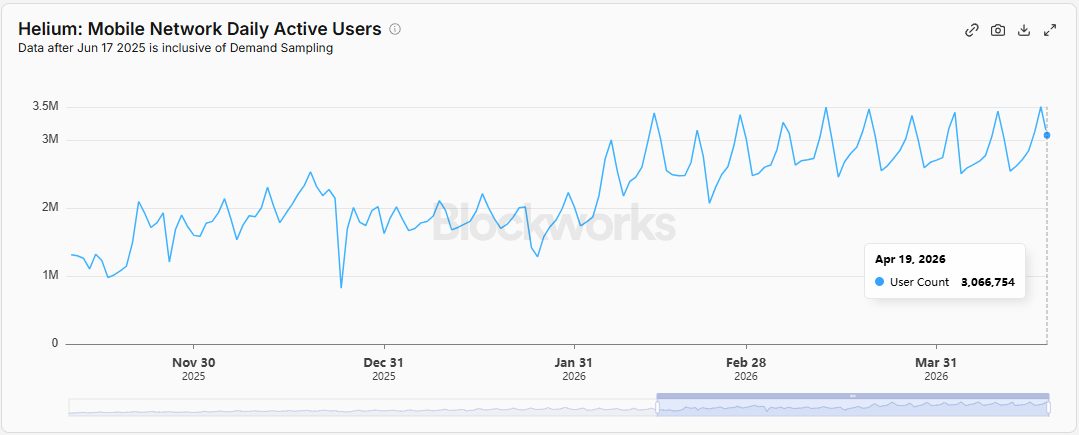
According to Blockworks data, Helium Mobile currently has almost 700,000 total sign-ups, gaining almost 100,000 sign-ups in the past two months, reflecting continued interest in its service model. Monthly subscriber additions also increased, rising to 14,000 in March from 12,000 in February.

The company introduced Helium Hangouts, a new in-app feature that allows subscribers to discover local venues with Helium connectivity.
This feature aims to deepen user engagement and reinforce the network’s real-world utility by connecting digital participation to physical locations.
At the same time, Helium’s broader usage metrics continue to expand. Daily offload reached 111 terabytes, while total subscribers stand above 3 million. Average daily data offload increased by 10%, and the number of daily offload users rose by 12% in March, indicating stronger engagement across the network.
Shift From Deployment to Utilization
Helium’s growth strategy has increasingly emphasized network utilization over rapid infrastructure expansion. Monthly hotspot deployments remained in the low thousands, a sharp contrast to early 2025 levels that ranged between 27,000 and 30,000 per month.
Despite slower deployment, the existing network base of approximately 128,000 hotspots continues to support rising traffic volumes. Real-world usage has begun to validate this approach. Thousands of users connected through Helium infrastructure at the Okeechobee Music Festival, demonstrating the network’s ability to handle dense, high-demand environments.
This shift suggests that Helium has entered a phase where demand growth can be absorbed by existing infrastructure, improving capital efficiency while supporting higher throughput.
Revenue Composition and Carrier Offload
As mentioned in Syndica’s March 2026 DePIN report, Helium Mobile’s revenue growth remained consistent throughout the first quarter. Monthly revenue rose 14% from $2.2 million in February to $2.5 million in March. This marks the third consecutive month that Helium Mobile has generated more than $2 million in revenue, a threshold first crossed in January 2026.
Carrier offload now represents the majority of Helium Mobile’s revenue. In March, offload-related fees accounted for 57% of total revenue, continuing a steady increase from near parity earlier in the year. Major United States carriers are routing larger volumes of traffic through Helium’s network, reinforcing its role as a complementary infrastructure layer within the telecom ecosystem.
This transition highlights a structural shift in Helium’s business model. While subscriber revenue remains important, enterprise demand from carrier partners increasingly drives overall income.
Solana DePIN Ecosystem Rebounds
According to Syndica’s March 2026 DePIN report, The broader Solana DePIN sector also showed signs of recovery in March. Projects including Helium, Render, Hivemapper, UpRock, NATIX, XNET, and GEODNET collectively generated $2.9 million in revenue, representing a 16% increase from February.
At the same time, deployer rewards reversed a prolonged decline. Total rewards distributed across Solana DePIN protocols rose 31% to $2.1 million, up from February’s $1.6 million. Upcoming token generation events from projects such as Wingbits and Dabba may further increase incentives and network participation.
Wireless-focused protocols reached another milestone, delivering a combined 45,000 terabytes of offloaded data in March. This represents a 22% increase from February’s 37,000 terabytes and underscores rising demand for decentralized connectivity solutions.
Performance Across Key DePIN Projects
Several projects within the ecosystem reported notable gains. Dabba Network recorded a 24% increase in usage, reaching 42,000 terabytes of data consumption. The project also signaled a transition toward on-chain infrastructure through a newly published roadmap.
XNET achieved 150 terabytes of offloaded data in March, a 40% increase from the previous month. It also introduced Passpoint, a feature that streamlines WiFi authentication by removing the need for captive portals. This development aims to reduce user friction and attract more venue operators.
Hivemapper delivered one of the strongest recoveries in the sector. Revenue rose from $9,000 in February to $75,000 in March, driven by renewed token burn activity and new product releases. Contributor participation increased 51% to 242, while total mapped distance grew 38% to 11 million kilometers.
Render Network nearly doubled its revenue to $176,000, supported by progress in integrating decentralized GPU infrastructure through a partnership proposal with Salad. Meanwhile, UpRock expanded its reach with the launch of OpenClaw DePIN and a global internet survey covering over 500,000 devices.
Read More on SolanaFloor
Solana PropAMMs Better Than CEX in 99.3% of Retail Swaps
Tether Leads $150M Drift Recovery Plan After Circle Refused to Freeze Stolen Funds
1 Hack Cost Solana DeFi Ecosystem $1B