Loading...
en

Harmonic Targets New Focus Areas After Reviewing Ethereum’s PBS Failures

Solana’s block builders find common ground in mission to push network forward

Harmonic has published an article reaffirming its commitment to sustainable market structure on Solana. Learning from the mistakes made in the Ethereum ecosystem, the emerging block building client has outlined three key focus areas for optimization. 

Harmonic’s stance comes after a recent conflict with Jito, which saw the rivals argue the definition of what “healthy block building” on Solana looks like. 

Solana’s block builders appear to have put their differences aside, with the network’s leading operators aligning on the push towards sustainable, long-term market structure.

Supporting Sustainable Market Structure

In the interest of Solana’s long-term success, Harmonic has issued a statement on its forward plans to improve execution quality and application stability. Harmonic’s new stance comes after criticism from competitors that the block builder was prioritizing short-term validator profitability and revenue generation over the network's sustainability. 

Harmonic’s approach to contributing to a competitive, positive-sum block building market of Solana has been distilled down to three focus areas: apps, microblocks, and transparency.

Similar to Jito’s BAM and ACE (Application Controlled Execution), Harmonic will create tools that give apps the ability to control the ordering of transactions within blocks. This will enable the formation of ‘fast’ and ‘slow’ lanes, unlocking powerful features like cancel order prioritization, while also giving developers the necessary tools to inhibit toxic flow.

Other improvements to Harmonic’s block building stack include censorship resistance and updates to its auction design, which enforce a strict 50ms time interval on sub-blocks. Beyond direct technical implementation, Harmonic is committing more resources to educating the wider Solana community on its product.

Thought leaders across the ecosystem have lauded Harmonic’s stance. Anza Lead Economist Max Resnick has called Harmonic’s upcoming improvements “positive changes”, while Jupiter CTO Italo Casas remarked that healthy competition will continue to raise the ceiling for the ecosystem as a whole.

Block Builders Bury the Hatchet

While Harmonic is being commended for its outlook, it wasn’t too long ago that the firm was in the grip of a fierce public debate with Jito over its block building approach. In early January, Jito published a dashboard giving all validators an ‘IBRL’ score, which was widely considered a directional signal of good behaviour and long-term alignment.

At the time, Harmonic originally hit back at Jito’s IBRL rankings, arguing that the dashboard had been created to discredit the emerging block builder. Harmonic hit back at Jito’s scoring methodology, arguing that “healthy block-building” shouldn’t be measured by a monopolistically defined rubric.

Fortunately, it would appear that Jito and Harmonic have set their differences aside and are committing to honest competition that collectively drives Solana forward.

JitoBAM Powers 27.23% of Network Stake

Away from the slings and arrows of social media, Jito maintains a firm grip on Solana’s block-building race. Over 27% of network stake is now running Jito’s BAM, which is continuing to onboard more validators

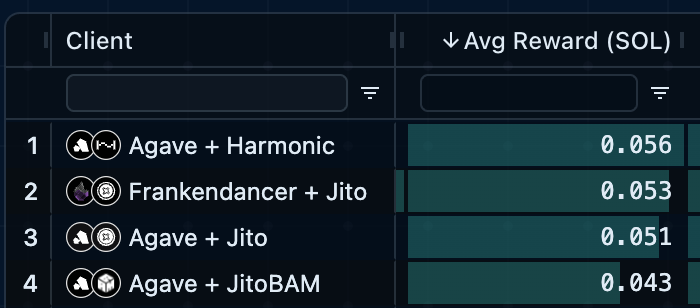
Not to be left behind, Harmonic is also growing its influence across Solana. According to Firedancer reports, 16.8% of network stake is now running Harmonic, which continues to offer the highest average rewards for operators.

harmrewards

Harmonic’s share of network stake has been bolstered by the recent onboarding of several large validators, including Jupiter, Coinbase, and Kraken.

Read More on SolanaFloor

AI Meets Crypto in deBridge’s latest Product

deBridge Brings ‘Vibe Trading’ to the Onchain Economy as Solana Seeks to Reclaim x402 Lead

Is the DAT Experiment Over?

Solana Weekly Newsletter

Tags


Related News