Harmonic Hits Back at Jito’s IBRL Validator Scores
Solana’s blockbuilding wars reach a fever pitch
- Published:
- Edited:
Launched earlier this week, Jito’s IBRL validator explorer has sparked fierce debate on what can be considered ‘healthy block-building’ on Solana.
Much of the network has commended Jito for illuminating the complex world of onchain block-building. On the other hand, Harmonic argues that the IBRL explorer is “self-serving” and deliberately paints emerging competitors in a bad light to further entrench Jito’s monopoly.
What are the arguments from either side of the block-building divide, and what other resources are available to help inform the average $SOL staker?
Harmonic Decries Jito’s “Self-Serving” Scoreboard
After finding themselves vilified by Jito’s IBRL explorer, Harmonic has struck out at Solana’s largest block engine. In a recent 𝕏 article, Harmonic accused Jito of designing a scoring system that “is engineered to push the network toward the block-building style Jito prefers”.
Denouncing Jito’s IBRL methodology, Harmonic argues that ‘healthy block-building’ shouldn’t be measured by a monopolistically-defined rubric, but by what ultimately improves Solana’s performance at the execution layer.
Using the transaction count of Solana’s top DEX programs (HumidFi, SolFi, and Pheonix) as a benchmark, internally processed data argues that validators running Harmonic block-building software consistently include more transactions per slot. Harmonic equates this denser transaction packing, and higher CUs (compute units) per block, with superior performance.
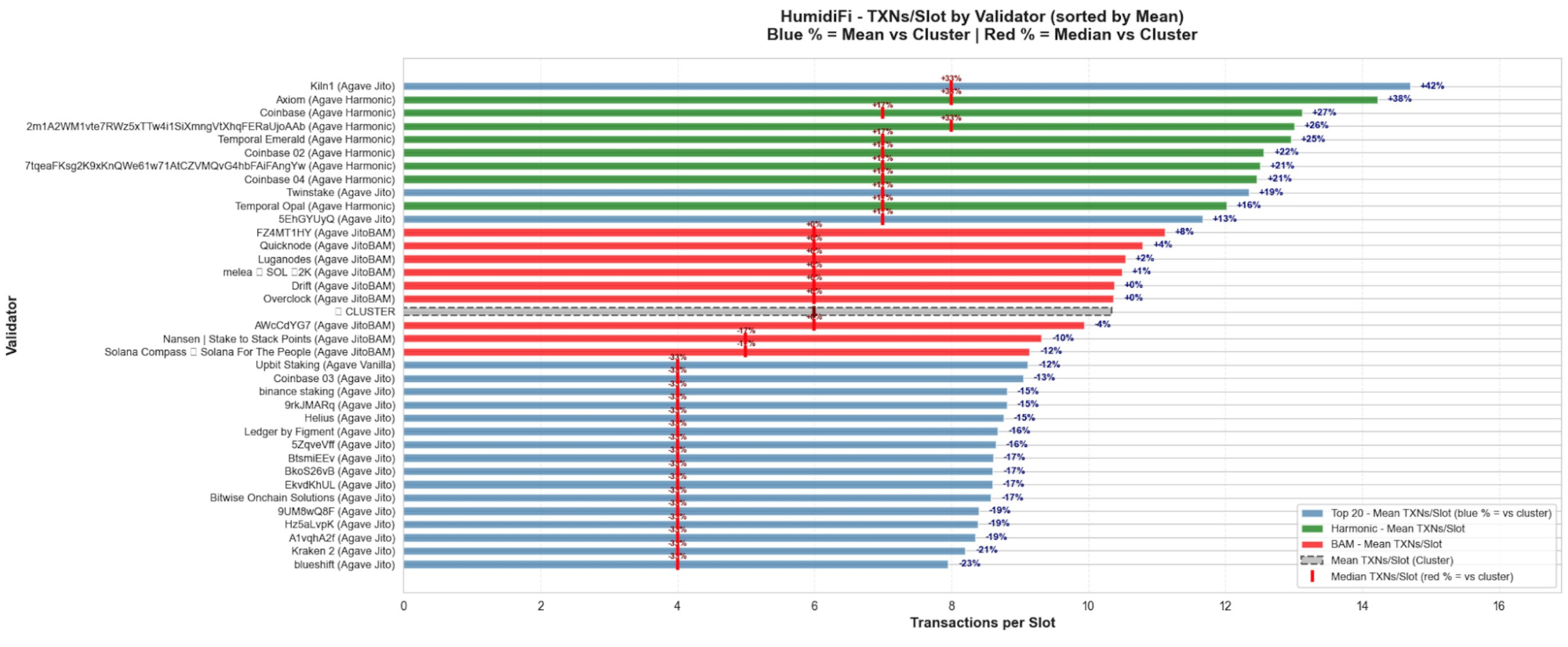
A few things worth noting: HumidiFi, Solana’s leading DEX program is operated by Harmonic’s parent company, Temporal. Additionally, the ‘best performing’ validator by these standards, Kiln1, runs Jito, but has been criticized in the past for slot lagging.
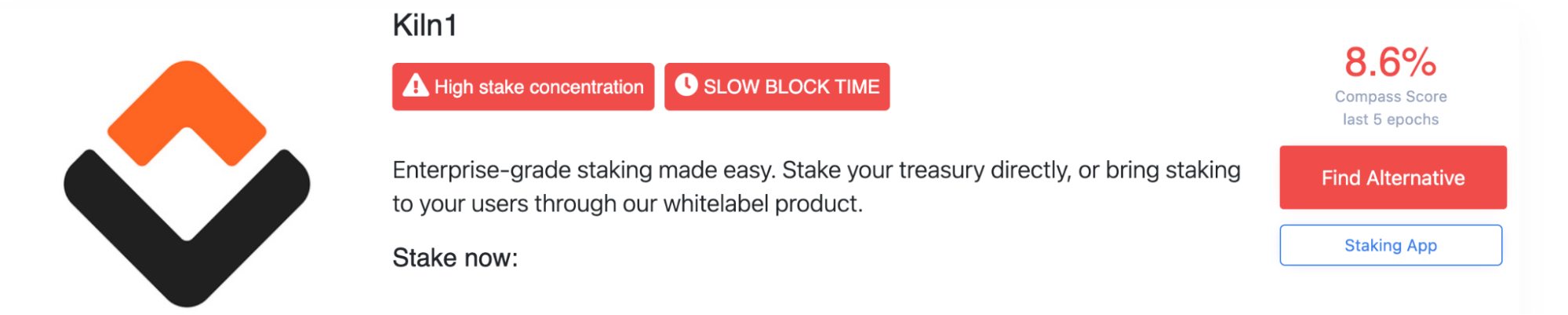
Despite being flagged by other validator score resources for poor performance, Kiln1 ranks highly on Jito’s IBRL explorer with a score of 84.3.
Jito Affirms Position on Late-Packing
While Harmonic champions execution, transaction count, and optimizing compute units, Jito has stood by its belief that this can harm network health as a whole. In discussing and contextualizing various approaches to block-building, Jito co-founder Zano Sherwani denounced Harmonic’s strategy.
Sherwani’s position reinforces statements made by Jito Foundation Executive Director Brian Smith. Earlier this week, Smith asserted that Harmonic’s delayed state propagation had harmful second-order effects that made other validators less performant.
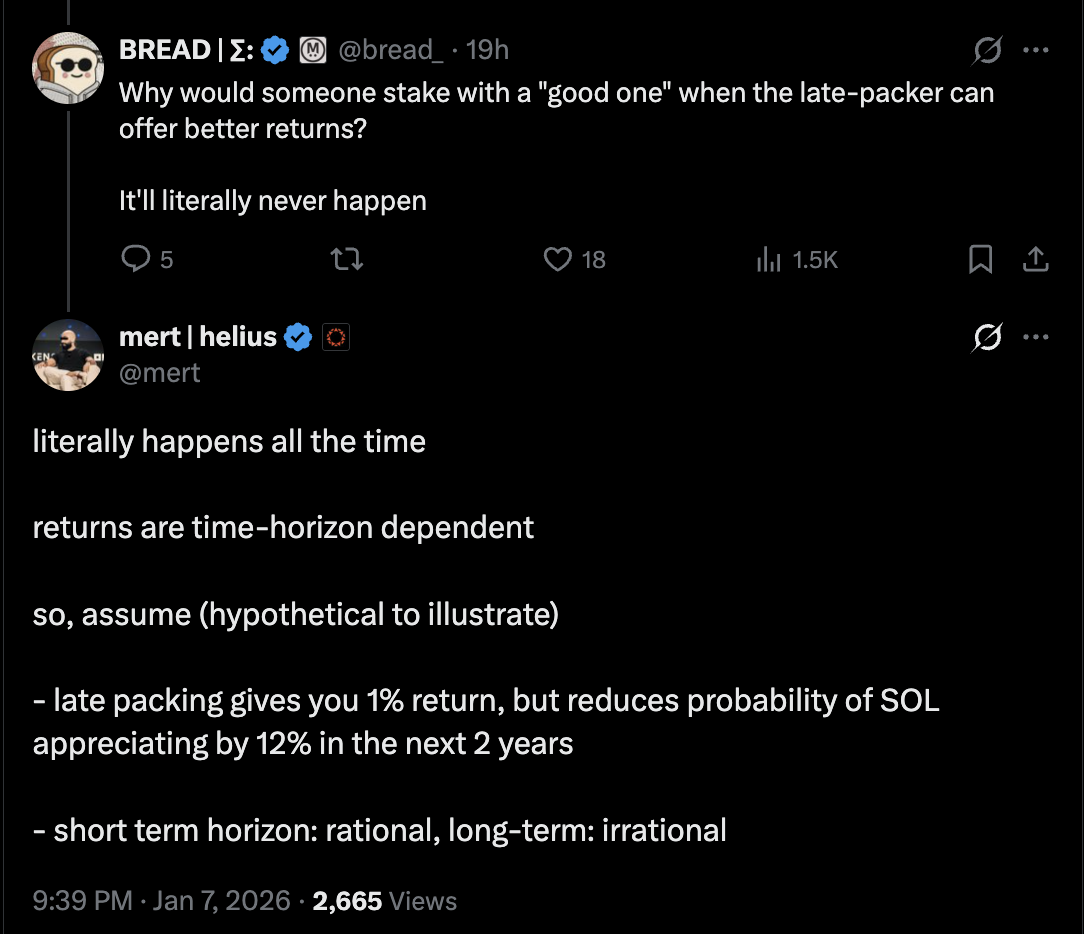
Impartial commentary from network participants outside of Jito and Temporal is, unfortunately, relatively thin. While some ecosystem leaders have insinuated that Jito’s stance is better for Solana long-term, the counter-argument is that increasing performance at the execution layer is the only thing that matters.
Validator Scores are Nothing New
While Jito’s brand awareness, reputation, and market size give them, and their messaging, enormous influence across the Solana ecosystem, the IBRL explorer is hardly the validator gospel.
The Solana community has developed a wealth of third-party resources for measuring validator health, with platforms like Solana Compass and Art3mis Cloud highlighting contentious practices.
Long before Jito launched the IBRL, Solana Compass has been ranking validators using a rubric covering everything from stake concentration, commission, and slot lagging. In some cases, the top-ranked operators on IBRL, like Viking, Quantum Crypto, and EONPool, score terribly on alternative scoring systems.
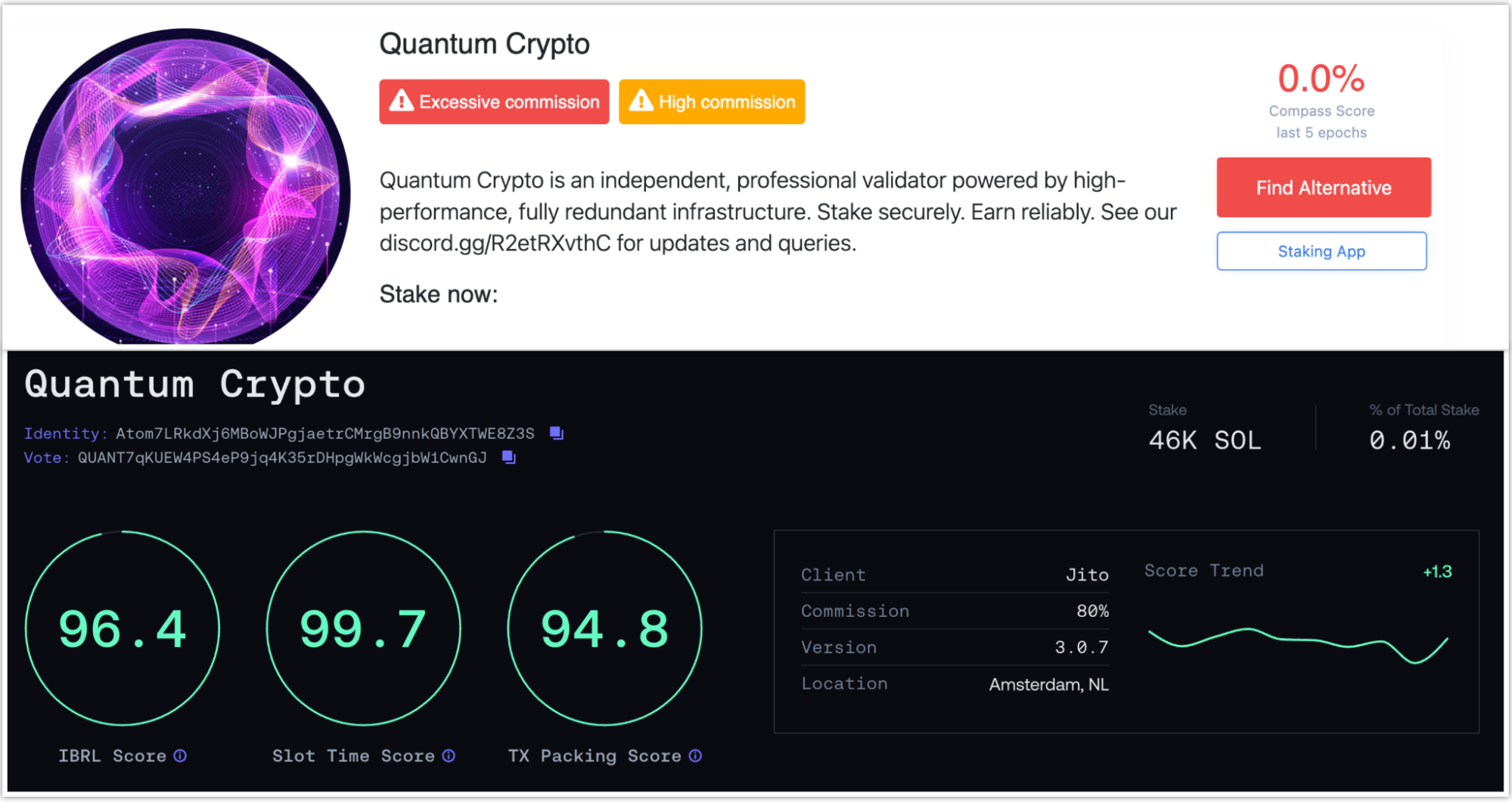
In a blog post accompanying the IBRL explorer launch, Jito acknowledged that “no single score should be treated as a definitive judgment of validator intent or quality”. The scoring methodology will certainly be iterated on over time, though it remains to be seen if the changes made will be forgiving of Harmonic’s execution-optimization block-building techniques.
Which Way, $SOL Staker?
CT can argue forever about what’s philosophically right or wrong. Network participants with a stake of any size can tear their hair out over who has vested interests or biases that shape what ‘healthy block-building’ looks like.
Stakers who feel that they need to pick a side would do well to educate themselves as best they can when allocating $SOL. Delegators seeking objective, third-party opinions should take the time to ask validators why they choose to run various block-building software.
Ultimately, the market will decide what people value. People from all corners of the Solana community would do well to remember that where they allocate their stake represents the culture and outcomes of the network as a whole.
Read More on SolanaFloor
Solana DeFi welcomes a new liquidity paradigm
Manifest Trade Launches Tokenized CLOB Liquidity Positions
Has Solana Betrayed the Crypto Ethos?