
Jito’s Validator Scorecard Shines Light on Solana DATs' Poor Performance
Turns out not all validators are long-term aligned
- Published:
- Edited:
Jito’s new block-building explorer, the playfully named IBRL.wtf, is quietly stoking tensions across Solana’s validator landscape.
Promising to measure the quality and performance of the network’s validators, Jito’s IBRL explorer condenses key validator behaviors into a singular score. Despite all operators claiming to have Solana’s best interests at heart, it seems some validators are prioritizing individual profit over network performance.
Which Solana validator operators are upholding the integrity of the network, what can be done to discourage “harmful” activity, and which protocols are staying true to the IBRL thesis?
DATs Slammed for Low IBRL Scores
In a bid to combat slot lagging and late transaction packing, Jito has unveiled the IBRL block explorer. While timing games, or deliberately slowing block production to boost rewards, were largely present across Solana, Jito’s new explorer shines additional light on yet another harmful practice: late packing.
According to Jito, many validators are turning to late transaction packing as a means of boosting their rewards. Jito argues this hurts Solana as a whole, with late packing ultimately leading to stale, unpredictable state data and degrading network efficiency.
Reviewing the behavioural habits of validators, Jito has boiled operator performance down to a singular metric, which it calls the IBRL score. While Jito admits that the IBRL score is not yet a “definitive assessment of validator quality and intent”, higher scores are widely considered to be a directional signal of good behavior.
Perhaps unsurprisingly, Solana DATs are consistently some of the biggest perpetrators of “harmful” activity. While community favorites like Certora, Solflare, Radiants, and BULK have achieved high IBRL scores of over 95, $SOL treasury vehicles like Forward Industries, Solmate, and Defi Development Corporation rank poorly.
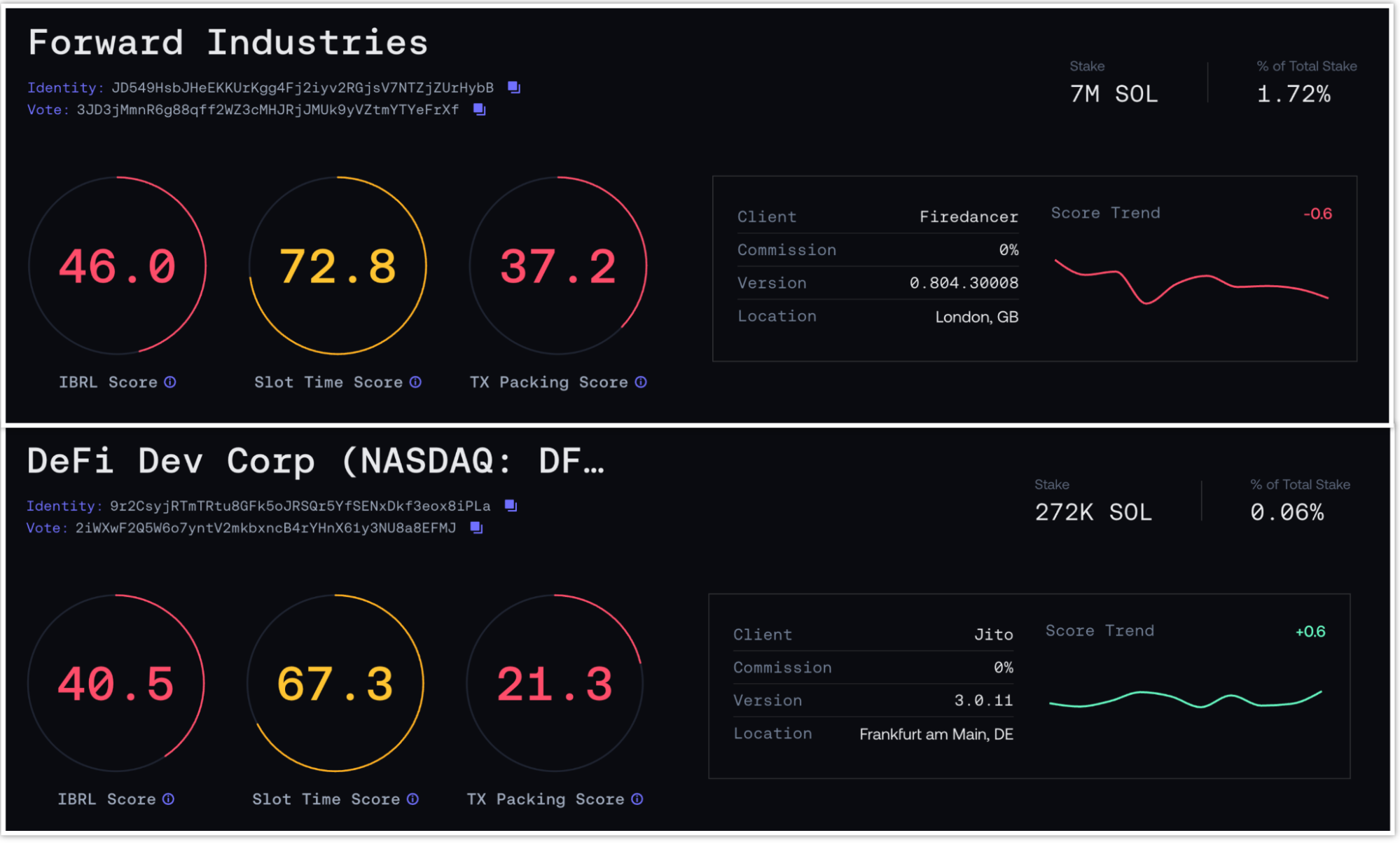
SolanaFloor has engaged all the aforementioned DATs for commentary on the effectiveness of Jito’s IBRL score methodology and whether they planned to address factors contributing to a lower score. At press time, Forward Industries, Solmate, and Defi Development Corporation have declined to comment.
Meanwhile, rival block-builders have struck out against Jito's scoring methodology. Temporal and Harmonic co-founder Ben Coverston argues that Jito's IBRL explorer was created with the express intention of discrediting competitors, promising to outline what Harmonic considers "healthy block-building" in the immediate future.
Jito and Harmonic have shown themselves quick to engage in public sparring on the timeline, with representatives from both companies eager to start public discourse on block-building debates.
Is a Protocol-Level Fix the Only Solution?
Despite widespread agreement that slot lagging and late transaction packing are damaging to the health of the ecosystem, one could argue that they are inevitable until a protocol-level fix is deployed.
Speaking previously with SolanaFloor on slot lagging issues, experts like Sol Strategies CTO Max Kaplan and Phase Labs co-founder Seb Moriarty both agreed that without a hard-coded fix, social pressure remains the only tool available in the fight against anti-IBRL behavior.
Meanwhile, an OG Solana eco developer who wishes to remain anonymous has communicated to SolanaFloor that taking advantage of weaknesses is a critical part of the game theory that forces network resilience to improve and helps Solana succeed long-term.
“Exploiting issues for profit is good for the chain. It's a hole in the game theory and its up to protocol change to fix imo. Exploiting a hole to actually kill the chain is bad. Exploiting holes for legit profit, not breaking rules, is good.” - Anonymous Ecosystem Developer
At the same time, validators seeking maximum rewards can hardly be criticized. Solana’s validator landscape is in a state of aggressive contraction, with the number of operators in rapid decline.
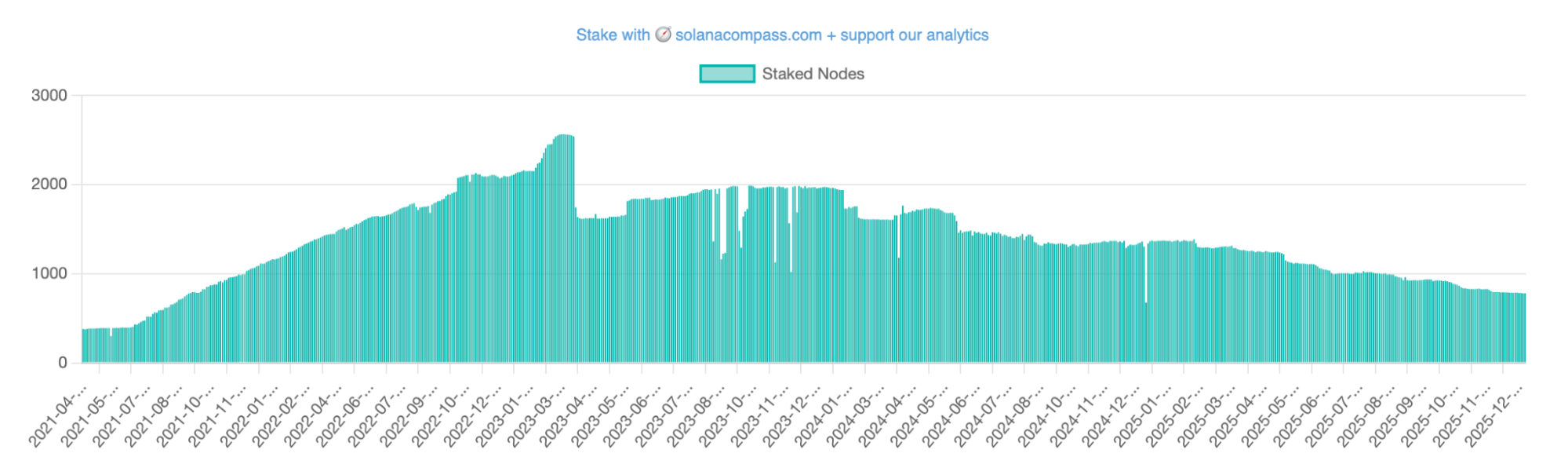
Solana Foundation Executive Director Dan Albert opines that while the network’s dropping validator count is hardly an “existential concern” and represents a shift to “quality over quantity”, independent operators with smaller amounts of stake are having a tough time staying profitable in current conditions.
According to Layer33 founder Nicky Scanz, validators need ~160k $SOL (valued at $22.6M) in stake to break even. Founded by Scanz in the wake of Solana’s growing institutional influence, Layer33 is a validatorship collective designed to ensure that independent operators hold 33% of network stake, preserving Solana’s decentralization and security.
On the other hand, DATs are hardly at risk of being squeezed out of profitability due to low stake, with treasuries like Forward Industries holding over 7M $SOL.
Why Reputable Validators Place Network Health over Profit
At the other end of the spectrum, reputable operators with high IBRL scores are valuing “reliability more than gains”, arguing that “a network is only as good as its participants”.
Certora, a leading blockchain security firm boasting one of Solana’s highest IBRL scores, chose the more difficult and rewarding route when it came to validator operation. Steering clear of the beaten path, Certora opted against using typical validator security and monitoring architecture.
In a recent blog post, Certora Security Researcher and Engineer Giuseppe Cocomazzi outlined how Certora wrote its own monitoring “anti-framework” to avoid compression on its validator machine. In a nod to Unix first principles, Certora’s validator stack is inherently designed to be as small, simple, and streamlined as possible.
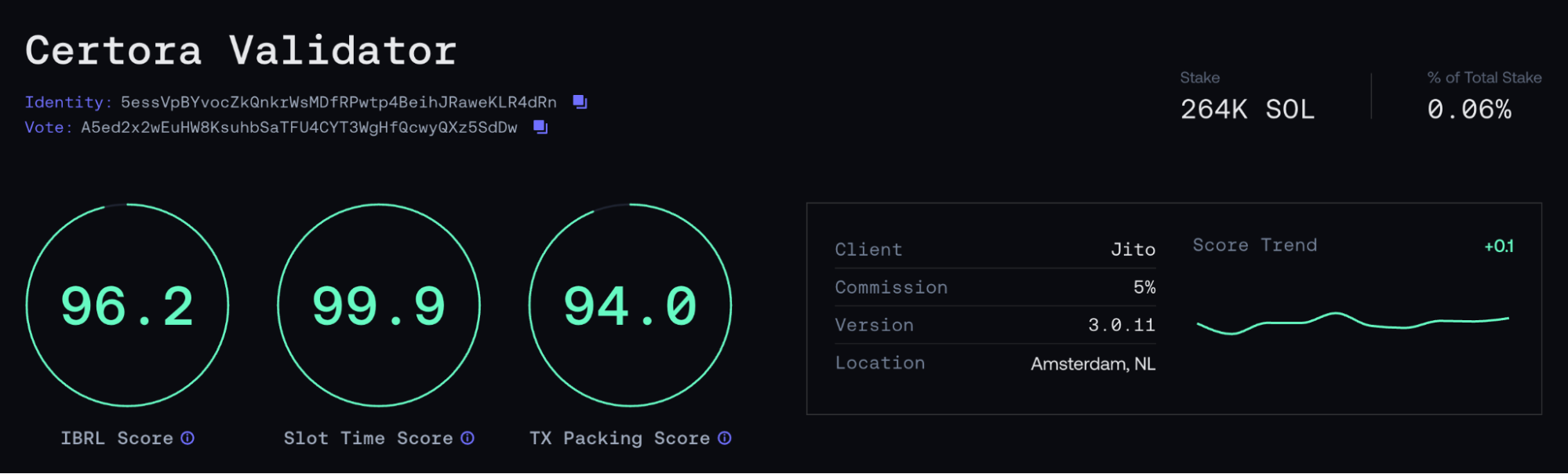
These structural decisions have likely contributed to Certora’s impressive IRBL score, ranking the firm among the network’s top 3% of validators. In an exclusive statement, Certora Seth Hallem outlined why reliable validator operation is so critical to Solana's long-term health.
"Blockchains are full of promise as a transformational technology in the financial industry, but in order to fulfill that promise, security and liveness are must-haves. When we decided to enter the Solana validator network, we wanted to build a reference implementation to lead the network by example in achieving high performance and high availability while maintaining stringent security standards. Our validator's performance shows the strength of our approach, and we hope that our efforts to share our work will encourage others to follow." - Seth Hallem, Certora CEO
Ultimately, Solana’s upcoming Alpenglow update is expected to resolve many of the issues currently threatening the validator landscape. Currently, validators are paying around 1.08 SOL per day in vote transactions that help the network reach consensus.
Under Alpenglow, votes are processed through a separate consensus, with validators paying a configurable Vote Admission Ticket (VAT) per epoch, as opposed to a flat fee (0.000005 SOL) with each transaction.
According to Dan Albert, this new economic model proposes to initially set VATs a ~1.6 $SOL, which will help to reduce operational costs for validators across the network, giving smaller operators some welcome relief.
Read More on SolanaFloor
Are buybacks overrated?
Helium Abolishes Token Buybacks - Will Jupiter Be Next?
Looking Back on Solana’s Biggest Year Ever