
Solana is increasingly competing for a place in global financial market infrastructure, according to a new report from Fidelity Digital Assets titled ‘Solana's Competitive Advantage in Onchain Trading'. Fidelity describes Solana as "an emerging piece of financial market infrastructure."
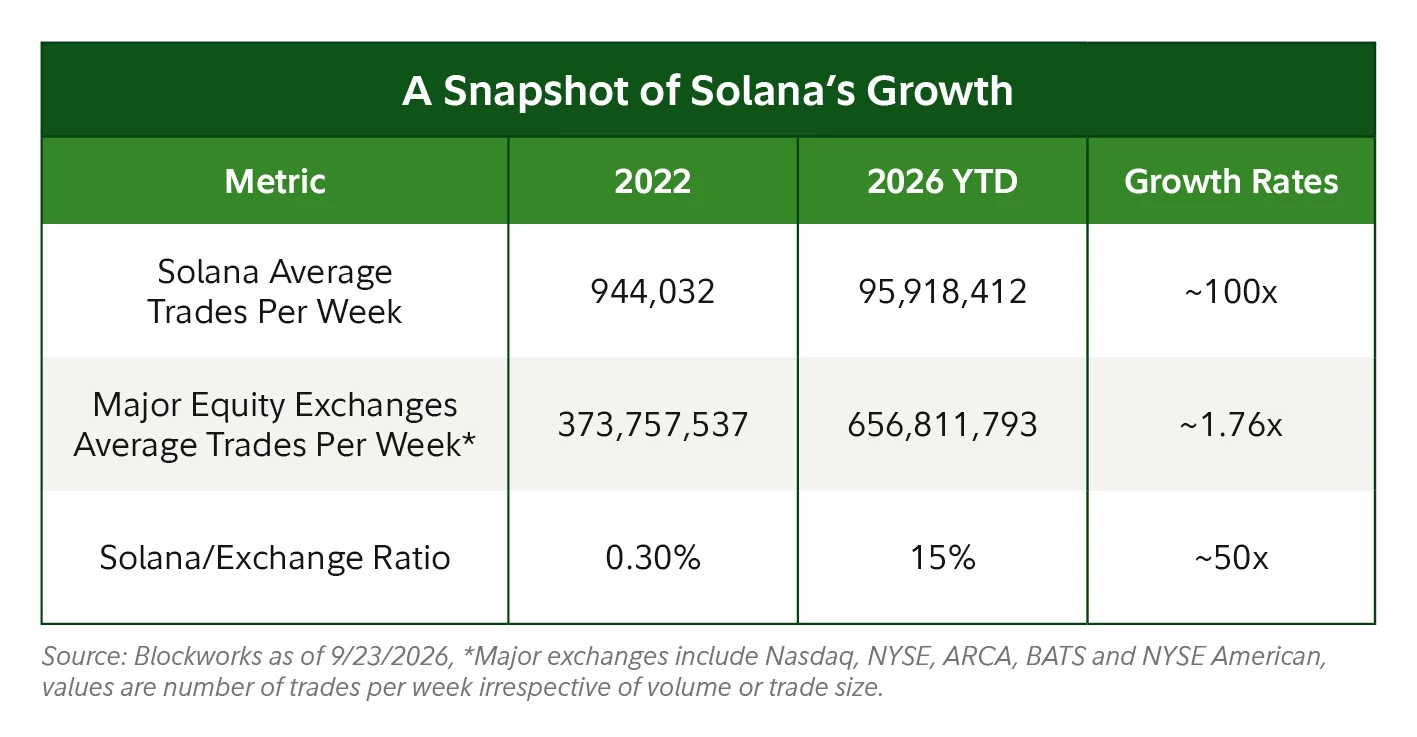
The report highlights the network's rapid growth in trading activity, noting that Solana accounted for approximately 15% of average weekly trades across major US stock exchanges in 2026, up 50x from just 0.30% in 2022, in line with the network’s goal of being the “onchain NASDAQ.”
In late 2026, Solana briefly surpassed the New York Stock Exchange (NYSE) in weekly trade executions.
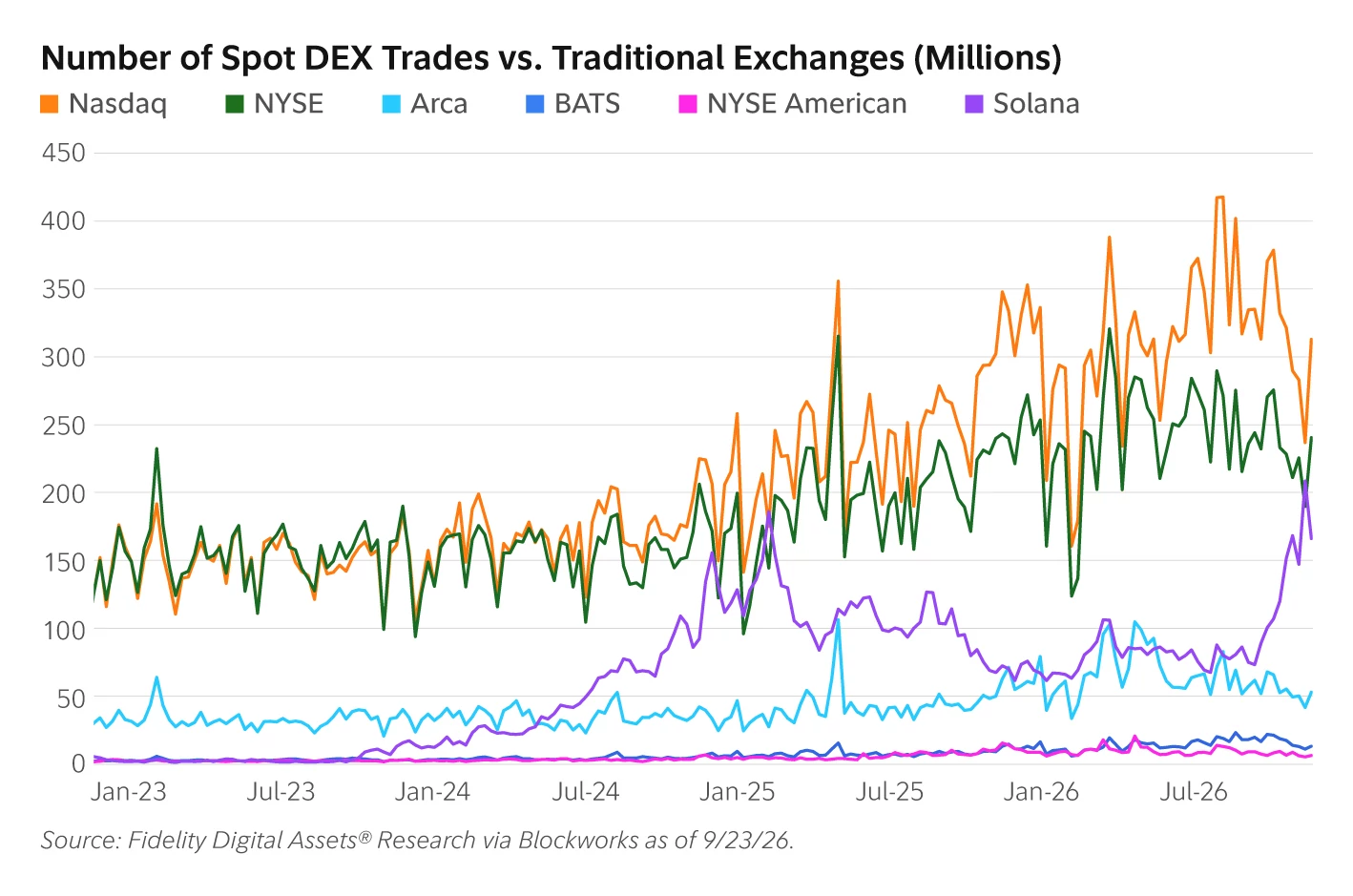
This growth is particularly notable compared with established financial exchanges. Fidelity's data shows that Solana averaged approximately 95.9 million trades per week in 2026, compared with 656.8 million across major equity exchanges, including Nasdaq, NYSE, ARCA, BATS, and NYSE American. Fidelity also highlighted the expansion of Solana's tokenized asset market, where monthly trading volume grew from less than $100 million to nearly $5 billion. Solana’s tokenized equities supply alone reached a new all-time high of $1.28 billion yesterday, November 8th, adding $670 million over the past week.
Network Performance Strengthens Solana's Position
Fidelity identifies execution speed, transaction capacity, and reliability as important factors behind Solana's competitiveness. In October, the network successfully reduced slot times to 200 milliseconds. More consistent block production can reduce execution uncertainty, improve liquidity provision, and create additional trading opportunities.
Solana has also increased its block capacity from 60 million to 100 million compute units, representing a 66% increase. Alpenglow, Solana’s biggest consensus upgrade, went live on October 21, reducing finality from about 13 seconds to 150 milliseconds and introducing efficiency improvements that could support further increases in transaction capacity.
Fidelity also identifies Multiple Concurrent Proposers (MCP) as a potential development for improving transaction inclusion. By allowing geographically distributed proposers to contribute to block construction simultaneously, MCP could reduce the advantages associated with proximity to a single block producer.
Low Fees and Better Liquidity Improve Execution
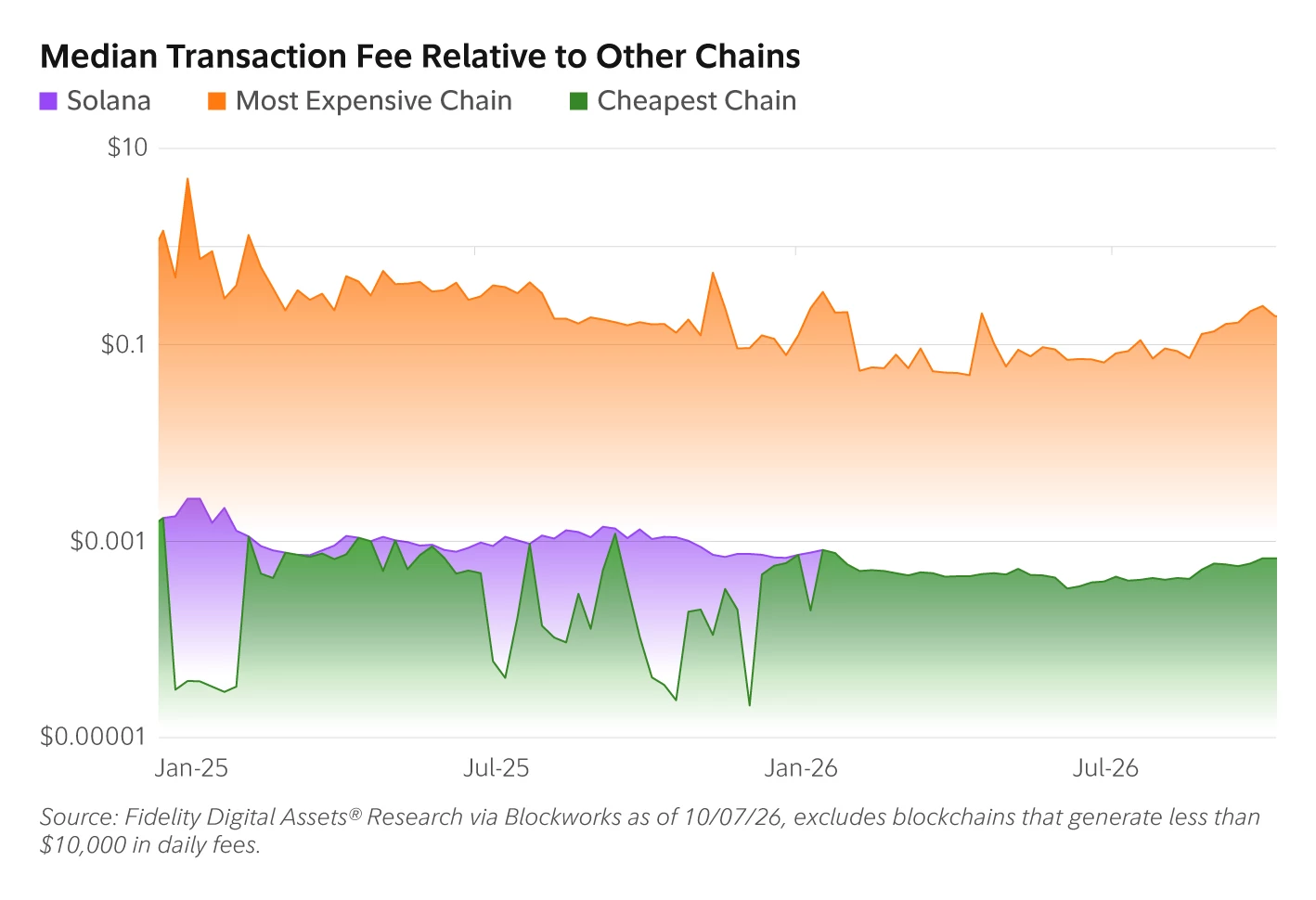
Beyond transaction speed, Fidelity highlights Solana's ability to keep transaction costs low, even during periods of elevated activity. The network combines fixed base fees with optional priority fees, allowing ordinary users to transact cheaply while traders competing for time-sensitive opportunities pay more for execution priority.
The report also identifies prop AMMs as an important development in Solana's trading ecosystem. Unlike conventional liquidity pools, these platforms use professional market makers who actively manage prices and deploy their own capital. This approach can reduce adverse selection, tighten spreads, and improve execution quality for traders.
Tokenized Assets and Perpetual Futures Expand the Market
Fidelity argues that Solana's long-term competitiveness also depends on the range of assets available to trade. Tokenized treasuries, private credit, equities, and commodities are expanding the network's addressable market. Bringing these assets into a shared ecosystem could let participants trade, collateralize, and settle different financial instruments in the same environment.
Perpetual futures provide another source of growth. Solana-based perpetual futures exchanges processed more than $590 billion in notional trading volume over the past 12 months, demonstrating the growing importance of derivatives within the ecosystem.
What Solana's Growth Means for $SOL Holders
Fidelity explains that Solana's value accrual model relies heavily on competition for transaction ordering rather than users competing for limited blockspace. The network generates revenue through base fees, priority fees, Jito tips, and validator vote fees. However, priority fees and Jito tips are more closely tied to trading activity because market makers, arbitrageurs, and other sophisticated traders compete for profitable execution opportunities. This allows Solana to keep transactions inexpensive for everyday users while generating additional revenue from high-value trading activity.
Throughout 2026, the network has remained among the top 5 blockchains by weekly network revenue, according to Blockworks data.
Toly Wants to Double Solana's Market Share
In response to the report that Solana averaged roughly 15% of all exchange trades, Solana co-founder Anatoly Yakovenko responded with a brief challenge: "Let's double it!"

Solana Foundation Chief Strategy Officer Rachel Conlan also welcomed the report, describing its findings as evidence of growing momentum across the ecosystem.
Fidelity's assessment also carries significance given its existing involvement with Solana. In October 2025, the asset manager added $SOL to its trading and custody platforms, making the asset available to retail and institutional clients through Fidelity Crypto, Fidelity Crypto for IRAs, Fidelity Crypto for Wealth Managers, and Fidelity Digital Assets. Fidelity subsequently launched the Fidelity Solana Fund ETF on the NYSE, which now holds more than $182 million in assets under management.
Read More on SolanaFloor
Sanctum Introduces 2-of-3 Multisig Security For Sanctum Wallets Following Incessant Crypto Hacks
Bitcoin Falls Below $76,000 & $SOL Hits $90 as $1.27B Liquidations Wipe Out Post-Election Rally
Is Crypto Dead Again?