Best Crypto Cards for Solana Users in 2026
摘要
Crypto cards let Solana users spend stablecoins and digital assets anywhere debit/credit cards are accepted, with automatic crypto-to-fiat conversion at the point of sale.
The Solana ecosystem now offers a wide range of card options, including cards that spend directly from self-custodied wallets, custodial exchange-linked cards, and crypto-backed credit cards.
Leading providers such as KAST, Jupiter, Solflare, Phantom, MetaMask, and others compete through different combinations of cashback rewards, low fees, self-custody, ATM access, and global availability.
Crypto cards let Solana users spend stablecoins and digital assets anywhere Visa or Mastercard is accepted. These cards work like normal payment cards: at checkout, they instantly convert the required amount of crypto (usually a stablecoin like $USDC) into fiat. This lets you pay with crypto without manual conversion. Modern crypto cards often plug into popular wallets (Apple Pay, Google Pay) and let you shop online or swipe in person.
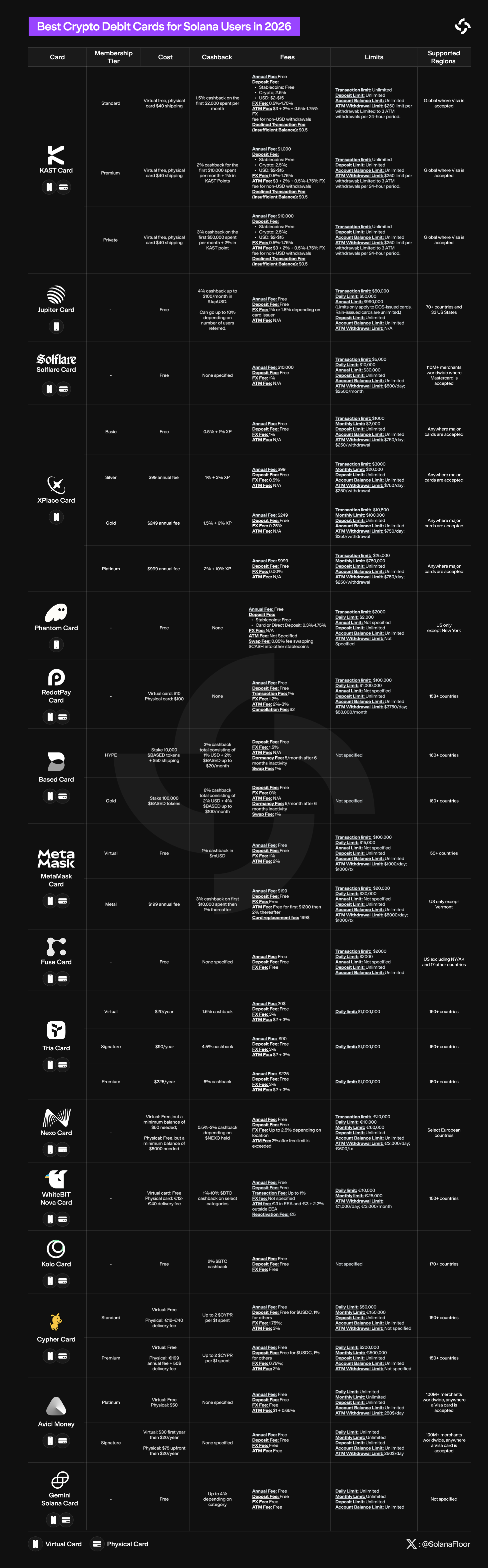
Below, we profile the top crypto cards you can use in 2026:


KAST Card
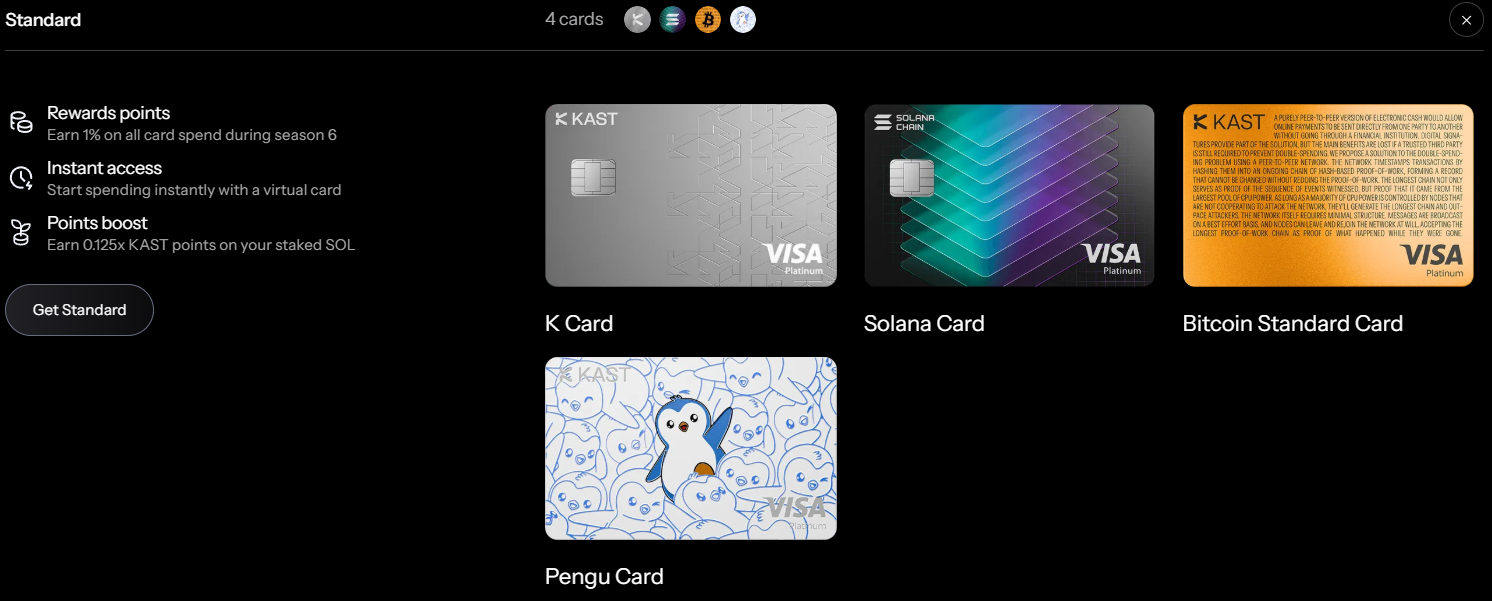
Features: KAST’s Standard Card is a Visa card that draws directly from your KAST wallet balance. It works globally wherever Visa is accepted and comes in different designs. All KAST cards are credit cards, but they behave similarly to debit cards because your spending is limited by your available credit line, which is secured by your deposited balance. The card offers 1.5% in cashback on transactions (up to $2,000/month). You also earn extra points by staking $SOL. You can activate a virtual card immediately and order a physical Visa card as well. Real-time transaction alerts, fraud monitoring, and standard security (PIN, biometrics) keep your account safe. KAST also offers a Premium card and a Private Card, which offer 3% and 5% in cashback/reward points, respectively.

Costs & Fees: KAST keeps fees straightforward. The card has no monthly or annual fee. Virtual cards are free, while physical cards cost $40 to ship. Domestic USD transactions carry 0% fees, but foreign currency transactions incur an FX fee of 0.5%–1.75%. There are no add-on charges for Apple Pay or Google Pay. ATM withdrawals cost $3 plus 2% per withdrawal (for both USD and non-USD withdrawals, with an additional FX fee for foreign currency). All fees and limits are clearly shown in the app before you spend.
Jupiter Card
Features: The Jupiter Card is a Visa debit card backed by $USDC on Solana. You can deposit only $USDC to your non-custodial Jupiter Spend account in the Jupiter app, and it converts 1:1 to USD, so you can spend it. The card is issued by regulated partners (Rain or DCS) for high acceptance and smooth dispute handling. It works wherever Visa is accepted worldwide. All qualifying purchases automatically earn at least 4% cashback (paid in $JupUSD tokens). You can add the card to Apple Pay or Google Pay for contactless payments. Jupiter cards are supported in over 70 countries and 34 US states. Jupiter currently offers virtual cards only, but ATM use is enabled in many regions.
Costs & Fees: There is no annual fee and no deposit fee. Depositing $USDC to the Spending account costs nothing and converts at 1:1. Purchases in USD incur 0% fee. Non-USD purchases incur a 1% FX fee for Rain-issued cards, or 1.8% for DCS-issued cards. ATM withdrawals are not available yet. Spending limits vary: Rain-issued cards have no preset limits, while DCS-issued cards are capped at $50,000/day and ~$990,000/year.
Solflare Card
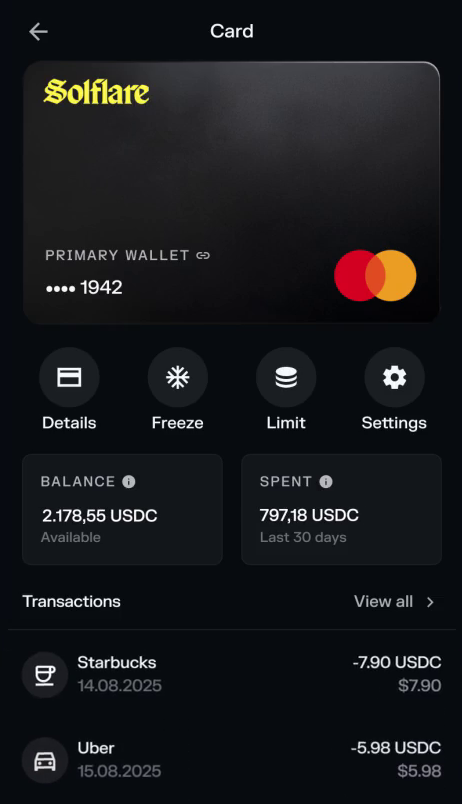
Features: The Solflare Card is a non-custodial Mastercard debit card that spends $USDC directly from your self-custodial Solflare wallet. No top-ups or transfers are needed. Your wallet funds are used at the time of payment, with instant $USDC-to-fiat conversion. It works with 110+ million merchants worldwide and is compatible with Google Pay and Apple Pay. Sign-up is fast with instant KYC, so you can start spending right away. Security features include biometric authentication and 3D Secure on transactions. Only virtual cards are available, with physical cards coming soon.

Costs & Fees: Solflare charges a 1% FX fee for non-USD transactions. The card uses Mastercard’s own exchange rate with no extra markup. Solflare charges no annual fee or top-up fee (since you pay directly from your wallet). ATM withdrawals are allowed wherever Mastercard is accepted; Solflare itself doesn’t charge an ATM fee, though local ATM operators might.
XPlace Card
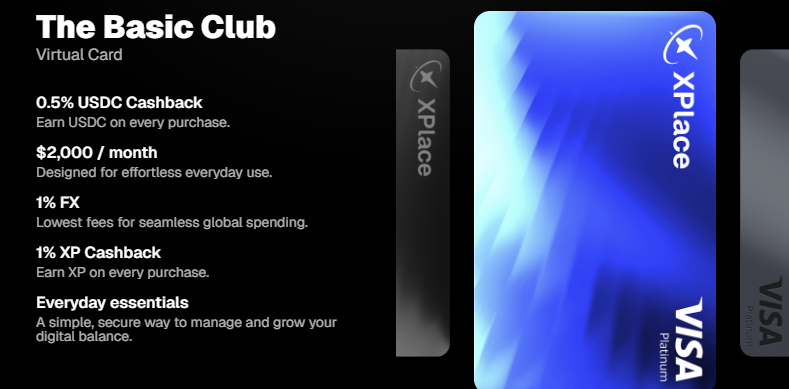
Features: XPlace offers a non-custodial crypto card that lets you spend your digital assets. All balances and transactions are managed through onchain smart contracts and licensed payment partners, ensuring transparency, security, and full ownership. You top up your wallet with any digital asset; when you spend, the smart contract automatically converts the exact amount needed to fiat in real time. It supports Apple Pay and Google Pay for instant payments. Earn 0.5% to 2% cashback on purchases, depending on your membership tier. You also earn yield on your idle crypto in the Savings Hub, and can take out credit lines against it in the Credit Hub. XPlace’s card works anywhere major cards are accepted.

Costs & Fees: XPlace charges annual fees of $10, $200, $1,000, and $5,000 for the Basic, Silver, Gold, and Platinum membership levels, respectively. There are no fees on USD transactions, but a 1% FX fee applies to non-USD transactions. The Basic, Silver, Gold, and Platinum membership tiers have monthly spend limits of $2,000, $10,000, $50,000, and $750,000, respectively, and per-transaction limits of $1,000, $3,000, $10,500, and $25,000, respectively. ATM withdrawals are only available in the US. They are treated as cash advances and do not carry a fee.
Phantom Card
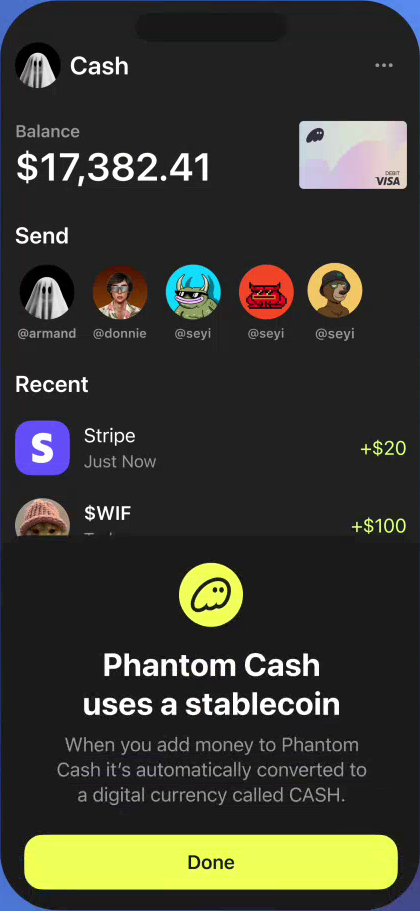
Features: Phantom Cash is a Solana-native payments system built into the Phantom wallet. It provides a USD-pegged stablecoin ($CASH) held onchain in a non-custodial Solana wallet. There’s a virtual card in-app now (physical to come), but it is only available in the US (except NY). Users can top up their $CASH by swapping Solana tokens or linking a bank (US only, not NY). The Phantom Cash Visa debit card lets you spend your $CASH balance anywhere Visa, Apple Pay, or Google Pay is accepted in the US (except NY). Your funds remain in your wallet until you tap to pay. Rewards are offered via interest on unspent $CASH.

Costs & Fees: Phantom doesn’t charge for card issuance or USD transactions. Swapping stablecoins to $CASH is free, but swapping from $CASH into other stablecoins incurs a 0.85% fee. Topping up by debit/credit card or via direct deposit incurs a 0.3%-1.75% fee, depending on the method. Phantom charges no monthly or annual fee on the card.
RedotPay Card
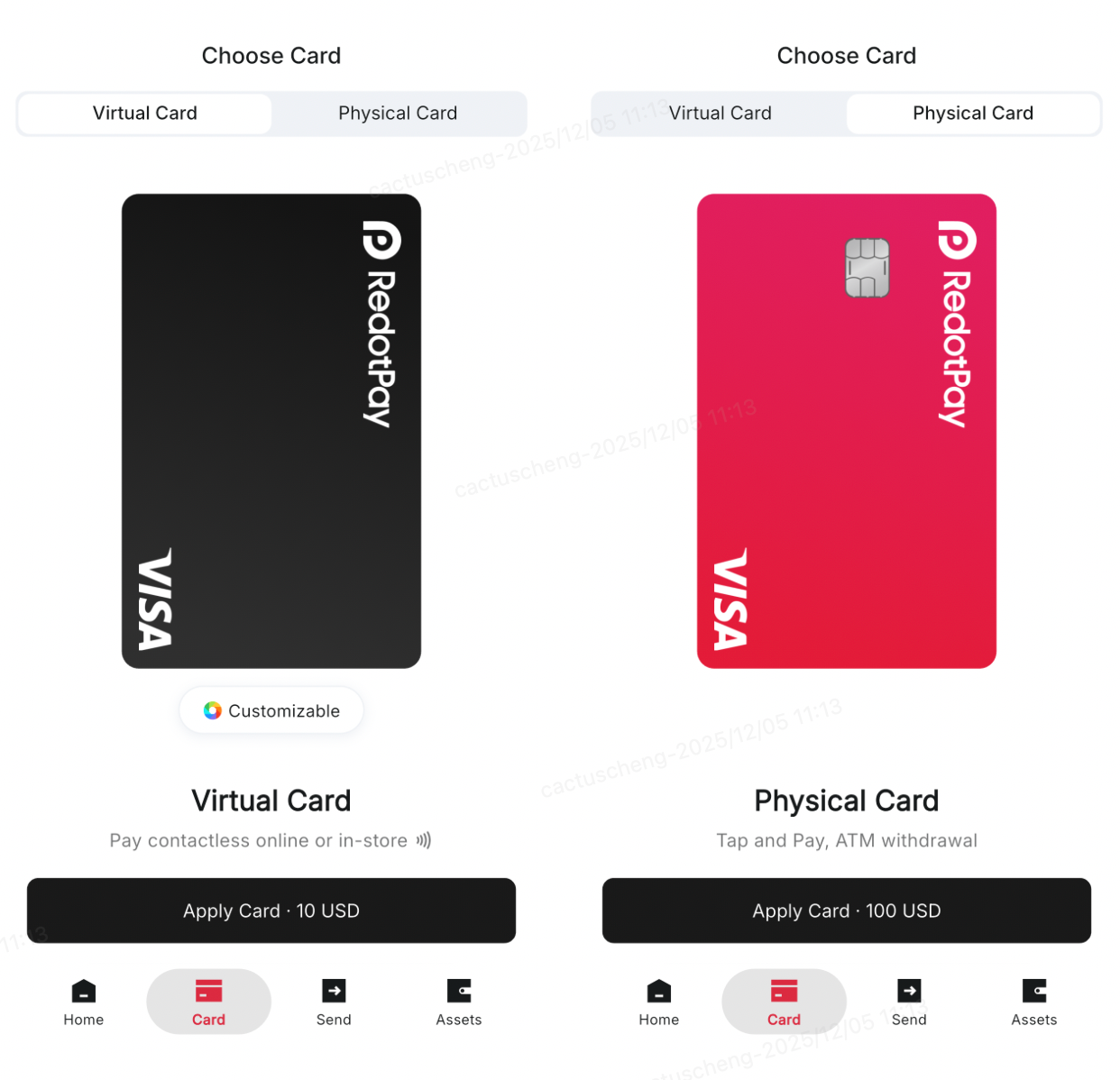
Features: RedotPay’s Crypto Card is a stablecoin-based Visa card for global spending. It supports many tokens ($BTC, $ETH, $SOL, $USDT, $USDC, and others) for payments and deposits. You can create virtual cards instantly or order a physical card. RedotPay works in over 158 countries. The physical card is enabled for ATM withdrawals. The service emphasizes “fast, affordable” transactions and 24/7 customer support.

Costs & Fees: RedotPay does not charge a monthly or annual fee, but it does charge a $10 issuance fee for virtual cards and $100 for physical cards. RedotPay charges a 1% transaction fee and a 1.2% FX fee on non-USD spend. ATM withdrawal fees are 2-3%, and there is a $2 fee for card cancellation. RedotPay cards have a transaction limit of $100,000 and a daily limit of $1,000,000.
Based Card
Features: Based offers self-custodial Visa debit cards that convert crypto to USD for payments. To get a Based Visa card, you have to stake $BASED tokens: 10,000 tokens for the HYPE (plastic) card and 100,000 tokens for the Gold (metal) card. The cards work globally (150M+ merchants in 160+ countries). Both virtual and physical cards are issued, with support for Apple Pay and Google Pay. You fund the card by depositing $USDT or $USDC on Solana. You retain custody of funds in your own wallet. Based Gold card offers 2% USD cashback + 4% crypto cashback (in $BASED), premium lounge access, subscription rebates, and no FX fee. HYPE card offers 3% cashback (1% USD + 2% $BASED) and 1.5% FX fee.

Costs & Fees: Based cards have no signup or annual fee. Top-ups have 0% fee. Non-USD purchases incur a 1.5% FX Fee for HYPE and 0% for Gold. Converting crypto to fiat or vice versa incurs a 1% fee. There is a $5/month dormancy fee after 6 months of inactivity. The Gold card offers 4% cashback, while the HYPE card offers 2%. No card issuance or cancellation fees, and card withdrawals are not yet enabled.
MetaMask Card
Features: The MetaMask Card is a non-custodial Mastercard linked directly to your MetaMask wallet. It lets you spend crypto in real-time anywhere Mastercard is accepted. You can use a free virtual card immediately or request a metal card (US only). It supports Apple Pay and Google Pay for contactless payments. Supported networks include Solana (outside the US), Linea, Monad, Base, and others. Supported tokens include $mUSD, $USDC, and $USDT. There's 1% cashback in $mUSD on all eligible transactions with the virtual card, and 3% on the first $10,000 on the Metal card, then 1% thereafter.
Costs & Fees: MetaMask charges a $199 annual subscription fee for the metal card, but the virtual card is free. There is no FX fee for the metal card, but a 0.5% FX fee applies to the virtual card. ATM withdrawals are limited to $1,000 per day for the virtual card, with a 2% ATM withdrawal fee; $5,000 per day for the metal card, with no ATM withdrawal fee up to $1200 per month, and then a 2% fee thereafter.
Fuse Card
Features: The Fuse Card is a virtual Visa prepaid debit card that spends $USDC from your Fuse mobile wallet. It’s non-custodial and available in the U.S. (excluding NY/AK) and 17 other countries. After KYC (via Bridge), you activate a Fuse Card account and top it up from your Fuse wallet’s $USDC balance. The card is integrated with Apple Pay for tap-to-pay. Daily spending limit defaults to $2,000 (can increase after usage). You can freeze/unfreeze instantly in-app for security.
Costs & Fees: Fuse has no top-up, monthly, or inactivity fees. There are also no FX fees. However, ATM withdrawals are not supported. So effectively, you pay no card fees at all. Just network fees when adding $USDC onchain and Visa’s exchange rate for purchases.
Tria Card
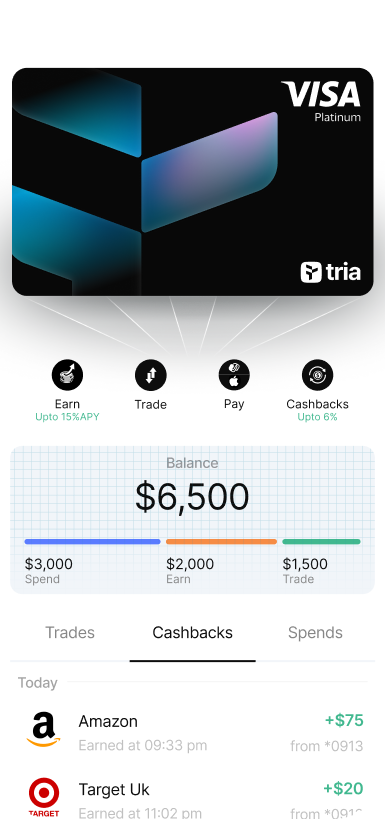
Features: Tria is a self-custodial crypto finance platform that offers Visa cards. You can fund the card with over 1000 tokens across Solana and major EVM chains. The virtual card is instant; a Signature or Premium physical card is available later. The card works in 150+ countries and supports Apple Pay/Google Pay. Tria offers onchain yield (up to 15% APY) and rewards: cardholders earn up to 6% cashback on spending. Other features include in-app cross-chain swaps, onchain staking, and referral rewards linked to card use.

Costs & Fees: The virtual card costs $20/year, the Signature plastic card costs $90/year, and the Premium metal card costs $225/year. Tria does not charge monthly or ATM fees by default. All cards automatically convert on spend. There are also no deposit fees. Tria does not charge an FX fee.
Nexo Card
Features: The Nexo Card is a hybrid crypto debit/credit card issued by Nexo. It can be used anywhere Visa is accepted (150M+ merchants). You switch between “Credit Mode” (borrowing against crypto) and “Debit Mode” (spending crypto directly) with one tap. When you spend crypto in Debit Mode, the card automatically sells your assets at the point of sale. In Credit Mode, your crypto serves as collateral for purchases, and you earn rewards (up to 2% crypto cashback, depending on your loyalty tier) when your portfolio balance exceeds $5,000. Unspent crypto continues to accrue interest on Nexo’s platform. However, the card is currently available to only citizens and residents of select European countries.
Costs & Fees: Nexo charges no annual, monthly, or inactivity fees. All FX transactions incur a 0.2% or 2% fee, depending on the currency spent, plus an additional 0.5% on weekends. Borrowing rates in Credit Mode vary by loyalty tier. Free ATM withdrawal limits range from €200 to €2000, depending on loyalty tier. A 2% fee applies to each subsequent ATM withdrawal after the free ATM withdrawal limit is exceeded. You must deposit at least $50 to activate the virtual card. Unfortunately, physical Nexo cards are temporarily unavailable.
WhiteBIT Nova Card
Features: WhiteBIT Nova is a crypto Visa debit card that supports many coins and stablecoins (including $BTC, $SOL, $USDC, and $USDT). It’s a custodial card tied to your WhiteBIT exchange account. You can spend crypto in 150+ countries where Visa is accepted. The card offers $BTC cashback of up to 10% on select categories of transactions (food, rideshare, subscriptions, etc.). The maximum monthly cashback is €25 and can be withdrawn once you accumulate at least 5 $USDC.
Costs & Fees: Your virtual card is available instantly, while physical cards may take up to 45 business days to arrive due to high demand. Physical card issuance fees vary by delivery method: DHL Standard costs €20, DHL Express costs €40, and standard mail costs €12. WhiteBIT does not charge fees for top-ups, monthly use, cancellation, or inactivity. Reactivating a deactivated card costs €5. Foreign transactions use Visa’s FX rate with no extra markup. ATM withdrawals cost €3 in the EEA and € 3 + 2.2% outside the EEA. Cards have ATM withdrawal limits of €1,000 per day and €3,000 per month.
Kolo Card
Features: The Kolo card is a crypto Visa debit card. It’s non-custodial: you can load multiple tokens across 7 blockchains (including $BTC, $SOL, $USDC) into Kolo and spend them globally. The card works in 170+ countries and is compatible with Apple/Google Pay. Every purchase earns 2% $BTC cashback. Both virtual and physical cards are available (with high withdrawal limits). The Kolo app auto-converts your crypto to USD when you pay, in real time.
Costs & Fees: Kolo advertises the card as free. They do not charge fees for top-ups or usage. Kolo also does not charge an FX fee. ATM cash withdrawals aren’t supported at the moment.
Cypher Card
Features: Cypher Visa card is a non-custodial crypto card that supports over 500+ tokens across 15+ chains (including Solana). It works across 50M+ merchants in 150+ countries. Every purchase earns $CYPR token rewards (up to 2 $CYPR for every $1 spent). The app lets you set spending limits (up to $200k per day) and freeze your card anytime.
Costs & Fees: Cypher’s standard tier is free, though physical cards incur a $50 shipping fee. Cypher’s premium tier has an annual fee of $199 and includes a metal card. Conversion fees are low: premium users load USDC with zero fee and pay “lower FX fees” on non-USD spends. Cypher charges a 0.75% or 1.75% FX fee, depending on your tier. There are no monthly or inactivity fees. ATM withdrawals have a 3% or 2% fee, depending on tier.
Avici Money
Features: Avici Money offers a Visa credit card that lets you spend crypto collateral as fiat. It’s not a debit card (it gives you a dollar credit line secured by your crypto). Avici’s cards are non-custodial, meaning you keep your keys. Avici uses a Rain-issued Visa card that can be added to Apple Pay or Google Pay. You fund a secured contract with $USDC, and Avici creates a matching USD credit balance. When you pay, it deducts from your credit balance and later liquidates $USDC to settle the payment.

Costs & Fees: Avici currently issues two tiers. The Platinum tier includes a free virtual card for new users, with additional virtual cards costing $10 as a one-time fee, and a physical card available for a $50 one time charge. The Signature tier carries a more premium positioning, with a virtual card priced at $30 for the first year and $20 annually thereafter, while the physical card costs $75 upfront with a $20 annual fee starting from the second year. Both physical card options ship with free, untracked delivery and typically arrive within 3 to 4 weeks. Transaction fees on the card are $0, and Forex markups are 1% for cross-border deals. The Platinum tier incurs a $1 + 0.65% fee per ATM withdrawal, while withdrawals are free for the Signature tier.
Gemini Solana Card
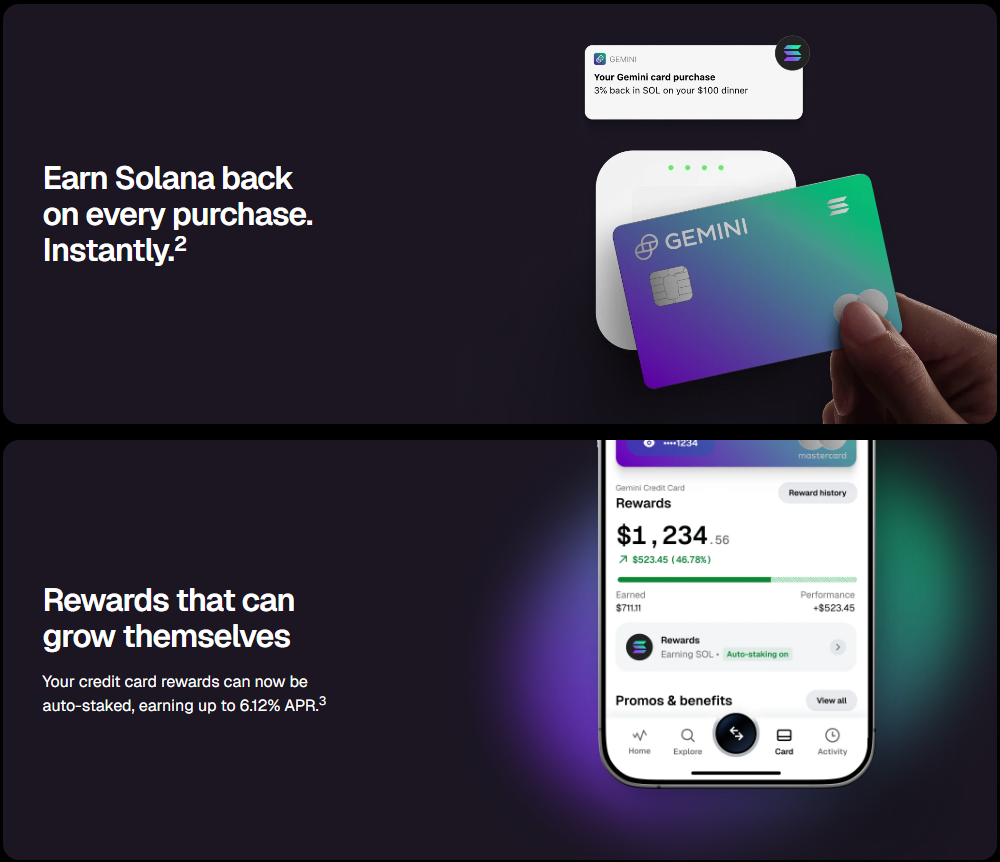
Features: The Gemini Solana Card is a credit card (Mastercard) that pays rewards in crypto. Although not a debit card, it merits mention for Solana fans. It lets you earn $SOL on purchases: 4% back in Solana on designated categories (gas, EV, rideshare), 3% on dining, 2% on groceries, 1% otherwise. Rewards are auto-staked, potentially earning up to 6% APR on held $SOL. The card is a Mastercard World Elite and integrates with budgeting apps. Note: You must use Gemini’s exchange account to hold and withdraw these rewards.

Costs & Fees: There is no annual fee and no FX fee. It functions like a normal credit card, so you need to pay the balance each month to avoid interest charges. Its standout is the high crypto cashback on categories popular with Solana users.
What Card Should You Choose?
Each of the cards above lets you spend Solana ecosystem assets in the real world. They vary by custody model, supported coins, reward rates, and fees. Compare card fees, supported assets, and rewards to find the best fit. All the cards above let you spend your crypto effortlessly, just be sure to check any foreign exchange or ATM fees before use.
Looking for more ways to make the most of your crypto beyond everyday spending? Lending and borrowing can help you put idle funds to work and access liquidity without selling your holdings. Whether you're interested in earning yield by lending assets or using your crypto as collateral for a loan, our Lending and Borrowing with Crypto Guide covers the fundamentals, key risks, and best practices to help you get started.