Solana Q3 Report: DeFi Bounces Back
Tokenization and RWA-Fi reign supreme, while network updates boost Solana’s scalability to unprecedented levels
- Published:
- Edited:
$SOL is back over $100, onchain activity is at all time highs, and the dawn of a new crypto bull market is starting to creep over the horizon.
Looking back, Q3 2026 was evidently a turning point for the crypto economy, punctuated by speculative social trading, creative RWA-Fi, perpetual trading flows, and wealth of fundamental improvements to Solana’s architecture.
What are the defining metrics powering Solana’s new trajectory?
Quarterly Tokenized Asset Trading Up 498% Since Q3 2025
Everyone from Blackrock’s Larry Fink to SEC Chair Paul Atkins is bullish on tokenization. But while the supply of tokenized assets on Solana has been steadily rising since 2025, Q3 2026 was undoubtedly a breakout moment for the sector.
Challenged by explosive volumes in meme/stock pairings on BNB and Robinhood, Solana’s innate competitive spirit fought back hard against its rivals. With Stonk enabling custom asset pairings, tokenized asset trading roared across Solana DeFi. Memecoins like $SI, $ALLINU, and $GP drove millions in trading volume through equities and commodities like $NVDAx, $DKNG, and $GLDX.
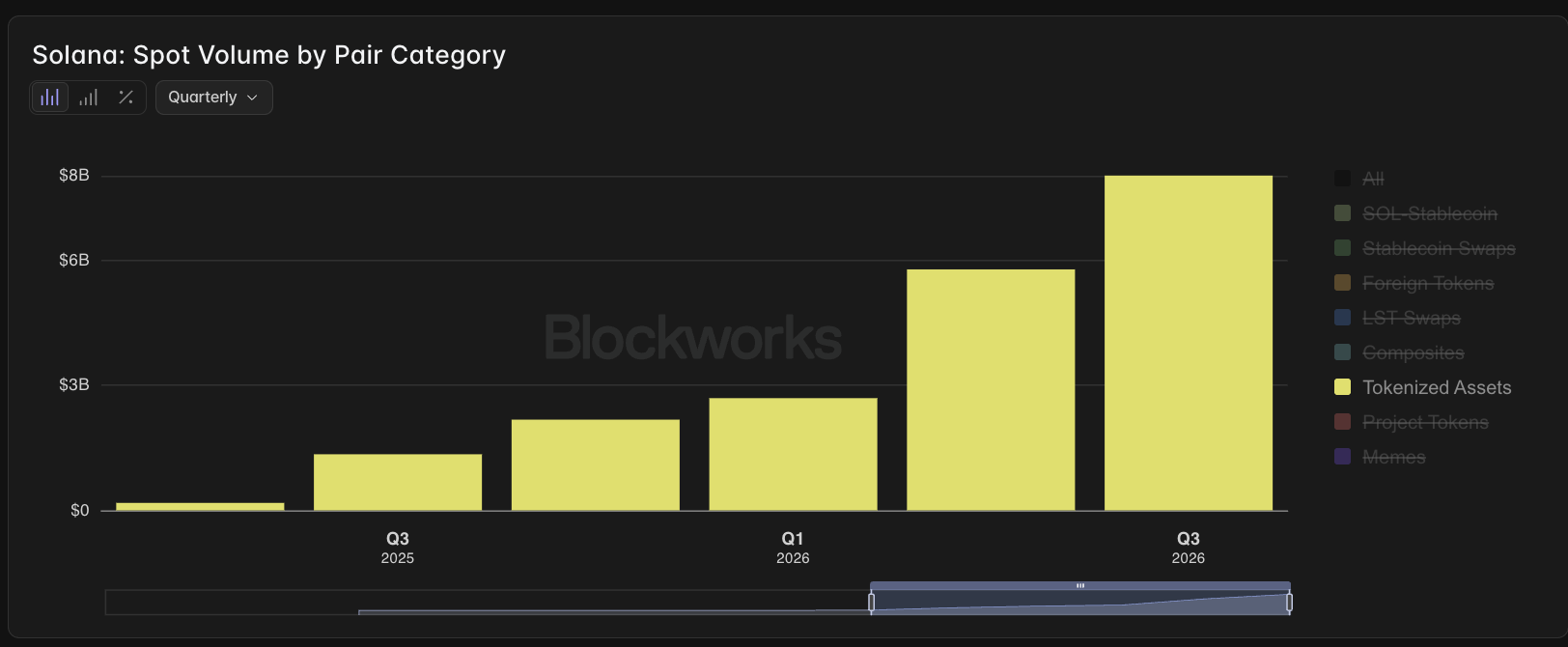
Driven by newfound speculative interest in meme/stock pairs, Solana’s tokenized asset trading volume rose 38.8% from Q2 to Q3. Zooming out, the growth trajectory is even more pronounced, with quarterly tokenized asset volume up 498% when compared with Q3 2025.
Naturally, surging volumes across tokenized assets in general has resulted in new quarterly all-time highs for both equities and commodities. xStocks, Solana’s first tokenized equities issuer, has solidified its position as the network’s leading provider, commanding 51% of quarterly market share in commodities.
Despite growing popularity for Backpack-issued securities, xStocks narrowly edged out the new challenger, retaining 48% quarterly market share over Backpack’s 46%.
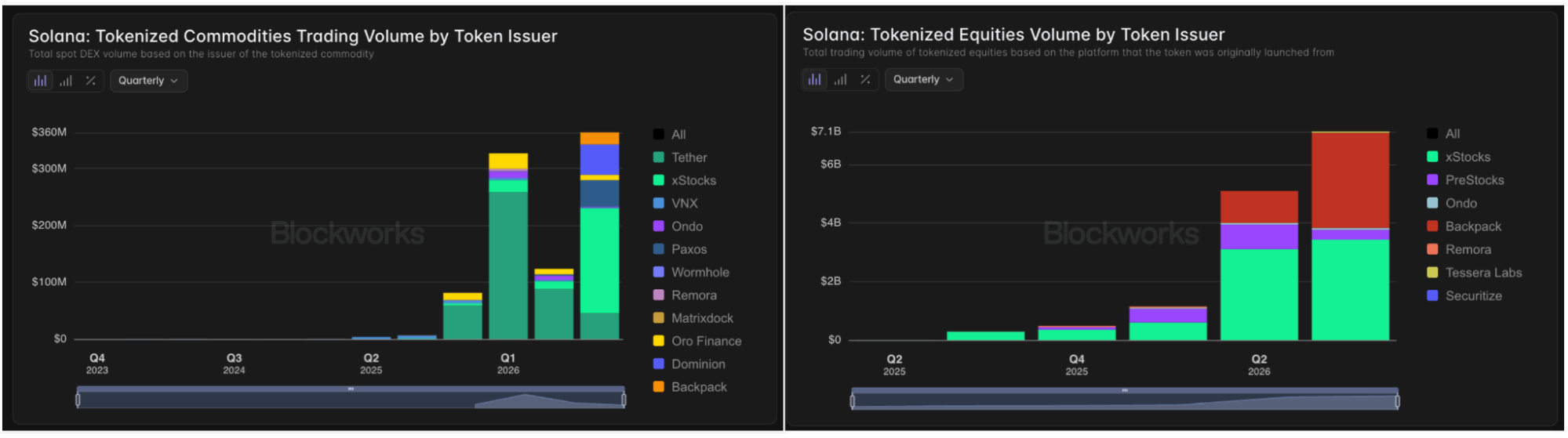
Despite Backpack’s explosive volume, xStocks boasts the largest supply and deepest liquidity of all tokenized equity and commodity issuers. Onchain data implies xStocks-issued equities make up 75% of Solana’s supply, with 8 of the network’s deepest equity liquidity pools holding xStocks assets.
Memes Return, DFlow Boosted by Social Trading
Memes are back in vogue. Whether it was $ANSEM sparking the first $400M onchain runner the trenches have seen in over a year, or social trading on apps like fomo reimagining the dynamics of the game, memecoins have witnessed their strongest flows since Q3 2025. To put that in perspective, $SOL was over $200 at the time.
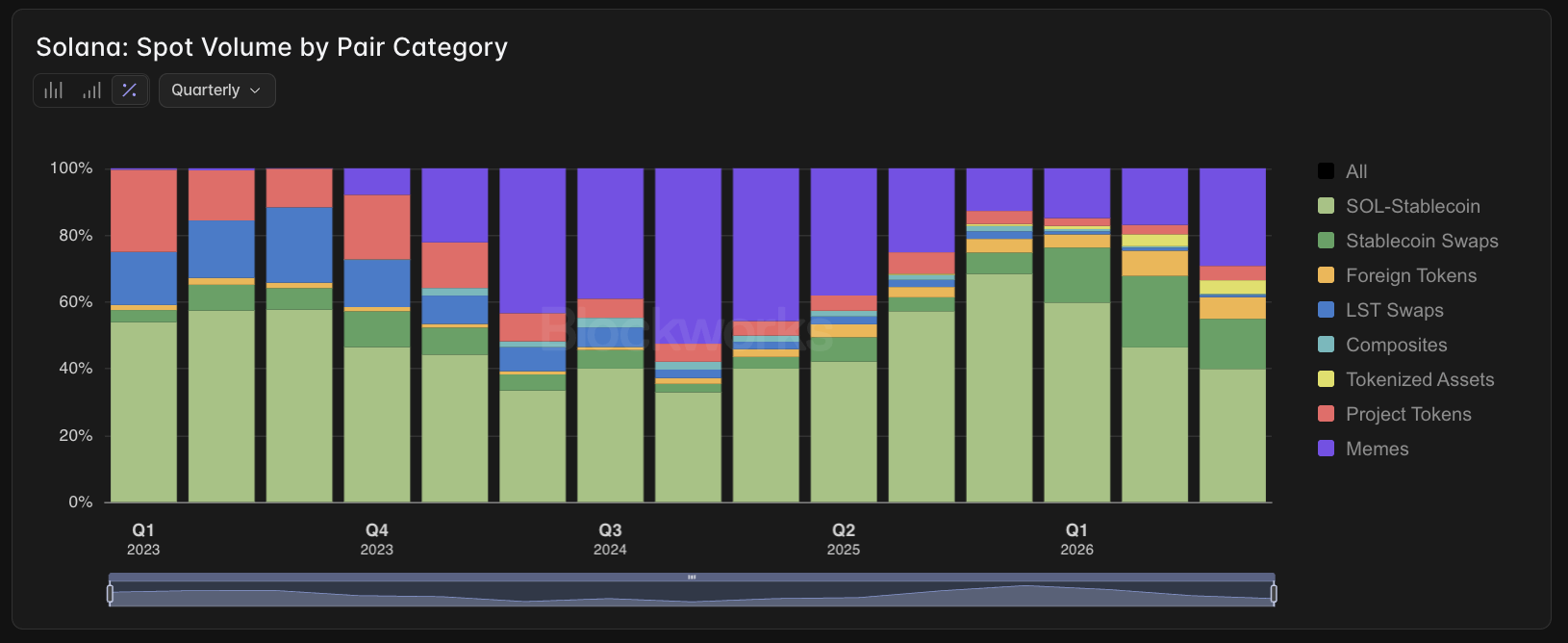
Memecoin volume hit over $57.6B in Q3 2026, representing 29% of all DeFi trading volume and flipping stablecoin swaps for the first time all year.
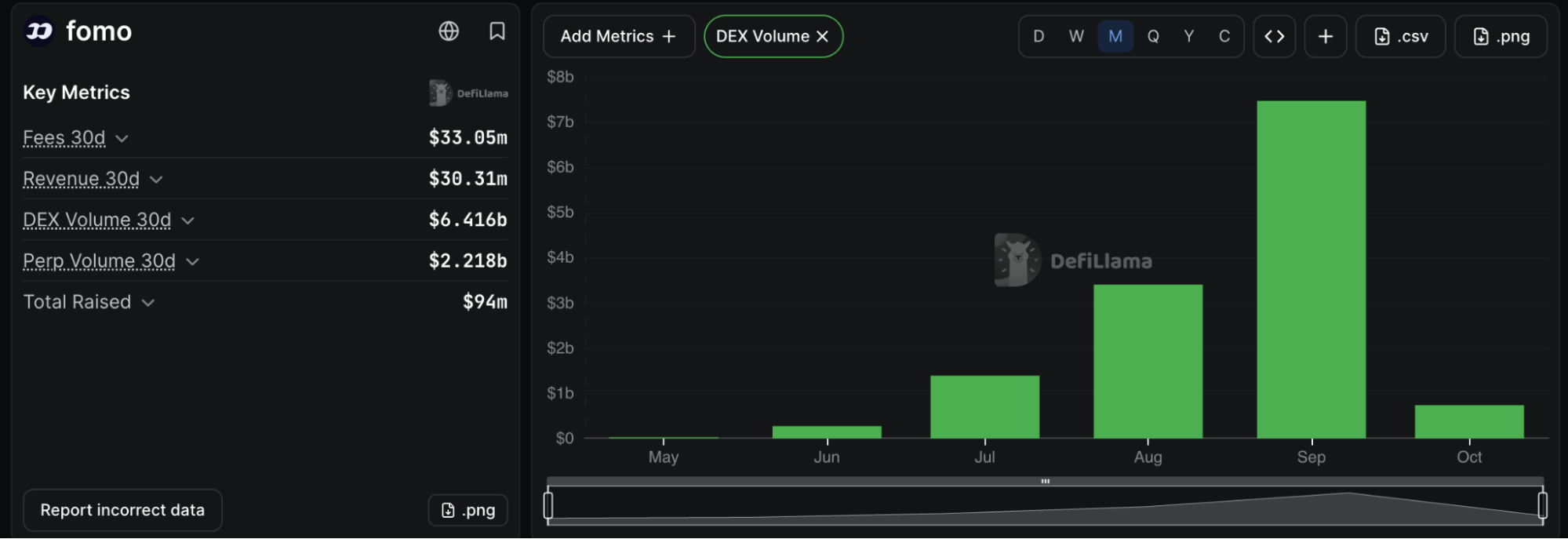
Social trading apps like fomo enjoyed explosive growth throughout Q3, attracting a self-reported 3M lifetime users with an estimated 105k+ traders placing logging activity every day. But beyond changing the way many people are trading, fomo’s success is having a direct impact on Solana’s underlying aggregator race.
Fomo, and other emerging trading venues like JTX, routes its Solana-based trades primarily through DFlow. With traders flocking to these trading platforms, DFlow’s footprint and influence in Solana DEX markets is rapidly expanding.
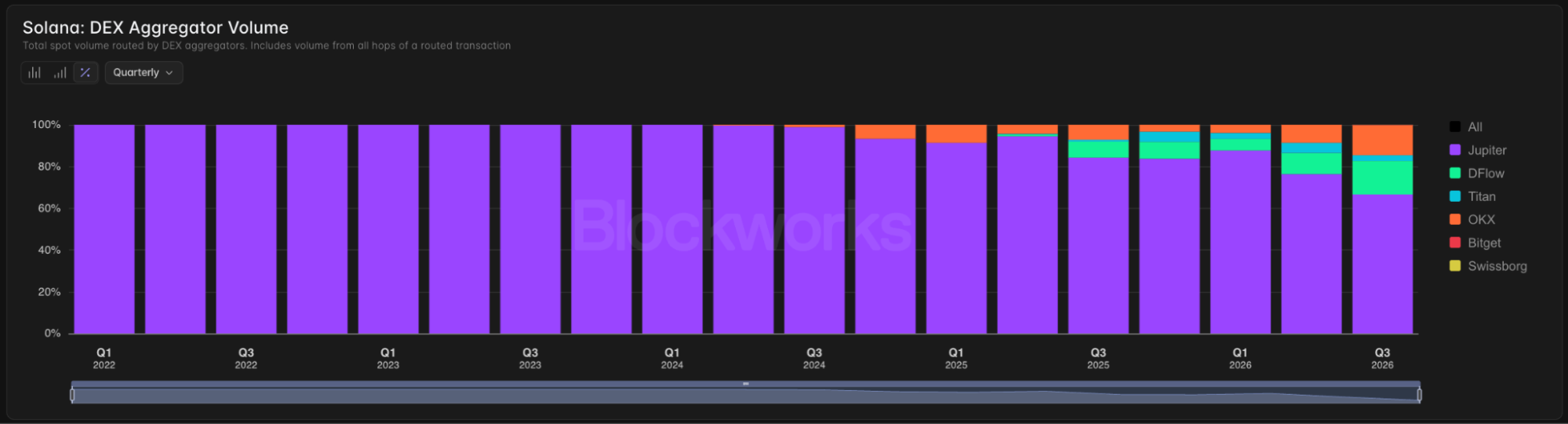
After capturing single digit market share for much of its lifespan, DFlow now processes 16% of Solana’s quarterly aggregator volume. Admittedly, 16% doesn’t sound consequential at face value, but one could argue the quarterly figures don’t accurately represent the platform’s trajectory. DFlow’s weekly market share currently sits at 24%, pushing as high as 34% on a daily basis.
Jupiter remains the kingpin of Solana’s aggregator race, maintaining its firm grip on the sector and capturing 67% of all volume. While still firmly in the lead, Q3 marked Jupiter’s lowest historical share of quarterly volume.
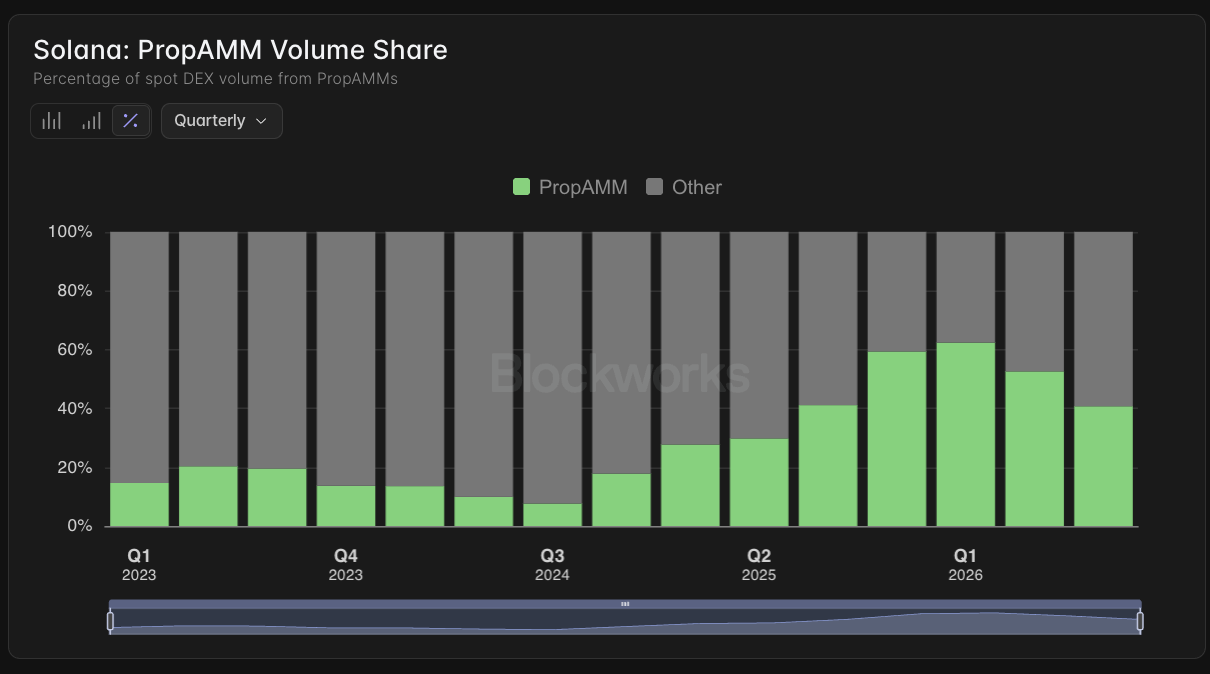
With memecoins returning to the forefront of Solana’s onchain markets, the chain’s prop AMMs are now taking a backseat. While offering superior price execution on larger assets, like $SOL, pAMMs simply cannot quote the diversity and dynamism of a thriving memecoin economy.
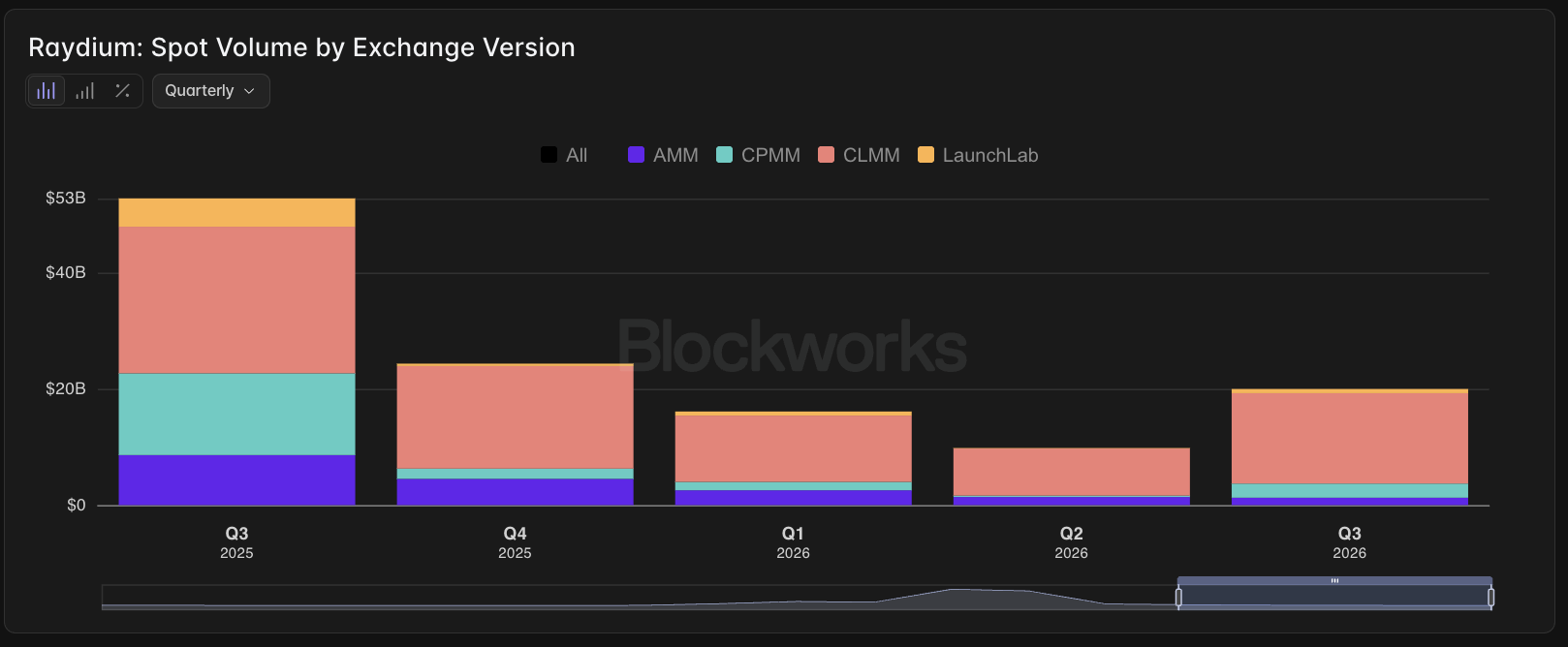
Traditional, passive AMMs are simply far better suited to provisioning liquidity for an unlimited range of long-tail assets. From Q2 to Q3, liquidity across Raydium pools climbed 29% from $410M to $532M, while quarterly trading volume rose by 102%. Tokenized asset trading volume exploded on the platform, and now represents an estimated 46% of protocol revenue.
Transactions Hit ATH as App Revenue, DeFi TVL Bounce Back
No one told $SOL price, but Solana is in an onchain bull run. Quarterly activity is at an all-time high, with over 14B transactions pushed through the network in the last three months.
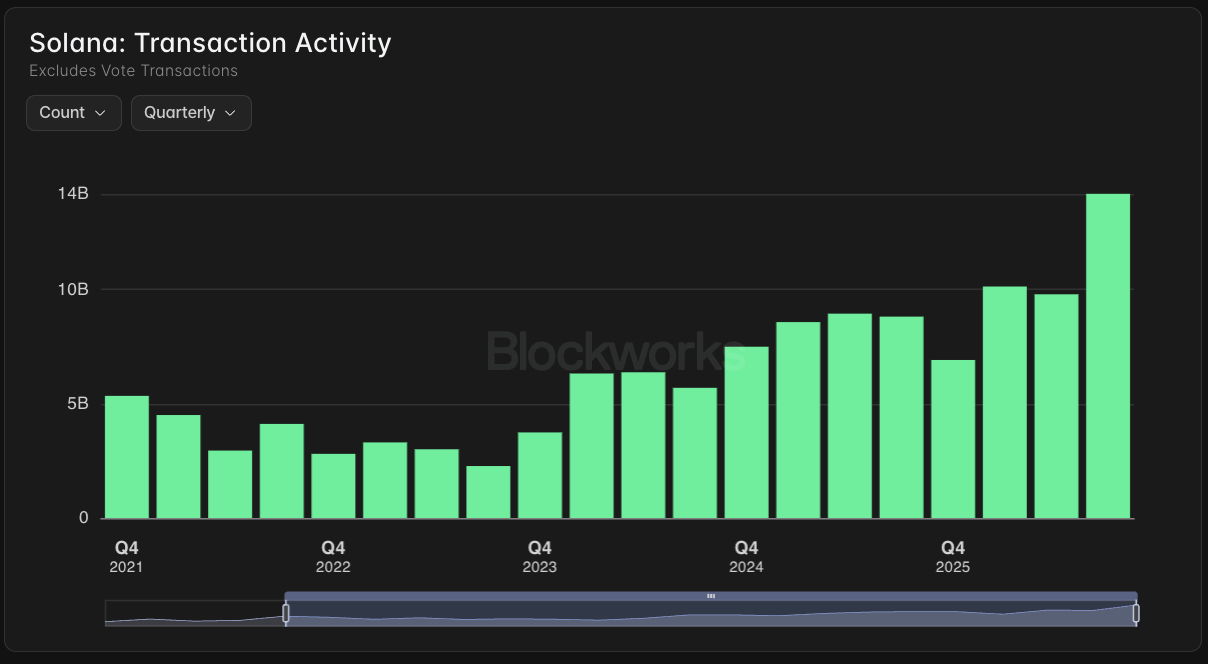
Led by speculative trading activity and a decidedly risk-on environment, Solana application revenue has roared back to its highest point since September 2025, a time when $SOL peaked at around $250.
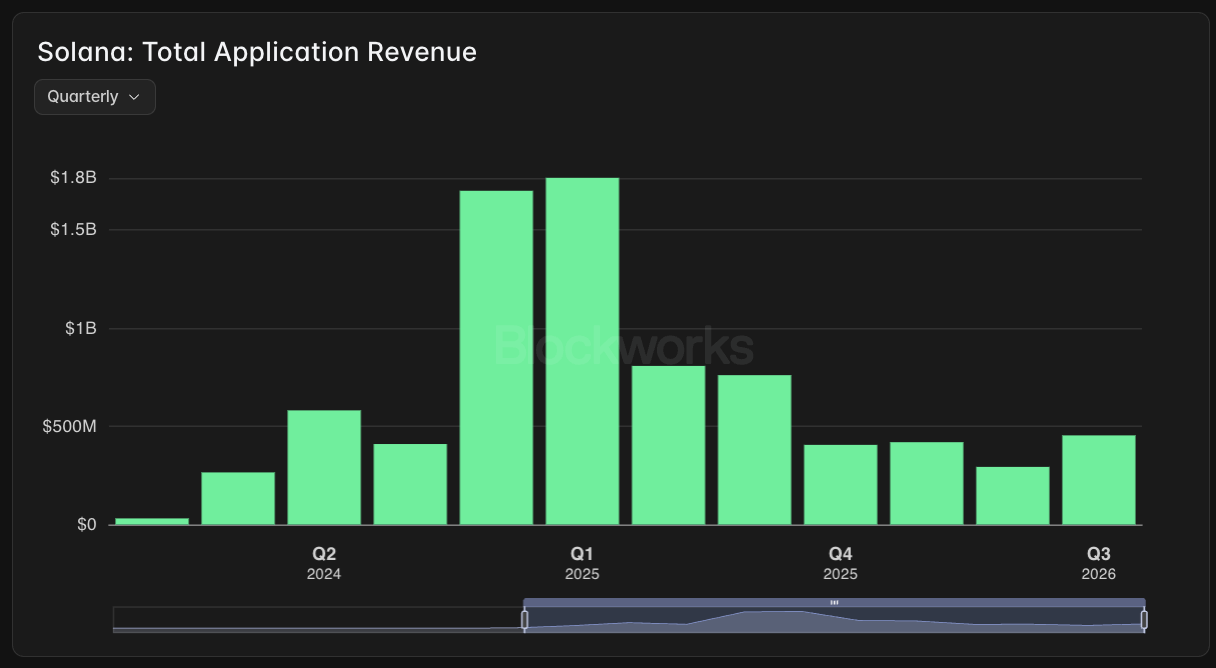
By the numbers, this suggests that activity and applications are more productive than they were at the height of 2025, while prices in larger assets like $SOL are still lagging.
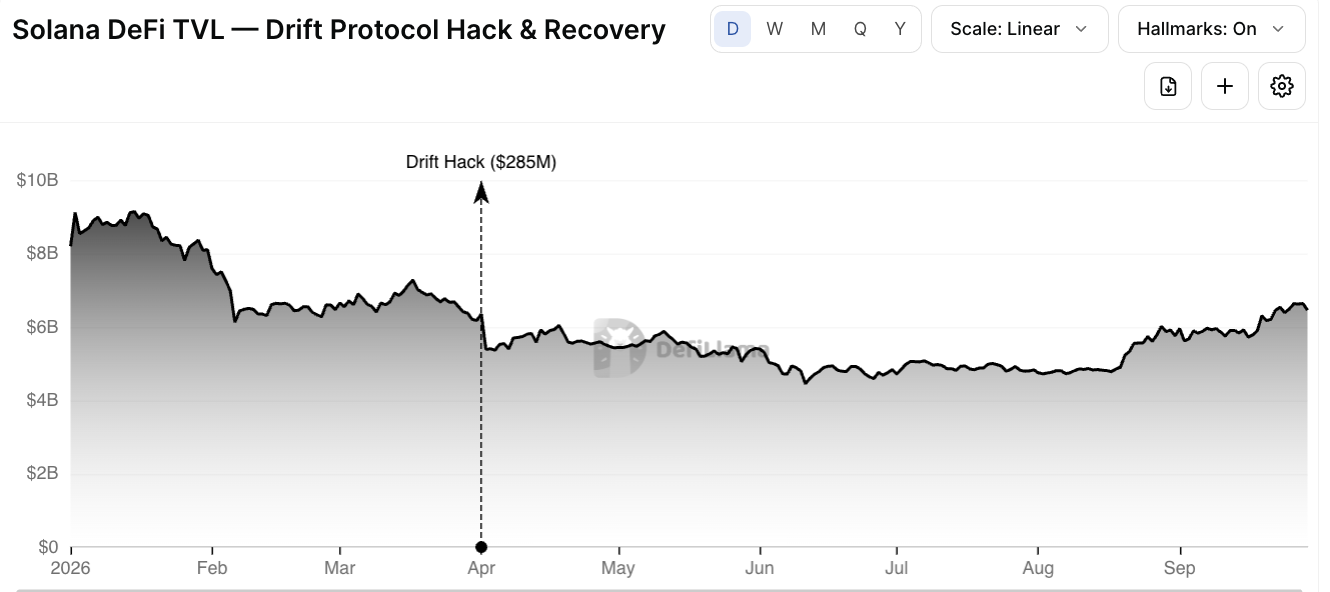
Meanwhile, DeFi TVL is once again trending upwards. Buoyed by bullish price action across many assets Solana TVL has returned to pre-Drift hack levels, with over $6.57B committed to DeFi on the network.
Despite Declining Perps Volume, Open Interest is Rising
In most respects, Solana DeFi is thriving. Spot markets are witnessing steady growth from Q2, TVL is on the rise, and tokenization is continuing its relentless drive to a $5B total market size. But while spot activity is constructive and encouraging, Solana’s perps sector has suffered a slight decline in notional volume.
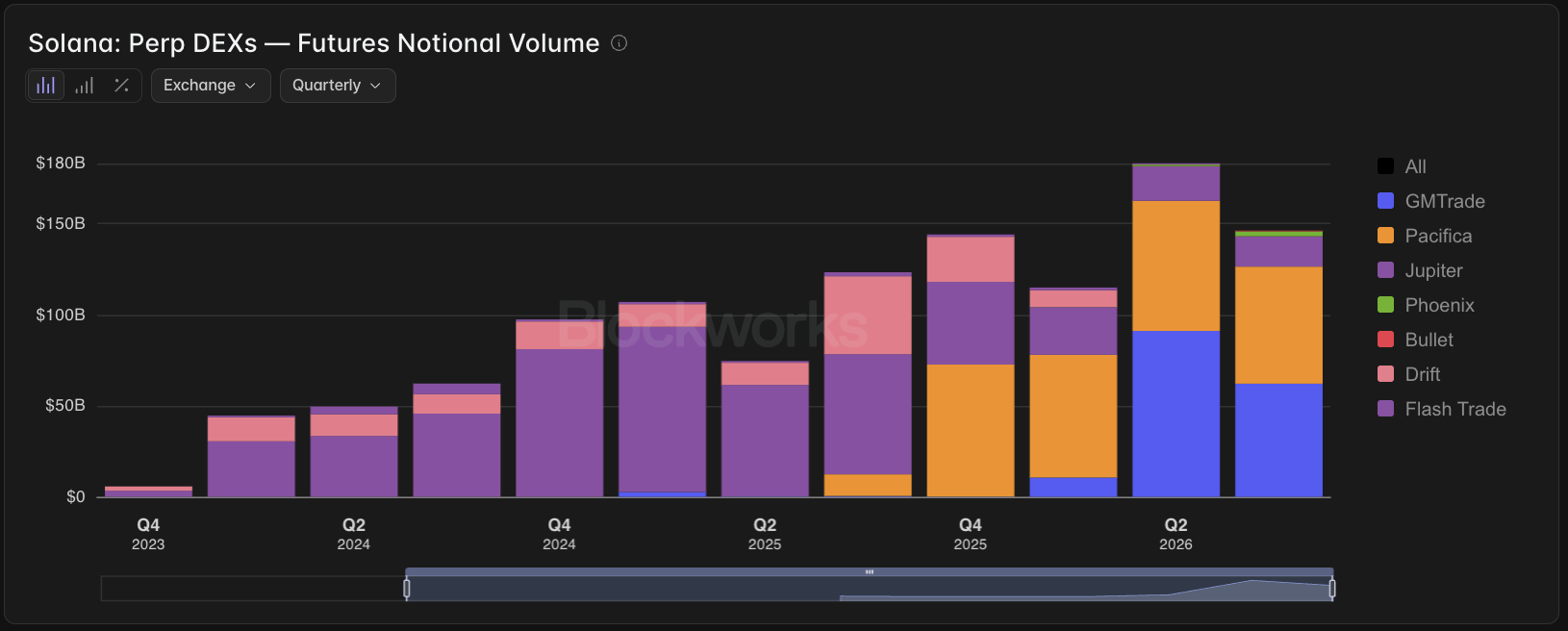
Solana perps venues collectively executed $146.1B in notional trading volume in Q3, down 20.2% from Q2’s $183.1B. Pacifica and GMTrade ranked highest among Solana’s growing list of perpetual futures DEXs, though both these venues are currently running incentive campaigns, which may be inflating activity.
While on paper, declining volumes could be perceived as a bearish indicator for Solana’s perps race, other metrics suggest activity is simply becoming more organic.
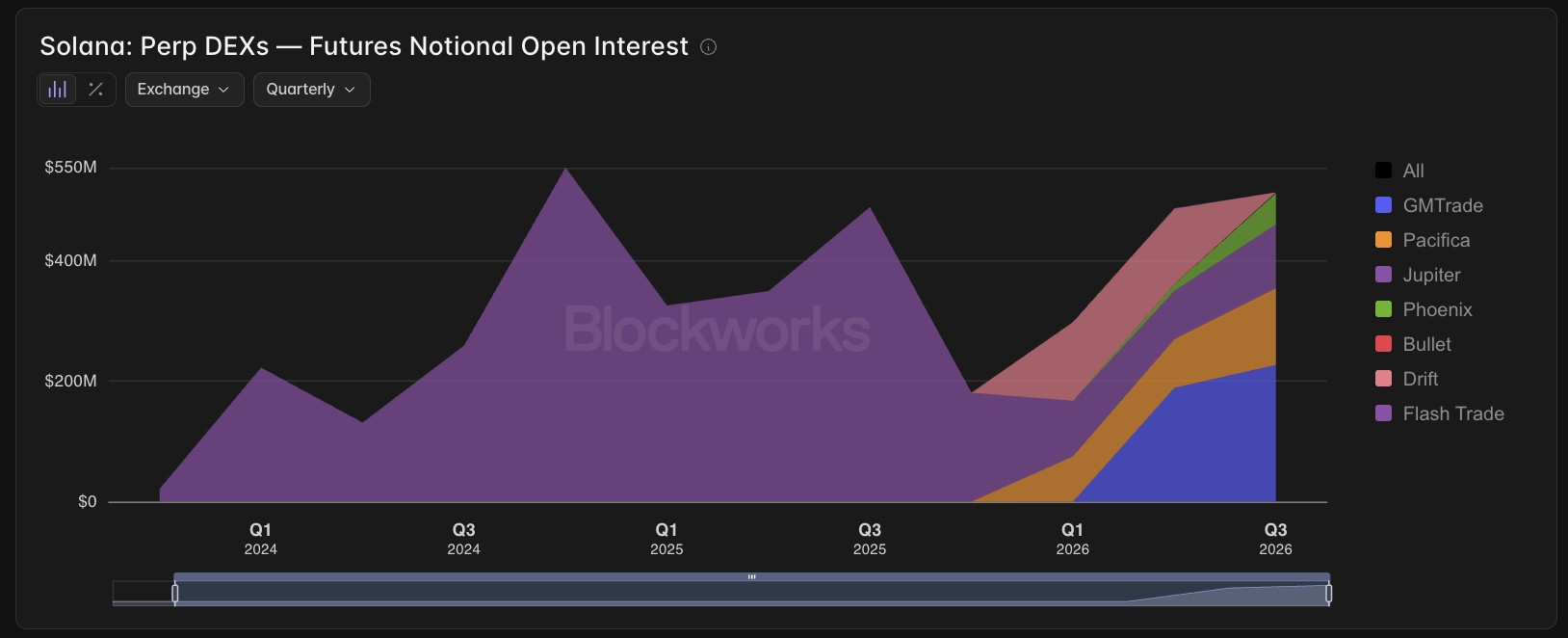
Open interest, or the amount of capital committed to live positions, trended upwards in Q3. Where volume is easily washed and inflated to capture value from incentive campaigns, open interest is often considered a more authentic measure of perps activity. From Q2 to Q3, Solana’s perp venues witnessed a 5.33% increase in open interest, rising from $487M to $513M.
Solana’s Q3 Upgrades
Solana has had a tremendous Q3, but onchain data and metrics only tell one side of the story. Rising volumes and activity provide an indicator of changing behaviors among end users, but much of this growth is only possible due to incremental improvements in the network’s underlying architecture and infrastructure.
In Q3 alone, Solana underwent several upgrades, and passed a critical governance vote:
-
Slot time reductions - Solana slot times dropped from 400ms to 250ms, with 200ms targeted in the coming weeks
-
CU limit increase - Solana’s block capacity rose to 100M CU (compute units), enabling more transactions to be packed into each block
-
SGP-002 - Solana’s stakeholders voted in favor of passing a governance proposal to increase $SOL deflationary curve, bringing $SOL emissions to its terminal rate ~3 years early
With onchain activity rising, markets showing life after breaking out of a stagnant downtrend, and Solana making considerable technical improvements, Q3 2026 was undoubtedly a productive quarter for crypto’s most performant Layer-1 blockchain.
Read More on SolanaFloor
Hayden Davis is Off the Hook, For Now
Federal Judge’s Dismissal Closes Door on $LIBRA, $M3M3 Saga
Solana vs Robinhood