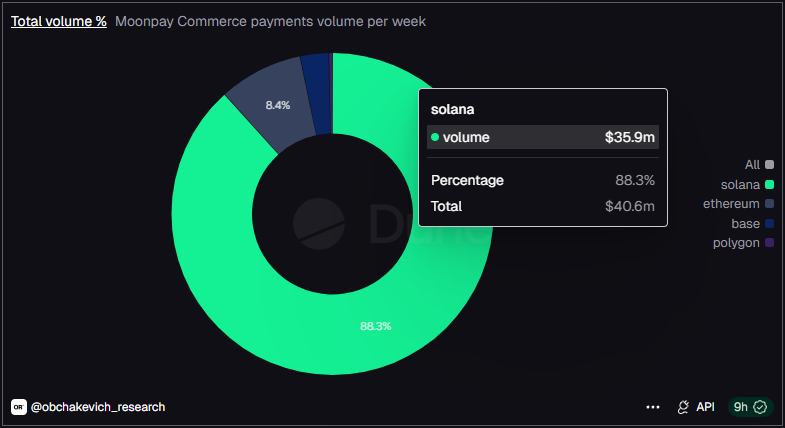
MoonPay Commerce hat seit Oktober 2025 ein Volumen von mehr als 40 Millionen US-Dollar verarbeitet. Die Daten von Dune zeigen, dass 88 % dieses Volumens auf Solana entfallen, was alle anderen unterstützten Ketten zusammen übertrifft.
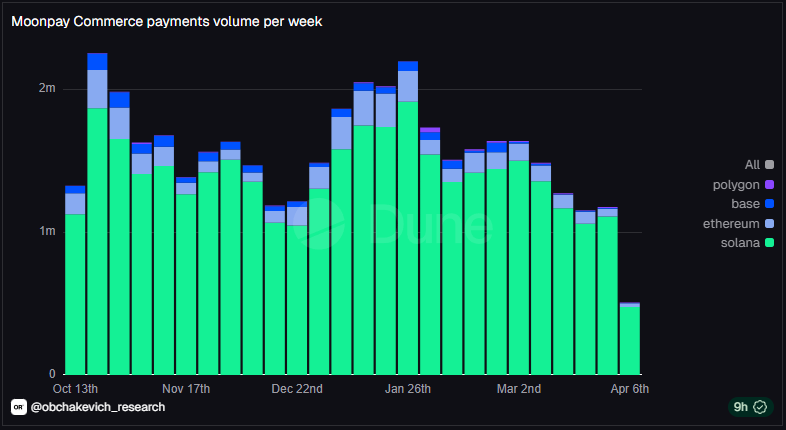
Das Diagramm zeigt auch, dass das wöchentliche Zahlungsvolumen zu mehreren Zeitpunkten nach dem Start die 2-Millionen-Dollar-Marke überschritten hat, wobei Solana den überwiegenden Teil dieses Flusses ausmachte.
Diese Konzentration ist wichtig, weil MoonPay Commerce als Multi-Chain-Krypto-Zahlungsprodukt und nicht als reiner Solana-Dienst gestartet ist. MoonPay stellte die Plattform im Oktober 2025 als globales Krypto-Zahlungssystem vor, das es Unternehmen ermöglicht, Produkte, Dienstleistungen und Abonnements zu verkaufen und gleichzeitig Zahlungen in Solana und anderen Kryptowährungen zu akzeptieren.
In der Praxis deutet das frühe Nutzungsmuster darauf hin, dass Händler und Kunden sich am stärksten zu Solana hingezogen fühlen.
Helio verschafft MoonPay ein stärkeres Standbein im Solana-basierten Handel
Die Akquisitionsstrategie von MoonPay aus dem Jahr 2025 erklärt, warum Solana jetzt das Volumen von MoonPay Commerce dominiert. Im Januar 2025 erwarb MoonPay Helio für 175 Millionen US-Dollar. Helio war 2022 auf den Markt gekommen und hatte sich eine starke Position im Solana-basierten Zahlungsverkehr aufgebaut, insbesondere bei Shopify, Discord und Solana Pay. Die Übernahme war zu diesem Zeitpunkt der größte Deal von MoonPay und signalisierte die Absicht, bei Krypto-Zahlungen direkter mit Coinbase Commerce zu konkurrieren.
MoonPay fügte später die Technologie von Helio in MoonPay Commerce ein. Bestehende Helio-Nutzer wechselten ohne Serviceunterbrechung zu dem neuen Produkt. MoonPay Commerce betreibt und pflegt auch weiterhin die Solana Pay-Integration für Shopify, die Helio ursprünglich für die Solana Foundation entwickelt hat. Diese Geschichte erklärt, warum Solana bereits einen praktischen Vertriebskanal innerhalb einer großen E-Commerce-Plattform hatte, als MoonPay Commerce auf den Markt kam.
MoonPay fügte im März 2025 einen weiteren wichtigen Baustein hinzu, als es Iron, eine API-first Stablecoin-Infrastrukturplattform, für etwa 100 Millionen US-Dollar erwarb. Dieses Geschäft folgte auf die Übernahme von Helio und verschaffte MoonPay im selben Jahr einen zweiten wichtigen Vermögenswert für die Zahlungsinfrastruktur.
Solanas umfassendere Erzählung über den Zahlungsverkehr hilft, die Daten zu erklären
Die Zahlen von MoonPay Commerce fügen sich in eine umfassendere Geschichte des Zahlungsverkehrs ein, die sich auf Solana entfaltet hat. Ende Februar 2026 startete die Solana Foundation payments.org, um Fintech- und Zahlungsverkehrsexperten über Stablecoins und reale Zahlungsanwendungen zu informieren. Die Website konzentriert sich auf Bereiche wie Treasury Management, grenzüberschreitende Zahlungen und Auszahlungen an Händler.
Die Darstellung der Solana-Zahlungen stützt sich zunehmend auf die praktische Anwendung und weniger auf die Theorie. Das von der Solana-Zahlungsinitiative zur Verfügung gestellte Material nennt etwa 2 Billionen US-Dollar an vierteljährlichen Stablecoin-Transfers, mehr als 300 Millionen US-Dollar an monatlichen Zahlungen und Bruchteile eines Pennys an Gebühren. Sie verweist auch auf sechs Jahre Betriebszeit des Netzwerks und mehr als 480 Milliarden verarbeitete Transaktionen. Finanzriesen wie Visa, PayPal, Stripe, Western Union und Fiserv sind bereits in der Produktion und betreiben keine kleinen Pilotprojekte.
Die Solana Foundation hat außerdem die Solana Developer Platform eingeführt, eine einheitliche Schnittstelle, die die Onchain-Entwicklung für Unternehmen und Institutionen vereinfachen soll. Große Unternehmen wie Mastercard, Worldpay und Western Union gehören zu den ersten Anwendern, die die SDP bereits nutzen. Die Plattform umfasst Emissionstools für tokenisierte Vermögenswerte, GENIUS-konforme Stablecoins und tokenisierte Einlagen.
Institutionen nutzen Solana zunehmend für Zahlungsströme
Der Bericht von Messari vom März 2025 über Solana-Zahlungen beschreibt ein schnell wachsendes Ökosystem. Der Bericht stellte fest, dass Visa, Stripe und Worldpay Solana für die Stablecoin-Abwicklung oder Zahlungsakzeptanz im Jahr 2025 integriert haben. Das USDC-Pilotprojekt von Visa überschritt ein jährliches Volumen von 3,5 Milliarden US-Dollar, während Worldpay die Bearbeitungszeiten mit USDG um 50 % verkürzte. Stripe fügte seinen Kryptoprodukten im Oktober 2025 die Unterstützung für Solana hinzu und ermöglichte es Händlern, Stablecoins mit automatischer Fiat-Umrechnung zu akzeptieren.
Derselbe Bericht beschreibt den Schritt von Western Union, $USDPT auf Solana auszugeben, den Plan von Fiserv, $FIUSD für sein Netzwerk von etwa 10.000 Finanzinstituten und sechs Millionen Händlern einzuführen, und Gustos Pilotprojekt für sofortige $USDC-Auszahlungen an internationale Vertragspartner. Er hob auch das starke Wachstum von $PYUSD auf Solana und den starken Anstieg des Transaktionsvolumens von Huma Finance hervor, das Stablecoins zur Unterstützung der 24/7-Abwicklung verwendet.
Messari argumentierte, dass das technische Profil von Solana zur Unterstützung dieser Anwendungsfälle beiträgt. Das Netzwerk hat in der Vergangenheit eine mittlere Blockzeit von 392 Millisekunden und eine mittlere Transaktionsgebühr von $0,0004 verzeichnet. Diese Merkmale unterstützen eine schnelle Abwicklung, verringern die Notwendigkeit einer Vorfinanzierung und ermöglichen es Instituten, Geld außerhalb der traditionellen Banköffnungszeiten zu bewegen.
Die ersten Daten von MoonPay Commerce beweisen nicht, dass eine Kette jede Zahlungskategorie dominieren wird. Sie zeigen jedoch, wo sich das tatsächliche Händlervolumen bisher innerhalb eines einzigen wichtigen Handelsprodukts konzentriert hat. Mehr als 40 Millionen US-Dollar an verarbeitetem Volumen seit Oktober 2025, von denen 88 % über Solana liefen, sind ein konkreter Beweis dafür, dass Händler offenbar Wert auf Geschwindigkeit, niedrige Kosten und einfache Abwicklungsoptionen legen.
Lesen Sie mehr über SolanaFloor
Jupiter sieht sich erneut mit Rückschlägen wegen Wallet-Beschränkungen für $JUP ASR-Forderung konfrontiert
Kamino führt Whitelist-Reserven ein, um Tresore vor Schlüsselkompromittierung zu schützen
Solana dominiert als Zahlungsschicht für KI-Agenten