
Solana ETFs See Largest Inflows In Two Weeks With $17.81M, Total Net Flow Approaching $1 Billion
Institutional demand builds despite price pressure and evolving market structure
- Published:
U.S. spot Solana exchange-traded funds recorded $17.81 million in net inflows on March 17, marking the largest single-day inflow in two weeks. The sustained inflows highlight continued investor interest in Solana-linked products, even as broader market conditions remain challenging.
Data from the SolanaFloor ETF Tracker shows that the latest inflow follows $2.83 million in inflows on March 16, bringing the current streak to five consecutive trading days of net positive flows. The March 17 figure represents the strongest daily performance since March 3, which saw $19.43 million recorded.
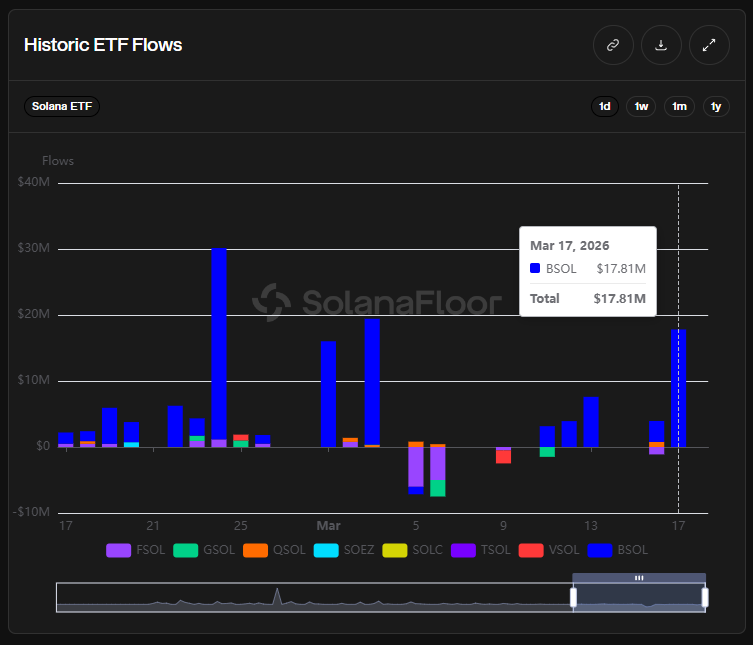
Issuer-level data shows that Bitwise’s Solana ETF has led inflows during the current week, attracting nearly $21 million in capital. The fund has accounted for the majority of recent activity, reinforcing its position as a dominant player within the Solana ETF landscape and capitalizing on its status as the first pure spot $SOL ETF to launch.
Institutional Demand Supports ETF Momentum
Institutional demand has played a central role in supporting the recent inflow trend. Spot Solana ETFs have now attracted $222.49 million in net inflows so far in 2026, with total net flows at $999.46 million.
Despite a significant decline in Solana’s underlying asset price, investor appetite for ETF exposure has remained resilient. Bloomberg Senior ETF Analyst Eric Balchunas noted that Solana has fallen roughly 57% since the launch of spot ETFs in July, yet the products have retained the majority of their accumulated capital.
Balchunas also highlighted that approximately 50% of ETF assets come from institutional investors disclosed through 13F filings. This level of participation suggests a relatively strong base of long-term investors compared to other recently launched ETF categories.
When adjusted for market size, Solana ETF flows appear particularly notable. Relative to Solana’s market capitalization, cumulative inflows equate to an estimated $54 billion in Bitcoin-equivalent flows at a similar stage, indicating comparatively rapid growth despite weaker price performance.
Institutions Are Loading Up on $SOL
Data from regulatory filings provides additional insight into the composition of Solana ETF holders. Approximately 49% of total assets are identifiable through 13F disclosures, a high proportion for products that launched less than a year ago.
As of March 9th, Investment advisers accounted for the largest share of reported holdings, with roughly $270 million in exposure. Hedge funds followed with approximately $186 million, while other categories, such as holding companies, brokerages, and banks, made up smaller portions of the total.
Among the largest known holders are Electric Capital, Goldman Sachs, and Elequin Capital, alongside a range of market makers and crypto-focused investment firms. This concentration suggests that early adoption has been driven primarily by industry-native capital rather than broad-based institutional participation.
Bloomberg Intelligence analysts have noted that the current holder base remains top-heavy and skewed toward specialized investors. However, they also point out that participation from traditional financial institutions continues to expand gradually.
Growing Market Influence and Price Sensitivity
As ETF assets continue to grow, their influence on Solana’s market dynamics appears to be increasing. Brian Rudick, Chief Strategy Officer at Upexi, noted that Solana ETF products now represent approximately 2% of the asset’s total market capitalization, a milestone reached within 18 weeks of launch.
This pace exceeds that of Bitcoin ETFs, which required significantly more time to reach a comparable share of market capitalization. The rapid growth suggests that ETF flows are becoming an increasingly important factor in Solana’s price behavior.
Max Shannon, Senior Research Associate at Bitwise, also observed that ETF flows may now account for roughly 25% of Solana’s price variance.
Broader Ecosystem Strength Provides Context
Recent regulatory developments have strengthened institutional interest in Solana. The U.S. Securities and Exchange Commission introduced a crypto asset taxonomy on March 17 that classifies Solana as a digital commodity alongside Bitcoin and Ethereum. The framework divides assets into five categories and clarifies that activities such as staking, mining, and token wrapping are administrative tasks rather than securities transactions, reducing regulatory uncertainty and lowering barriers to participation. While the guidance does not yet carry the force of law and attention remains on the proposed CLARITY Act, it signals a more structured regulatory environment.
Beyond ETF activity, Solana’s broader ecosystem continues to show signs of growth. Total value locked across Solana-based decentralized finance protocols recently reached an all-time high of over 81 million $SOL and has remained near that level in recent weeks.
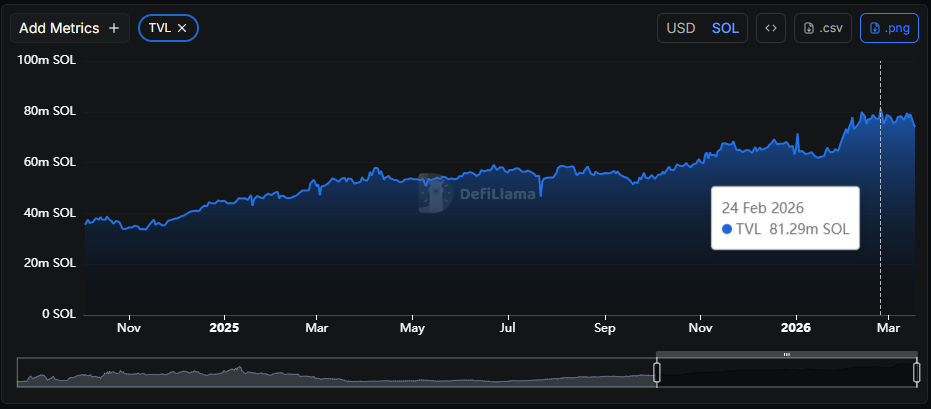
This growth in onchain activity contrasts with the asset’s price decline and suggests that network usage remains strong. The divergence between price performance and underlying activity continues to shape investor sentiment.
Read More on SolanaFloor
Sanctum Launches Infinity V2, Aiming To Distribute Staking Yield Every Second
SEC Declares $SOL a ‘Digital Commodity’ Under New Crypto Asset Taxonomy
Solana’s New Bullcase!