Senate Republicans Release New Draft of CLARITY Act Banning Federal Officials From Issuing Digital Assets
The 616-page crypto market structure bill adds ethics restrictions for federal officials.
- Published:
Senate Republicans have released an updated version of the Digital Asset Market Clarity Act, bringing the long-awaited crypto market structure bill closer to a potential Senate vote while reigniting debate over ethics provisions involving federal officials.
The 616-page draft combines legislation that cleared the Senate Banking and Agriculture committees over the past year. Republicans could push the bill toward a full Senate vote as soon as next week after months of negotiations over market structure, illicit finance, stablecoin rewards, software developers and government ethics.
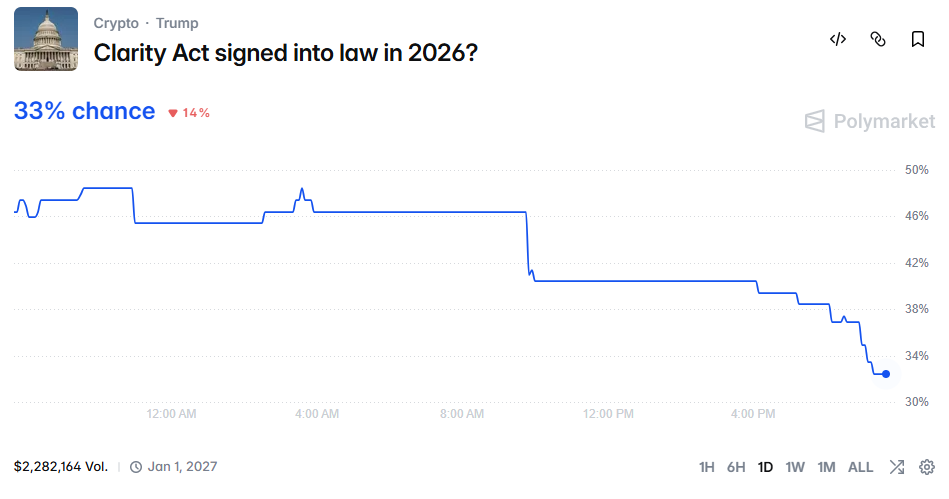
However, prediction markets have become considerably less optimistic. Polymarket odds that CLARITY will become law in 2026 fell to 33% following the draft’s release, down from 49% in late June and an 82% peak in February.
New Ethics Rules Bar Officials From Issuing Digital Assets
Crypto in America host and former Fox Business journalist Eleanor Terrett reported that the White House negotiated the latest ethics package with Republican Senators Cynthia Lummis and Bernie Moreno. Democrats have not yet signed off on the proposal.
The draft would prohibit the president, vice president, members of Congress, federal judges, other covered officials, and their spouses from issuing or sponsoring digital assets for compensation while in office. The restriction would expire on January 20, 2029.
Covered officials would also need to sell their crypto holdings and investments in crypto companies, place them in blind trusts they do not control, or use a combination of both approaches. The proposal would require disclosure of crypto sales above $1,000 and direct the Government Accountability Office to examine additional ethics gaps.
The Justice Department would receive civil enforcement authority, including the power to pursue exchanges that knowingly list prohibited tokens.
Ethics has emerged as one of the biggest obstacles to bipartisan support. President Donald Trump’s memecoins and his family’s involvement with World Liberty Financial have intensified scrutiny after recent financial disclosures showed Trump received millions of dollars connected to the company.
Democrats could seek significant changes. Terrett reported that Democrats had not yet seen the latest text and strongly oppose giving the DOJ enforcement authority without a role for state attorneys general.
Developer Protections and Self-Custody Remain
The Blockchain Regulatory Certainty Act remains unchanged from the version that cleared the Senate Banking Committee in May. It clarifies that non-custodial software developers and blockchain infrastructure providers do not qualify as money transmitters solely because they build or maintain decentralized networks.

The Lummis-Grassley amendment also preserves existing federal criminal liability for anyone who knowingly facilitates illicit transactions. The Keep Your Coins Act remains intact, protecting individuals’ right to self-custody crypto.
The bill also retains the Tillis-Alsobrooks compromise on stablecoin rewards. Companies cannot pay interest on idle payment stablecoin balances, but they can offer rewards tied to activity such as transactions or staking, provided those rewards do not function like bank deposit interest.
Bill Expands Crypto Crime Enforcement
A new section strengthens law enforcement’s ability to investigate crypto-related crime. It increases funding for state and local investigations and blockchain analytics, creates training programs for prosecutors and law enforcement, and establishes a cyber center focused on nation-state threats, including North Korea and Iran.

The legislation would also create a public-private task force targeting crypto fraud and require stablecoin issuers to comply with lawful orders to freeze, seize, burn, and reissue tokens when appropriate.
Bankruptcy provisions aim to keep customer digital assets separate from a failed exchange or custodian’s bankruptcy estate, giving them protections similar to traditional financial assets and potentially reducing the risk of another FTX-like collapse.
CLARITY Still Faces a Difficult Senate Vote
The latest draft represents a major attempt to reconcile months of work across 2 Senate committees, but the ethics package remains unsettled.
The bill will likely need 60 votes to advance through the Senate, requiring meaningful Democratic support. That challenge comes as lawmakers face a shrinking legislative calendar ahead of the 2026 midterm elections.
For the crypto industry, the stakes extend beyond ethics. CLARITY would establish statutory boundaries between digital commodities and securities, expand the CFTC’s authority over blockchain-native assets, and provide federal protections for DeFi and self-custody.
The SEC and CFTC previously identified $SOL among 16 digital commodities in March, but that designation rests on agency interpretation. CLARITY could give classifications for assets such as $SOL a stronger statutory foundation.
With bipartisan negotiations expected to continue in the coming days, reconciliation efforts by crypto lobbying groups and industry leaders, such as Coinbase cofounder Brian Armstrong, have accelerated in recent days given what is at stake and the narrow window to push the bill across the finish line, even as the 33% prediction-market odds reflect growing uncertainty over whether lawmakers can resolve their remaining differences before time runs out.
Read More on SolanaFloor
Solana ETF Inflows Hit 2-Week High as July Rebound Gathers Pace
Melee Markets Unveils New Spin on Prediction Markets Through Novel PMM Model
What's Next For Crypto If CLARITY Fails?