Fomo has attracted more than 40,000 daily active traders on average so far in August, with Solana accounting for most of its activity. Last week, Solana generated $283.53 million in weekly volume on Fomo, the highest among the chains tracked on the platform.
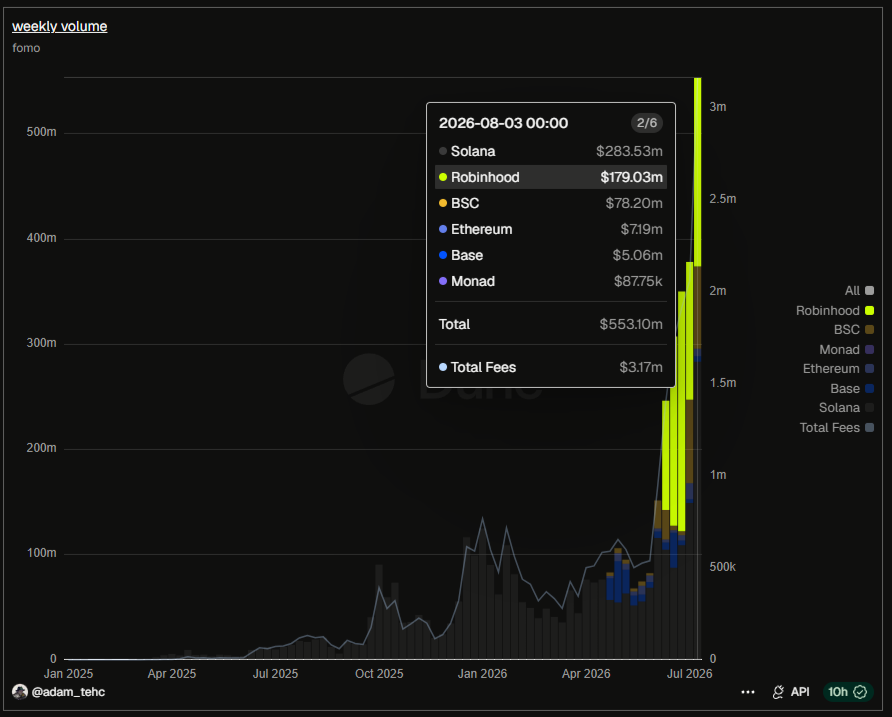
Fomo has also processed about $4.74 billion in lifetime volume across 29.14 million trades and generated roughly $32.1 million in lifetime fees.

Those figures have strengthened Fomo’s position in the trading market, but they have also brought greater scrutiny of what users actually pay to trade.
Popular Solana community member fabiano.sol recently highlighted a 0.5% Fomo trading fee, compared with 0% on Pump.fun and 0.1% on Jupiter for applicable trades. He argued that a trader depositing $1,000 and completing 10 round-trip trades on Fomo could lose $100 to fees alone.

Fomo co-founder Se Yong Park disputed that framing. Park said some transactions cost as little as $0.10, while Fomo covers gas, token rent and priority fees. He also said blue-chip tokens can carry a 0.05% fee.

The disagreement partly comes down to how Fomo applies its minimum charge.
What Fomo’s Terms Actually Say
Fomo’s Terms of Service state that the platform charges a minimum fee of 0.50% per transaction, subject to a minimum charge of $0.95.
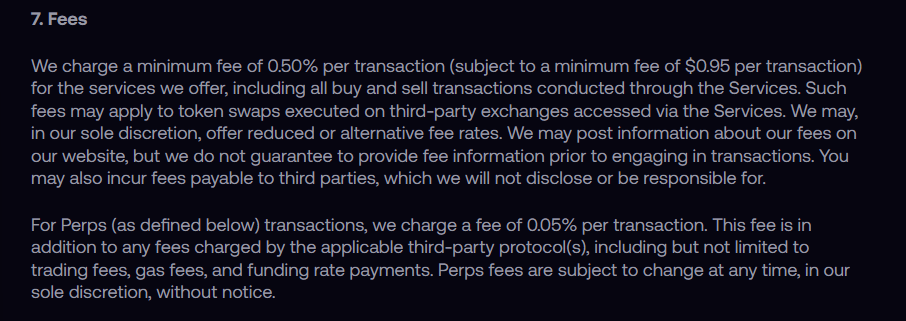
That structure means smaller trades can face a higher effective percentage. A $0.95 minimum on a $100 transaction equals 0.95%, while a $0.95 charge on a $50 transaction equals 1.9%.
Fomo’s terms also say the company does not guarantee that it will provide fee information before every transaction. Third-party fees can apply as well. For perpetuals, Fomo lists a 0.05% transaction fee, while noting that third-party protocols can charge additional trading, gas and funding fees.
Community members have questioned when the $0.95 minimum applies and whether users can easily determine their final costs before trading.

One trader claimed a $400 purchase produced only $380 worth of tokens. That example does not establish whether the difference came from fees, slippage, execution or market movement.

Another post claimed a 3.2% fee on a $5 purchase, returning tokens worth only $4.84 after the transaction.

Those figures do not reconcile mathematically, underscoring the confusion surrounding some of the fee complaints.
The Bigger Fight: Pump.fun vs. Fomo
The fee debate arrives as Fomo and Pump.fun increasingly compete for the same traders.
Fomo has built a mobile-focused experience around social and cross-chain trading, while Pump.fun controls a major part of Solana’s memecoin infrastructure. Fomo’s recent growth has made the rivalry harder to ignore.
Reports circulated this weekend that Pump.fun offered some of Fomo’s largest traders a $20,000 signing bonus and a $30,000 monthly salary to move their activity. Pump.fun has not confirmed or denied those specific figures, so they remain unverified.

The broader competitive push, however, has become increasingly visible. Pump.fun has introduced 0% trading fees, cross-chain $USDC deposits and more social features, moves that place its product closer to Fomo’s territory.
Pump.fun still generates substantially more revenue. DeFiLlama data put its 30-day protocol revenue at $10.62 million, while Fomo recently reached $3.25 million in weekly revenue last week and around 50,000 daily active traders.
The gap matters, but so does its direction.
Traders Now Have a Clearer Choice
Fomo’s argument rests on user experience, social trading, and simplifying access to crypto. Pump.fun can use its existing infrastructure and revenue base to subsidize its front end.
That creates a direct test of what traders value most: lower fees, better execution, stronger social features or a smoother overall experience.
For smaller traders, the fee structure could become particularly important. A 0.5% rate already matters over repeated trades, while a $0.95 minimum can push the effective cost much higher on small positions.
The rivalry therefore extends beyond Pump.fun and Fomo. It reflects a wider fight over crypto’s consumer layer, where platforms increasingly compete not only to execute trades but also to become the place where users discover tokens, follow traders and make decisions.
Read More on SolanaFloor
SEC to Roll Out “Major Initiatives” to Turbocharge Crypto Industry as CLARITY Flounders
Solana Summit Nigeria Put RWAs, Tokenized Stocks and Global Capital in the African Spotlight
Solana Wants To Burn 14x More $SOL