PreStocks’ Success on Solana Drives Total Tokenized Pre-IPO Trading Volume to $544M
Expanding access to private markets in a growing RWA ecosystem.
- Published:
- Edited:
Solana’s RWA ecosystem has evolved rapidly, moving beyond stablecoins into more complex financial instruments such as tokenized equities. Within this broader trend, PreStocks has emerged as a distinct category leader by focusing on pre-IPO equity exposure. Instead of replicating publicly traded stocks, PreStocks introduces tokenized representations of private companies, including Anthropic, OpenAI, SpaceX, Kalshi, Polymarket, and Anduril.
This approach places PreStocks at the intersection of DeFi and private equity. Historically, access to pre-IPO investments remained limited to institutional investors, venture capital firms, and high-net-worth individuals. PreStocks changes the structure of access by allowing onchain participation through tokenized instruments, even though these tokens do not grant legal ownership or governance rights.
Growth Metrics and Market Activity
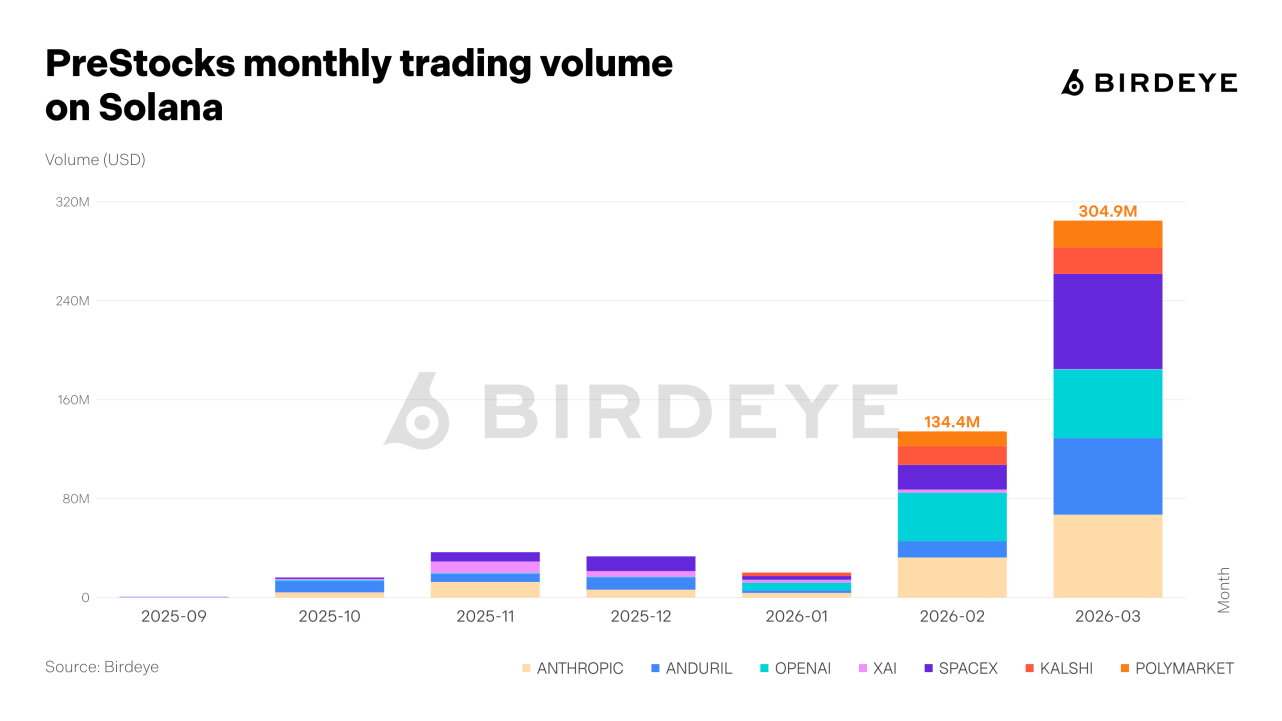
According to a recent Birdeye report, PreStocks tokens reached a combined supply of $13.06 million across 12,910 holders by March 2026. Total trading volume climbed to $544.78 million, reflecting strong engagement relative to the sector’s early stage. Growth accelerated sharply in 2026, with trading volume increasing more than fivefold compared to late 2025. March alone accounted for $302.87 million in trading volume.

Trading activity remained broadly distributed across key tokens. SpaceX led with $76.64 million in volume, followed by Anthropic at $66.72 million, Anduril at $60.72 million, and OpenAI at $55.54 million.
The early launch period showed volatility in participation. PreStocks recorded more than $1.29 million in trading volume on its first day, but activity declined by over 90% within a week. However, subsequent months demonstrated sustained recovery and expansion, suggesting that initial volatility gave way to more stable user engagement.
Retail Conviction and Price Discovery in Pre-IPO Markets
Individual trades highlight the market's speculative, opportunity-driven nature. One trader who purchased approximately $524,000 worth of Anthropic tokens on PreStocks five months ago now holds a position valued at roughly $1.8 million. This increase coincided with rising interest in Anthropic’s Claude models and broader growth in artificial intelligence valuations.
Unlike tokenized public equities, PreStocks assets do not rely on arbitrage mechanisms tied to listed shares. As a result, price movements often reflect retail sentiment, perceived growth potential, and updates in private funding rounds rather than strict price parity with underlying assets. Recent developments in the private market reinforce this dynamic. Anthropic’s latest raise in February valued the company at $380 billion, while rising adoption of its Claude models and reported usage by the United States defense sector have further shaped market expectations. These signals, combined with broader user growth, contribute to speculative pricing behavior onchain, introducing opportunity and volatility into valuation.
Last month, Jupiter announced an integration with PreStocks that introduces support for limit orders. This feature allows traders to define entry and exit conditions, bringing a level of control that resembles traditional market structures.
Structural Characteristics and Limitations
According to the project’s documentation, PreStocks tokens function as price-exposure instruments rather than as traditional equity holdings. Each instrument relies on one or more screened entities that maintain the underlying positions, with verifiable backing at the structure level. The identities of these counterparties remain confidential under contractual terms to limit unsolicited outreach, reputational risk, and potential friction with issuers or market intermediaries.
Liquidity conditions reflect both the nature of private markets and the early stage of tokenization. Private equity has historically operated with limited liquidity, and onchain pairs often exhibit low liquidity, leading to slippage and short-term volatility. As the market matures, participation may increase alongside successful pre-stock IPO outcomes and early investor returns, similar to how tokenized public equities existed since 2022 but only began to scale meaningfully in 2025.
Solana’s Position in the Broader RWA Market
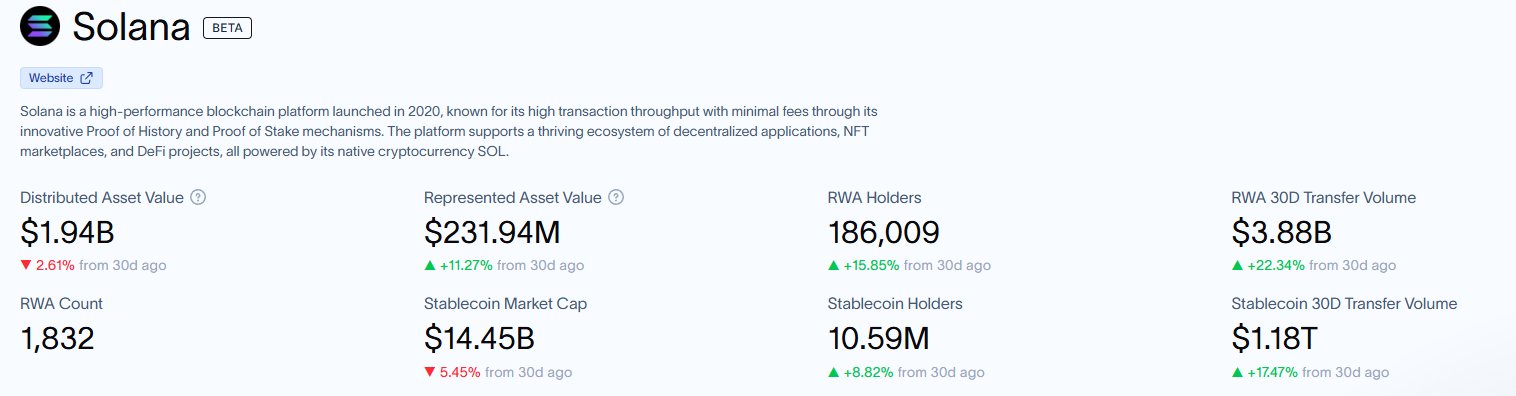
Solana has strengthened its position within the tokenized asset sector, particularly in comparison to other networks. Data from rwa.xyz shows that Solana’s RWA ecosystem has doubled in value to almost $2 billion over the past 6 months, supporting over 187,000 holders, surpassing Ethereum’s 166,135. This growth aligns with rising activity across categories, such as tokenized stocks and pre-IPO assets.

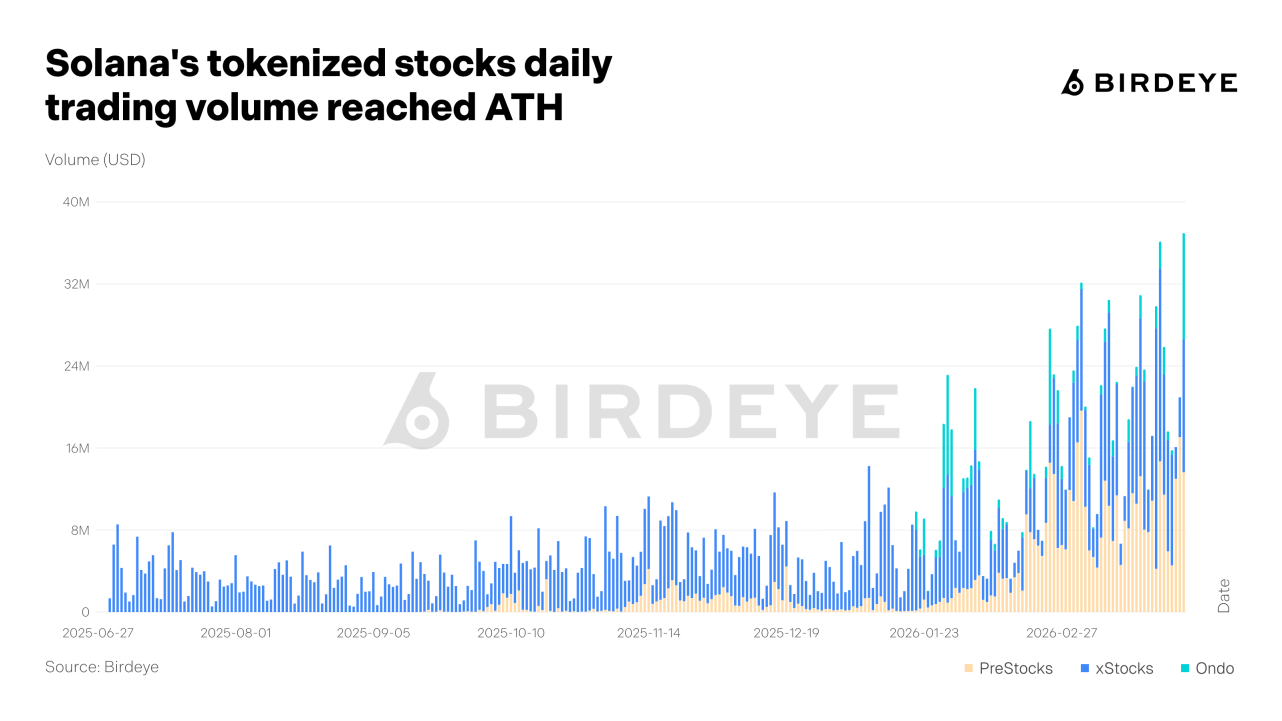
At the same time, Solana’s tokenized stock market continues to expand through multiple platforms. Daily trading volume for tokenized equities reached an all-time high of $36.96 million on March 30, according to Birdeye data, reflecting broader ecosystem momentum.

PreStocks operates within this expanding environment, contributing to overall activity while maintaining a specialized focus on private markets.
Read More on SolanaFloor
Solana DeFi Alarmed After DPRK-Linked Developer Was Revealed to Have Worked Across Multiple Projects
Solana Products Attract $34M in Inflows While Ethereum Extends YTD Outflows
Has Solana Lost the Perps Race For Good?