Orca and Loopscale Merge Into Formation: What Happens to $ORCA and Billions of Loopscale Points?
Both platforms to continue normal operations while Loopscale points will be converted later this year.
- Published:
OG Solana DEX Orca and lending protocol Loopscale have merged to form Formation, a new platform focused on capital formation and allocation for tokenized assets and the so-called frontier economy.
The combined company brings Orca’s trading and liquidity infrastructure together with Loopscale’s credit and vault infrastructure. Loopscale co-founder Luke Truitt will lead Formation as CEO, with Mary Gooneratne serving as COO and Orca’s Christopher Montagano as Chief Strategy & Legal Officer.
Both Orca and Loopscale will continue operating as products under Formation. Existing positions, loans, vault deposits, Whirlpool positions, fees, and rewards remain unchanged. The merger also does not introduce a new token. The Orca and Loopscale protocols will form the foundation of the $ORCA and $xORCA token network, with $ORCA representing the combined Formation ecosystem.
"The frontier economy is creating new business models, and financing needs more rapidly than traditional market infrastructure is evolving to serve them. Every major technological revolution has been paired with a financial one. We're at an inflection point that requires capital markets to keep pace with the industries reshaping the economy." - Luke Truitt, CEO of Formation.
The Merger Follows Orca’s Push for a New Growth Phase
The merger follows Orca’s recent push to fund a new growth phase. A September 29 DAO proposal sought to retain 80% of protocol fees for development, use 10% for $ORCA buybacks distributed to $xORCA holders, and allocate another 10% to a team-controlled buyback wallet.
The proposal also called for roughly 14.2 million $ORCA, worth about $40.4 million, to support acquisitions, while the community treasury’s $SOL would move into DeFi strategies. The proposal referenced plans to acquire a “leading Solana DeFi protocol” and add credit and yield products, which now aligns with Orca’s merger with Loopscale.
What Happens to Loopscale Points?
The merger immediately raised questions among Loopscale users who spent months accumulating points in anticipation of a potential token launch.
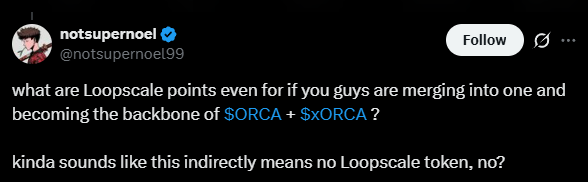
Formation’s documentation provides a direct answer: Loopscale will not launch its own token. $ORCA will serve as the token for Formation, including Loopscale.
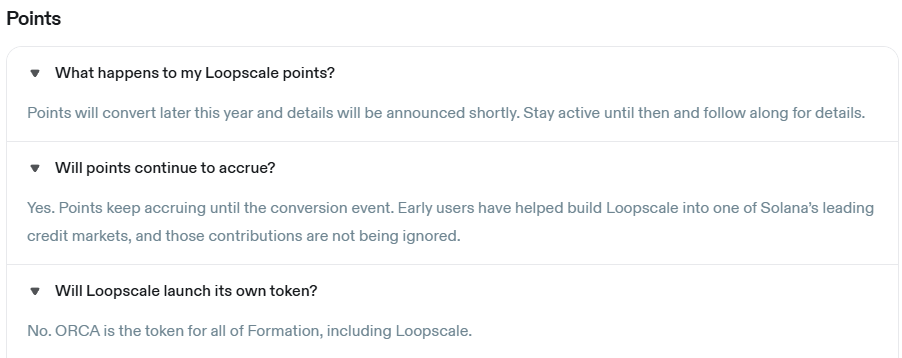
The points will not disappear, however. Formation says Loopscale points will convert later this year, with specific details coming shortly. Points will continue accruing until that conversion event.
That clarification addresses one of the biggest uncertainties surrounding the merger. Users who accumulated billions of points do not lose them simply because Loopscale joined Orca, but Formation has not yet disclosed the conversion mechanism or how points will translate within the $ORCA ecosystem.
A Full Stack for Tokenized Assets
Formation wants to connect several parts of the asset lifecycle that currently operate across separate platforms. Orca provides liquidity through infrastructure such as Whirlpools, Riptide, and permissioned pools. Loopscale adds credit through its order book, which supports fixed-rate loans and asset-specific terms. Its vault products provide strategies spanning yield, credit, and market making.
The combined platforms already operate at significant scale. Orca has processed more than $550 billion in trading volume since 2021, while Loopscale has facilitated more than $2 billion in loans and holds more than $150 million in deposits.
"Orca has spent years building deep liquidity, and we've seen firsthand that liquidity alone isn't enough to scale an asset. The greater challenge is building the credit and distribution those assets need to grow, and Orca and Loopscale built complementary pieces of that infrastructure. Together, we can give issuers a complete path from launch to long-term market adoption." - Christopher Montagano, Chief Strategy & Legal Officer of Formation.
Formation Targets the “Minimum Viable Asset”
Formation is targeting a structural problem in traditional capital markets. A $5 million financing can require much of the same underwriting, legal, servicing, and distribution infrastructure as a $50 million transaction. Those fixed costs can make smaller assets economically unattractive to issue. Formation calls this threshold the “minimum viable asset.”
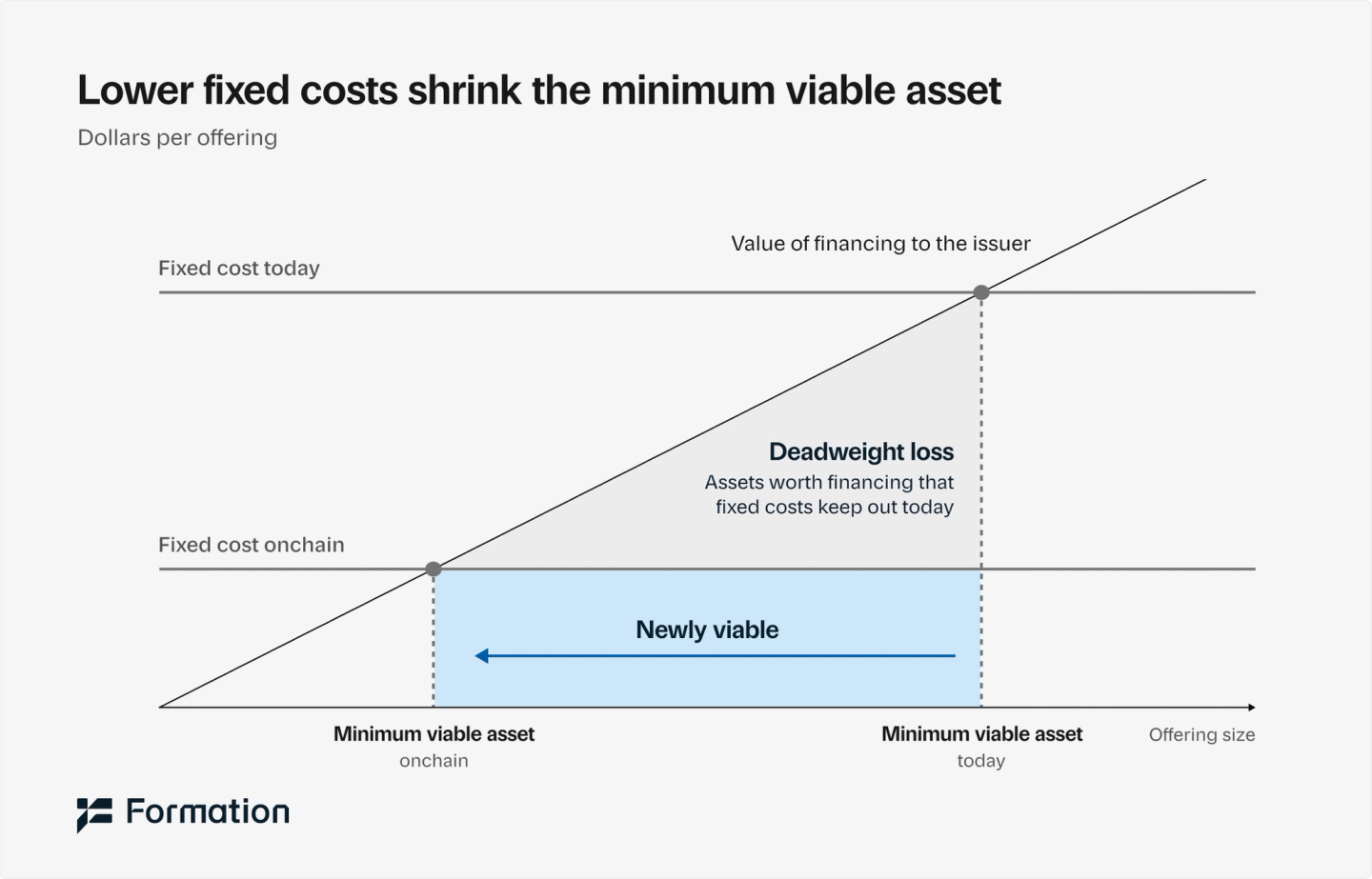
Its thesis argues that tokenization and onchain infrastructure can lower those fixed costs, allowing smaller assets and financing opportunities to reach markets that previously could not support them economically.
The company points to assets across reinsurance, telecom debt, and tokenized credit as examples of what this model could enable.
A Push Toward Regulated U.S. Markets
Formation also plans to move toward regulated U.S. capital markets. The company says it intends to operate a tokenized securities venue under the SEC's innovation exemption and pursue the licenses required to expand its offerings.
Over the next 12 months, Formation plans to develop issuer tools, capital allocation strategies, credit infrastructure, market-making products, and new tokenized assets.
For $ORCA holders, the merger's immediate impact remains unclear until more details are revealed. A key question is how Loopscale points will convert and whether that process could create $ORCA sell pressure. If Formation indeed goes that route, another concern would be how quickly the project can increase its revenue to absorb or offset any potential supply hitting the market. For now, though, both projects continue to run as normal.
Read More on SolanaFloor
Samsung Partners With Solana To Bring Cross-Border Stablecoin Payments to 82 Million Galaxy Devices
Dominion Market Shuts Down After $2.75M $SILV Exploit Leaves Recovery Plan Underfunded
Bitwise CIO Matt Hougan On What To Expect From Crypto In 2027