“A No Brainer Yes” - Anatoly Yakovenko Backs Controversial SGP-003 Vote as App Builders Push Back
Voters still strongly in favor of introducing resource fee despite builder concerns
- Published:
In true crypto governance fashion, SGP-003 has divided the Solana community into two distinct camps.
On one side, holders and stakers are avidly in support of a resource fee and its theoretical value accrual to $SOL. On the other hand, application builders and developers have spoken out against the proposal, expressing concerns that “yolo economics” will stifle onchain innovation.
With Ghost Labs publishing a simulator tracking the potential impact a resource-fee could have on builders, Solana Labs co-founder Anatoly Yakovenko has finally weighed in on the fierce debate.
Toly Likes the Burn
Blockchain governance proposals are divisive by nature, and Solana’s SGP-003 is certainly no exception. Aiming to introduce a programmatic fee based on transaction resource consumption, SGP-003 opened a rift in the Solana community, sparking fresh debate over what’s most important to the network’s long-term health.
Ghost Logs, a Solana-native R&D firm analyzing Solana’s micromarket structure, recently published a dashboard outlining the impact of SGP-003 implementation.
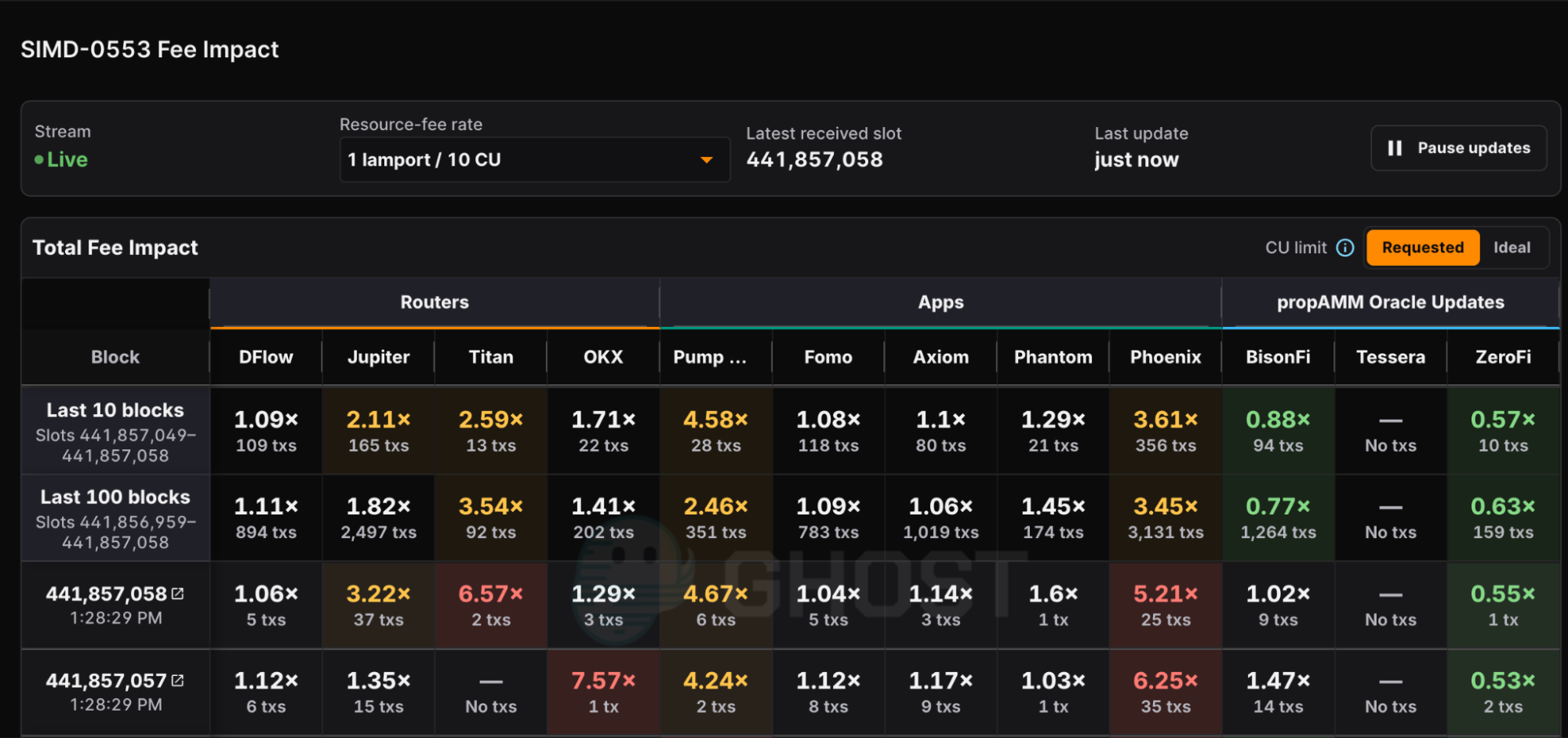
The simulation demonstrates a strong disparity between the impacts of a resource fee on trading and consumer apps, like Jupiter, Pumpfun, and Phoenix, and the network’s Prop AMMs, which are credited with enabling Solana’s unrivaled onchain trade execution.
After initially requesting more data on the impacts of the proposal, Solana Labs co-founder Anatoly Yakovenko has voiced his support for SGP-003. At the simulated rate of 1 lamport per 10 CUs, Yakovenko claims the proposal is “no brainer yes vote”, adding that the projected $SOL burn is roughly equal to the current burn and remains a small fraction of total net revenue.
However, it’s important to note that the 1 lamport/10 CUs fee is intended only as a starting point. With time, SGP-003 could raise resource fees as high as 1 lamport/2 CUs, effectively five times higher than the initial rollout.
Beyond Yakovenko, other prominent ecosystem have stepped forward to put their weight behind the proposal, including BlueShift, Firedancer Development, and Hylo.
DeFi Leaders Vote Against SGP-003
But while Yakovenko and a mass of other influential figures have endorsed SGP-003, the vote has been met with harsh criticism from application builders, who’ve called the proposal “damaging”, “opinionated”, and “counterintuitive”.
Raydium, one of Solana’s OG DeFi applications, has voted against SGP-003, arguing that increasing the costs of onchain market making will only drive trading activity offchain long-term. Raydium’s position echoes similar sentiments expressed by Ellipsis Labs CEO Eugene Chen, one of SGP-003 earliest and more outspoken critics.
Responding to commentary from Multicoin Capital capital co-founder Tushar Jain, Chen argues that the simple fact that Solana’s DeFi apps, like Phoenix, Manifest, and Raydium, are against resource fees should be enough to prove that the proposal is not in Solana’s best interests.
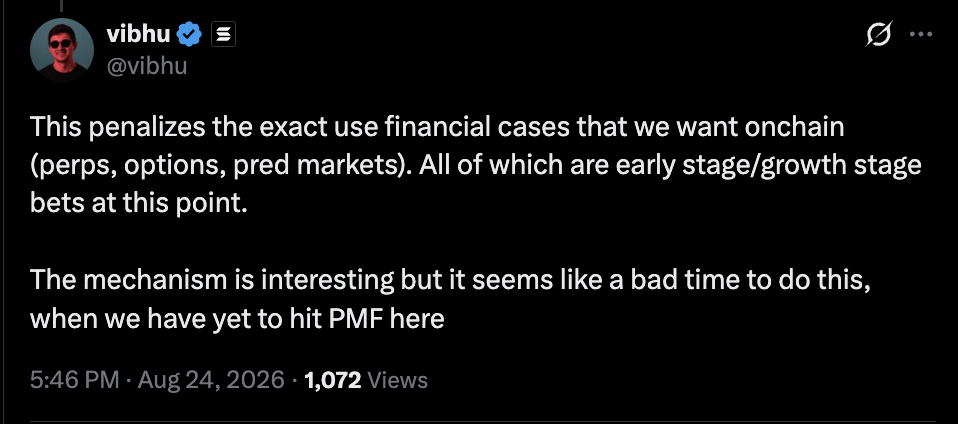
Solana Foundation’s Vibhu Norby asserted that resource fees penalize financial primitives at the cutting edge of onchain innovation, like perps, options, and prediction markets. While Ghost Labs simulation suggests that SGP-003 will make Solana’s prop AMMs, and consequently, its spot market, more efficient, a resource fee is expected to stifle more complex applications.
87% of Voters Support SGP-003
Despite strong opposition from DeFi builders, Solana’s voters are leaning heavily in favor of passing SGP-003. With just over 2 days left on the clock, over 87% of voters are backing the proposal.
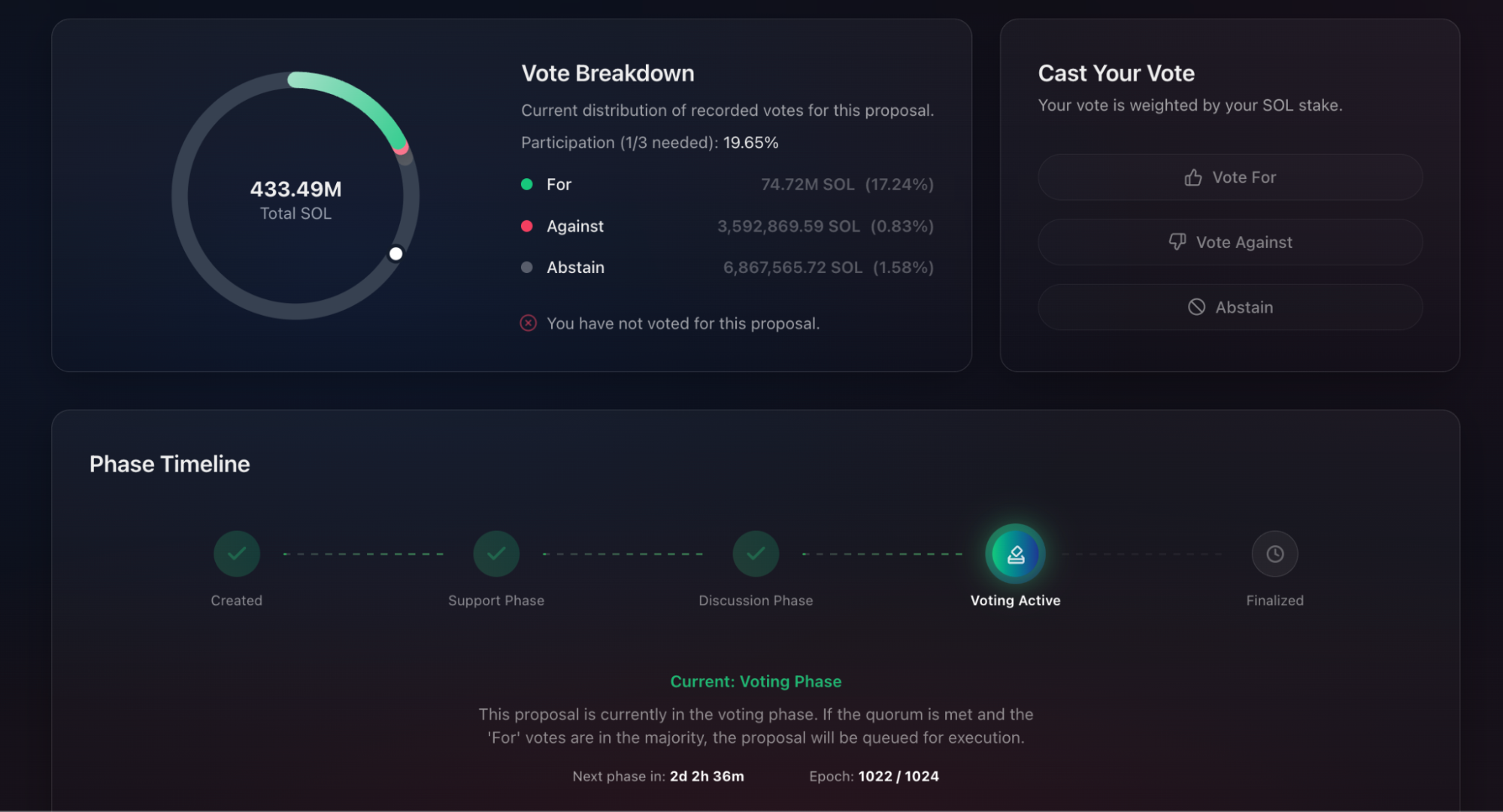
Simultaneously, SGP-002, a proposal aiming to double $SOL’s disinflation rate and reduce emissions is witnessing similar levels of support. But despite strong advocacy from ecosystem leaders, pockets of the validator community have opposed SGP-002, claiming it disproportionately affects smaller operators.
While a promising start for SGP-003 advocates, early voting is not necessarily indicative of final outcomes. SIMD-0228, an early $SOL emissions rate proposal, saw a flurry of late activity that overturned initial projections. Crypto governance, like many market-centric and market-influencing phenomena, is often only decided in the final hours before a deadline.
Read More on SolanaFloor
Solflare embraces leverage
Solflare Launches Perpetual Futures Trading, Powered by Phoenix
Get an Inside Look at SGP-003