Jito lanceert JIP-38 om 100% van de DAO JTX-inkomsten te besteden aan het terugkopen en vernietigen van $JTO
Het voorstel houdt in dat het volledige aandeel van 80% van de DAO in de handelsvergoedingen van JTX gedurende ten minste één jaar wordt besteed aan geautomatiseerde terugkoop- en vernietigingsacties van $JTO.
- Geplaatst:
- Bewerkt:
Solana-grootmacht Jito heeft JIP-38, een governancevoorstel dat het volledige aandeel van 80% van de Jito DAO in de vergoedingen gegenereerd door JTX, het nieuwe handelsplatform met eigen beheer, gedurende ten minste 1 jaar zou worden ingezet voor geautomatiseerde terugkoop en verbranding van het $JTO-token op de open markt.
Het voorstel, aangekondigd door Jito en opgesteld door Dr. Nick Almond, hoofd Governance bij de Jito Foundation, heeft tot doel Jito formeel te vestigen als wat het omschrijft als een „token-centric netwerk“. In dat model vloeien alle belangrijke inkomsten van het protocol naar de DAO en blijven deze onder het bestuur van de tokenhouders, met als enige vaste uitzondering de 20% van de JTX-vergoedingen die gereserveerd zijn voor de ontwikkeling van JTX.
Indien goedgekeurd, zou deze toezegging van kracht blijven vanaf de lancering van JTX tot een geplande herziening door de governance in het vierde kwartaal van 2027.
Hoe het terugkoopmechanisme zou werken
JTX Trade, het langverwachte, op consumenten gerichte handelsplatform van Jito Labs op Solana, wordt vandaag gelanceerd voor gebruikers op de wachtlijst, met spotmarkten en tokenized aandelen, en met perpetual futures die later dit jaar gepland staan. Onder de huidige inkomstenstructuur vloeit 80% van de platformkosten van JTX naar de Jito DAO, terwijl 20% bij JTX blijft voor verdere ontwikkeling.
JIP-38 stelt voor om het volledige aandeel van 80% van de DAO naar een programmatisch systeem te sturen, genaamd de Rev Splitter. De Rev Splitter zou automatisch $JTO op de open markt kopen, waarna de verworven tokens definitief worden vernietigd.
In plaats van discretionaire uitgaven uit de kas toe te staan, zou elke dollar aan JTX-inkomsten van de DAO tijdens de verbintenisperiode automatisch de circulerende voorraad van $JTO verminderen. Omdat het systeem on-chain werkt, zouden tokenhouders de inning van vergoedingen, terugkoop en vernietigingen in realtime kunnen verifiëren.
Elke poging om die middelen vóór het einde van de verbintenisperiode anders te bestemmen, zou een afzonderlijk bestuursvoorstel vereisen.
Voorstel versterkt governance door tokenhouders
Volgens het voorstel wil Jito een einde maken aan een discussie binnen de sector over de vraag of waarde moet toekomen aan protocoltokens of aan het eigen vermogen van bedrijven die hieromheen zijn opgebouwd.
Het voorstel benadrukt ook dat tokenhouders de zeggenschap behouden over de besteding van die inkomsten. Het bestuur kan kiezen tussen mechanismen voor waardetoename, zoals terugkoop en vernietiging, en groei-initiatieven, zoals subsidies en stimulansen voor toekomstige JIP’s.
Vervolgens worden de verantwoordelijkheden van de Dev Council, de CSD en de Foundation uiteengezet: de Dev Council beheert de Rev Splitter, de CSD houdt zich bezig met terugkoopverplichtingen en analyses, en de Foundation coördineert de toewijzing van JTX-vergoedingen en updates over het bestuur. Er zijn geen bestaande kasmiddelen nodig, aangezien terugkoop zou worden gefinancierd uit de JTX-inkomsten, terwijl de ontwikkeling zou steunen op bestaande budgetten.
Opvallend is dat JIP-38 ook de governance-documentatie van Jito zou bijwerken om het token-gerichte beleid van het netwerk formeel te erkennen.
Breder uitbreidingsplan binnen het Jito-ecosysteem
Het voorstel komt ook op een moment dat het bredere Jito-ecosysteem in volle ontwikkeling is, met name wat betreft de voortdurende acceptatie van Jito’s Block Assembly Marketplace (BAM).
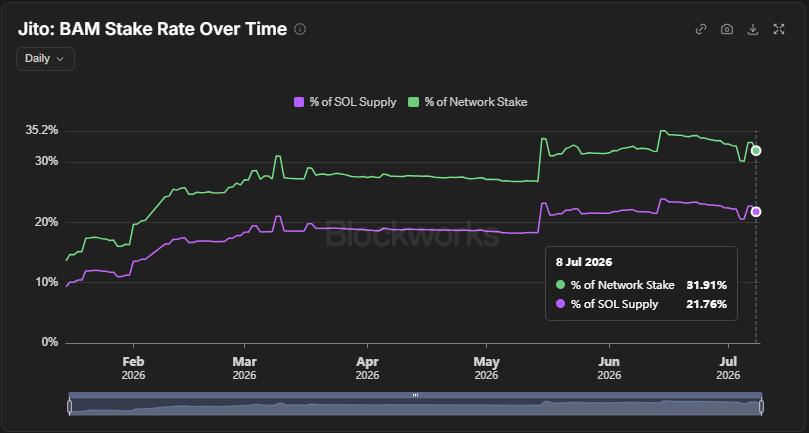
Gelanceerd in september 2025, introduceerde de BAM een nieuwe, krachtige architectuur voor het bouwen van blokken op Solana. De acceptatie is in een stroomversnelling geraakt: 369 van de 715 validators van Solana draaien nu de BAM-client van Jito, wat neerkomt op 51,6% van de validators. BAM-validators zijn momenteel goed voor 31,9% van de totale ingezette $SOL, wat neerkomt op ongeveer 10,65 miljard dollar aan inzet.
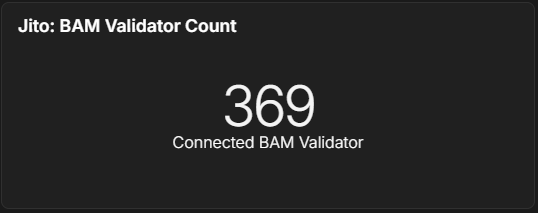
In 2026 tot nu toe is het aandeel van BAM in het netwerk gegroeid van ongeveer 12% naar 32%, zijn er bijna 150 validators bijgekomen (van 223 naar 369) en is de totale inzet van $SOL via BAM-validators de grens van 80 miljoen overschreden.
Jito Labs is doorgegaan met het uitbreiden van de mogelijkheden en infrastructuur van BAM. In april bracht het team de BAM-plugin uit, waarmee prop-AMM’s een speciaal transactiepad kregen om koersen met tussenpozen van 50 milliseconden bij te werken. Het systeem introduceerde een mate van voorspelbare, TradFi-achtige uitvoeringsprecisie die voorheen niet bestond op een gedecentraliseerd netwerk. In juni ging de Maker Priority Plugin live op Archer Exchange. MPP geeft prioriteit aan transacties tijdens BAM-slots en vermindert schadelijke stromen voor market makers, wat bijdraagt aan krappere spreads voor on-chain markten.
Gisteren, 13 juli, is er een nieuwe BAM-node in Hongkong in gebruik genomen. Deze implementatie breidt de aanwezigheid van BAM in datacenters uit en ondersteunt het bredere doel van Jito om een meer gedecentraliseerd en veerkrachtig netwerk op te bouwen.
Naast de inkomsten uit BAM behoren alle belangrijke inkomstenstromen van Jito al toe aan de DAO, inclusief inkomsten uit $JitoSOL en de Block Engine. Indien goedgekeurd, zou JIP-38 van JTX de nieuwste inkomstenstroom maken die bestemd is voor geautomatiseerde $JTO-terugkoop, terwijl tokenhouders verantwoordelijk blijven voor het bepalen van de langetermijntoewijzing van de netwerkinkomsten na de evaluatie in het vierde kwartaal van 2027.
Disclaimer: Solanafloor is een dochteronderneming van Jito Network
Lees meer over SolanaFloor
SBI en Solana Foundation werken samen om de eerste on-chain financiële markt van Japan op te zetten
Solana zakt onder de $76 nu een liquidatiegolf van $253 miljoen handelaren treft te midden van nieuwe geopolitieke spanningen
Wanneer is de $PUMP-airdrop?