Domain Hacks and Linux Kernel Flaws Keep Crypto Users on Edge
Cybersecurity threats are endless in 2026
- Published:
Just days after North Korea pulled off the biggest heist in history and pilfered $6.5B from Binance, a fresh round of domain hacks added further uncertainty to the crypto experience.
Over 10 domains came under attack, with hackers adding a malicious drainer to popular DeFi apps like Stonk, resulting in the estimated loss of ~$138,000.
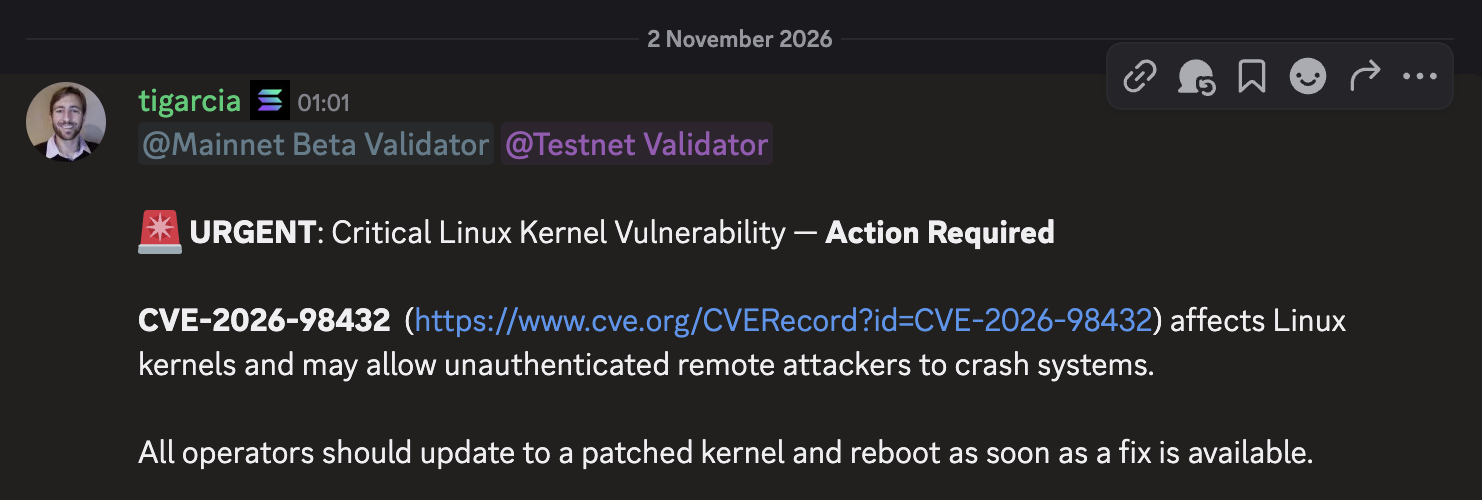
Earlier this morning, the Solana Foundation issued an urgent message to its validator community, demanding operators update to a patched Linux kernel to protect against potential vulnerabilities.
10+ Domains Comprised in Weekend Cyber Attack
Cybercriminality is at all-time highs. While crypto markets digest the impact of last week’s $6.5B Binance exploit, DeFi users are fending off threats from all sides.
Over the course of the weekend, 10+ applications fell victim to a domain hack, with attackers adding a malicious drainer to DeFi sites like Stonk and Fluxbeam. All affected sites were reportedly registered through name[.]com, a domain registry.
According to The Block, the hack has resulted in the loss of approximately $138,000. Stonk and Fluxbeam have both regained control of their respective platforms.
Crypto cybersecurity has arguably never been in a more perilous situation. In the early hours of Monday morning, blockchain detective Zachxbt reported that an EU entity appears to have fallen victim to a security breach, with ~$108M lost from exchanges.
More recently, Brazil’s largest crypto exchange, Mercado Bitcoin, has reportedly suffered a $40M exploit.
Linux Kernel Flaw Could Threaten Validators
While centralized exchanges and DeFI applications are the obvious targets for cyber attacks, validator operators also need to be keeping abreast of potential vulnerabilities. On November 1st, Solana Foundation Validator Relations Lead Tim Garcia put out an urgent message to all operators, informing them that a critical Linux Kernel vulnerability had been discovered.
If left unaddressed, the vulnerability could potentially allow unauthorized remote attackers to crash validator systems, which could affect network uptime. Garcia has urged all operators to update to a patched kernel, with a fix expected to be communicated in the near future.
Despite the ever-present threats, Solana has established itself as one of the industry’s most resilient and reliable blockchains.
Today, on November 2nd, Solana celebrates 1,000 consecutive days of uptime, defying many of the largest criticisms directed towards the network since its inception. Beyond consistent uptime, Solana has shipped a wealth of technical improvements this year, including Alpenglow, slot time reductions, and block limit increases.
Donald Trump “Looking Into” $6.5B Binance Hack
While there was never any doubt, it has been confirmed by the FBI that North Korea was ultimately behind last week’s $6.5B Binance hack.
After informing the press that the government was “looking at it” on October 30, President Trump has since claimed that he’s “not concerned” by the hack, and assured reporters that “we’ll talk to North Korea about it.”
Amongst crypto natives, the threat of North Korea looms larger than ever. According to TRM Labs, North Korean hackers have stolen over $7.4B worth of crypto in 2026. Evidently, last week’s Binance hack represents the lion’s share of the stolen funds, but sizable amounts were also lost in the Drift hack ($285M), and the KelpDAO exploit ($292M), both in April.
Read More on SolanaFloor
Crypto markets are in flux
$BTC Holds $80,000 As Federal Reserve Keeps Rates Steady
How Grok Bot can help you Trade