
Coinbase Withholds Support for CLARITY Act Amid Stablecoin Yield Dispute
Unresolved yield debate keeps the CLARITY Act in limbo.
- Published:
Coinbase, the largest cryptocurrency exchange in the United States, has once again declined to support the latest draft of the CLARITY Act as lawmakers continue negotiations over stablecoin regulation. The decision underscores a broader disagreement between the crypto industry and traditional banking institutions, with stablecoin yield provisions at the center of the debate.
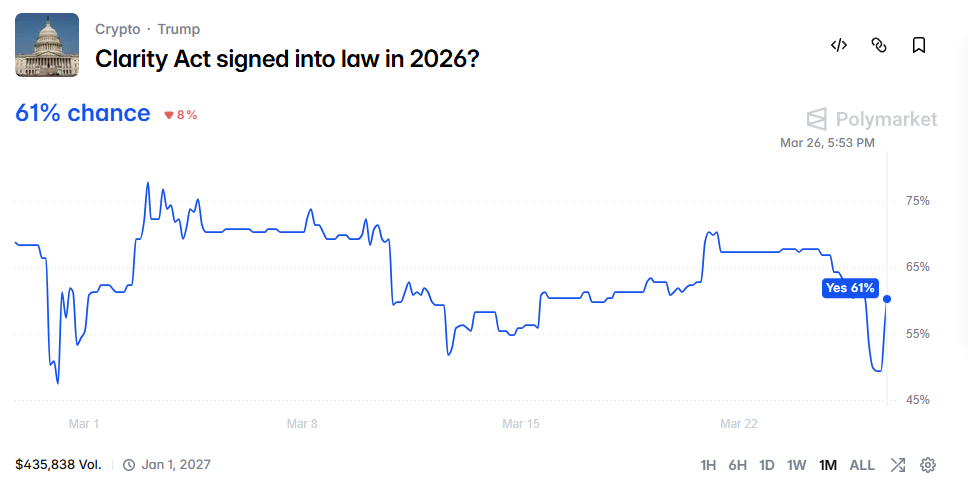
Prediction markets reflect continued uncertainty around the bill’s prospects. Following the news of Coinbase’s opposition, odds of the CLARITY Act being signed into law in 2026 on Polymarket rapidly nosedived from 68% to around 50%. As of the time of writing, odds have improved to a 61% probability.
Coinbase Raises Concerns Over Yield Restrictions
According to a report from Punchbowl News, Coinbase informed Senate offices earlier this week that it could not support the updated legislative text. The latest draft includes a compromise proposal aimed at addressing concerns from the banking sector regarding stablecoin yield.
Sources familiar with the discussions indicated that Coinbase expressed significant concerns about the proposed language. Senators Thom Tillis and Angela Alsobrooks led the effort to craft the compromise, which would restrict how crypto platforms offer rewards tied to stablecoin holdings.
The proposal would prevent exchanges from paying yield on idle stablecoin balances. It would also limit access to transaction-level data, making it more difficult for platforms to calculate and distribute rewards. These changes could materially alter how stablecoin products function in the United States.
Coinbase has taken a consistent position on this issue. The company previously withdrew its support for a Senate Banking Committee draft in January that included similar restrictions. At the time, CEO Brian Armstrong argued that banks were lobbying to limit competition from crypto platforms.
Banks and Crypto Firms Remain at Odds
The dispute over stablecoin yield reflects a fundamental divide between two financial ecosystems. Banks have strongly opposed allowing yield on stablecoin balances. They argue that such incentives could draw deposits away from traditional institutions, which rely on those funds to extend credit.
Crypto companies present a different perspective. They argue that allowing yield on stablecoins would expand financial flexibility for consumers and create new revenue opportunities for both fintech firms and banks. Industry participants view yield-sharing as a natural extension of how underlying reserves generate returns.
Lawmakers have attempted to bridge this gap. The White House has hosted multiple closed-door meetings involving policymakers, banks, and crypto firms, with Senator Bernie Moreno previously expressing hope that Congress could approve the legislation by April. Despite these efforts, participants have not yet reached a consensus.
Reaction from Policymakers and Industry Voices
Public commentary around the CLARITY Act reveals differing interpretations of the current situation and highlights the time sensitive and political nature of the debate. Senator Cynthia Lummis stressed that lawmakers cannot afford further delays and framed the current political environment as a critical window for action. She wrote, "Bipartisan compromise is necessary for the Clarity Act to pass. America’s financial future is at stake now— we can’t wait until 2030 for another chance."
Patrick Witt, executive director of the President’s Council of Advisors for Digital Assets, used a sports analogy to suggest that stakeholders should act before the opportunity closes. He wrote, "Quarterbacks often talk about what’s called an internal clock. Knowing when to get rid of the football or leave the pocket before you get sacked. It’s an important concept that applies to many areas of life. This is a tweet about crypto." His remarks point to a view within the administration that compromise may be necessary to secure progress.
Industry participants have also weighed in with a political lens. Some have urged Coinbase leadership to support the bill in its current form and refine it later, especially given uncertainty around future congressional control. Tommy Shaughnessy, founding partner at Delphi Ventures, wrote, "We need a bill and clarity before democrats take back the house. Once Crypto and stablecoins grow significantly we can revisit this down the road."0
Others continue to back a firmer stance against restrictions that could limit innovation.
Notably, Coinbase CEO Brian Armstrong has not issued a direct public statement on the latest compromise. However, he has reiterated a broader view that stablecoins represent a significant growth opportunity and that the “smartest” banks increasingly see crypto as a complementary technology rather than a direct competitor.
Still, the central issue remains unresolved. Policymakers must determine whether stablecoin issuers and platforms can pass on yield generated by underlying reserves. This question has shaped months of negotiations and continues to delay progress.
Read More on SolanaFloor
Solana DEX Spot Volume Continues To Rival and Exceed Spot Volumes of Major Centralized Exchanges
Solana DePIN Protocols Generate $2.4M in February 2026 as Growth Shifts Across Sectors
What Does the CLARITY Act Passing Actually Mean For Crypto?