CLARITY Act: Final Text Meets 126 Democrat Demands Ahead of Tomorrow’s Cloture Vote
Clarity approval odds surge as Trump agrees to ethics provisions
- Published:
CLARITY is closer than ever. Senator Lummis has released a final draft of the Digital Asset Market Clarity Act on Sunday, including key changes to reflect the 126 changes requested by the Democrats.
With President Donald Trump agreeing to ethic clauses floated as a reaction to his highly-lucrastive crypto ventures, odds of the bill passing have roared back to life.
What are the biggest changes to the bill’s text, what does it mean to be sufficiently decentralized in the eyes of regulators, and which crypto app’s might not qualify for the framework?
What’s New in the Final Clarity Text?
The biggest shift sits in ethics. State attorneys general now get direct enforcement power over three bans: officials issuing or sponsoring a digital asset, holding a significant financial interest in one, or exchanges listing an asset issued in violation of those rules.
Covered individuals must divest or place holdings in a qualified blind trust, a standard borrowed from the Ethics in Government Act of 1978. Penalties run 20 percent of the transaction value or $500,000, whichever is greater. The rules take effect 360 days after enactment, or 60 days after the implementing rule for section 10102, whichever comes first.
As for stablecoins, the fiat-pegged assets will get their own circuit breaker. If the Treasury Secretary determines deposit flight is hitting community banks at scale as the general public flood onchain, Treasury can restrict stablecoin rewards for up to 18 months.
The Blockchain Regulatory Certainty Act edits are smaller but matter for builders. Developers keep their shield from money-transmitter registration, and that protection now extends to miners and validators who weren't covered before.
In the eyes of crypto advocates, the Republicans have now addressed all the outstanding objections levied by the Democrats. Moonrock Capital’s Simon Dedic argues “who’s left to disagree”, calling for regulators to embrace a bill that will advance one of the most transformative industries in financial history.
Trump Agrees to Ethics Provision
As far as the Senate is concerned, the long-standing ethics debate revolves almost entirely around one family. Trump's 2025 financial disclosure showed more than $1.4 billion in crypto-related income, most of it from World Liberty Financial, the USD1 stablecoin, and the $TRUMP memecoin.
World Liberty Financial alone accounted for over $500 million of that total, according to Trump's filing with the Office of Government Ethics. The venture, co-founded by his sons, sells governance tokens directly to the public, the kind of arrangement Democrats argued a sitting president shouldn't run while his administration writes the industry's rules.
A senior Republican aide put Trump's buy-in at roughly 80 percent of the Tillis-Gallego ethics proposal, crediting the state attorney general enforcement piece as the biggest concession.
The final language doesn't stop Trump and the rest of the White Houose Cabal from holding crypto, only from issuing or sponsoring new assets while in office. The same laws will apply to all elected officials moving forward, discouraging future members of government from launching memecoins of their own.
Which Apps Will Not Qualify?
Inspired by Sarah Brennan and the Decentralization Research Center’s eight-prong Decentralization test, Division A of the bill lays out CLARITY’s "coordinated control" standard. A network has to clear five factors to escape securities treatment:
-
Open - is the code public and open source?
-
Permissionless and credibly neutral - can anyone censor, restrict, or grant itself preferential treatment?
-
Distributed - does any single party hold more than 49 percent of tokens or voting power?
-
Autonomous - has the network reached a state where no one can unilaterally change how it operates?
-
Economically independent - are the token's value mechanisms, like buybacks, esatblished?
The bill also defines a "distributed ledger control person" as anyone who can alter a network's functionality or consensus rules. A single operator running the only sequencer or validator set fits that almost by design.
Hyperliquid is the clearest large-app test case. Its small, foundation-influenced validator set and history of manual, albeit necessary, intervention, could cause some difficulties for the perps giant. The Hyperliquid Foundation validators constitute roughly 47% of all staked $HYPE. While this does come under the bill’s 49% threshold, there’s an argument that team allocations could tip the scales against Hyperliquid’s favor.
That said, President Trump recently stated in a public address his administration’s intention to “bring Hyperliquid to the United States”, so it’s likely that the two entities will work together to ensure the venue is compliant.
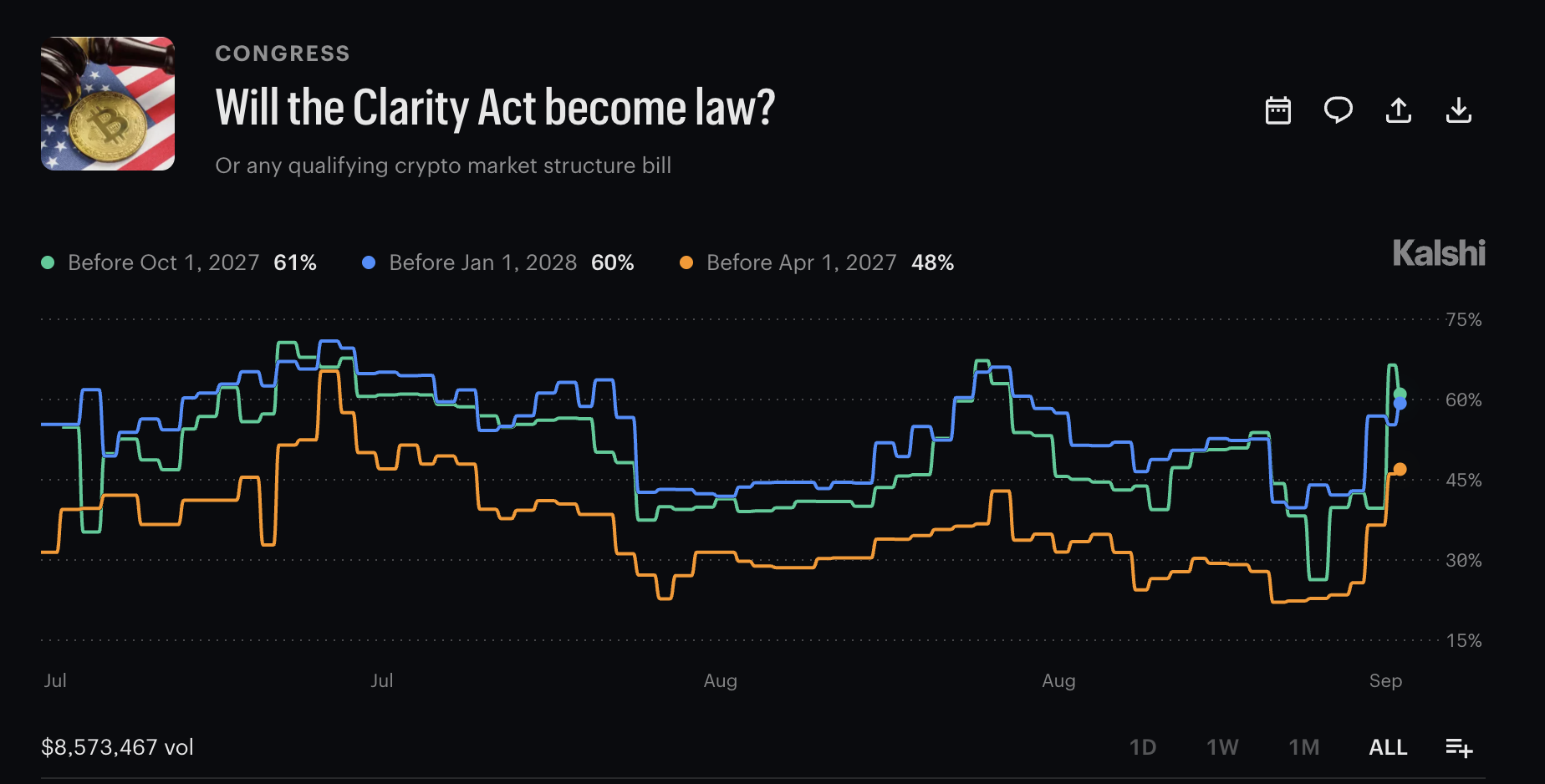
Prediction market forecasts have flipped optimistic on CLARITY’s passing, with approval odds soaring following the final bill’s public release. All eyes now turn towards tomorrow’s vote, which may decide the regulatory future of crypto in the United States.
Read More on SolanaFloor
Solana validators keep winning
Jito BAM Preconfirmations Go Live, Unlocking New Revenue Stream for Solana Validators
Solana Foundation’s Vibhu Norby Joins The Big Picture