Are Memecoin Traders Leaving Solana for BNB and Robinhood? Onchain Data Disagrees
KOLs claim memecoiners prefer rival chains, but are they right?
- Published:
- Edited:
With memecoin mania spreading throughout the cross-chain economy, traders are questioning Solana’s relevance and authority as crypto’s speculative hub.
As social trading apps like fomo onboard tens of thousands of new users, trader profitability is once again under the spotlight. Meanwhile, traders argue that new features from heavyweights like Axiom are transforming the onchain economy into an even more vicious environment for new users.
Have Solana’s memecoin traders truly migrated elsewhere? Onchain data disagrees.
“The Action is Everywhere Else But Solana”
Solana has undeniably been the home of memecoin trading for many years. Metas come and go, new chains rise and fall, but ultimately, Solana is the first port of call for memetic energy and onchain speculation.
However, with consumer-friendly crosschain apps onboarding new traders in droves, crypto KOLs and market participants argue that Solana is losing its grip on the sector.
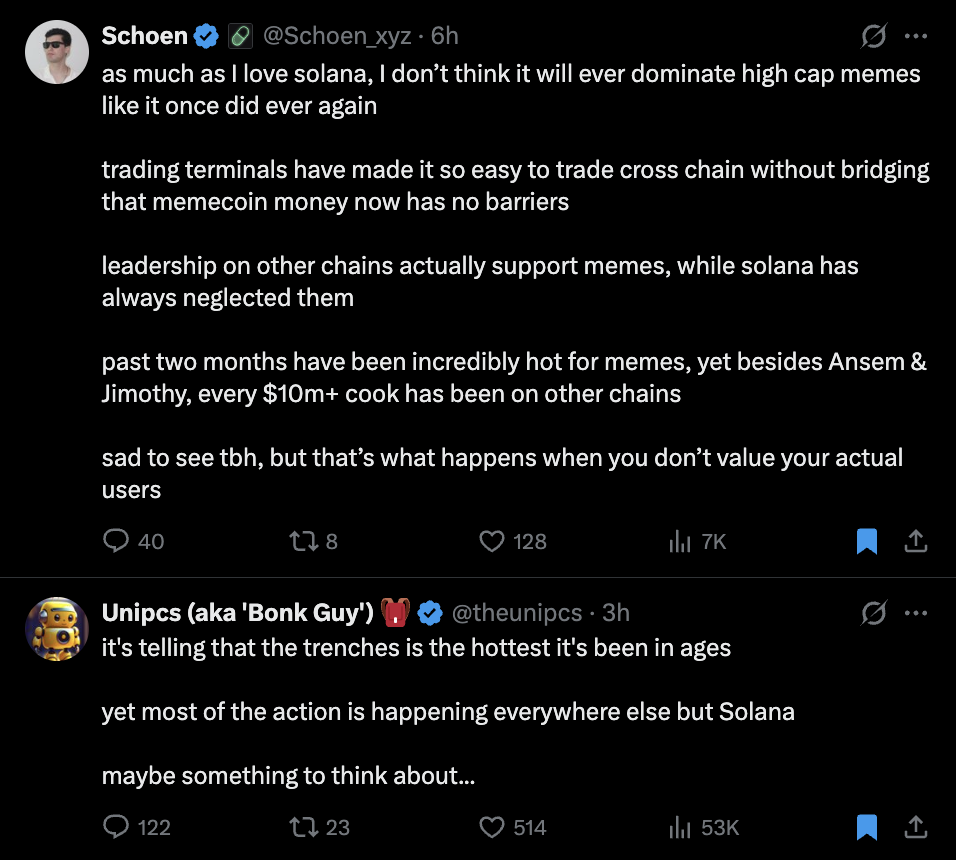
Amidst fierce competition between trading apps like fomo and pump, critics have noted that Solana’s memecoin economy is struggling to produce the same high-profile PvE runners as other chains.
Where high-profile coins like $KET and $TOAD have struggled to break a market cap of $20M on Solana, memecoins on rival networks like BNB’s $牛来 roared to over $40M. Outside of $ANSEM, the memecoin that arguably sparked this current season of memecoin mania, Solana-based coins have largely been outperformed by cross chain rivals.
Some might argue this signals a changing of the memetic guard, other traders are adamant that the rotation away from Solana could mark the end of another period of onchain abundance. Meanwhile, independent analysts suggest that slowing momentum comes from new traders simply running out of funds.
Trader Profitability Back in the Spotlight
Social trading apps like fomo have enjoyed massive growth in recent weeks, onboarding tens of thousands of new traders to the onchain economy. Unfortunately for the bright-eyed and optimistic new trader, the trenches have become a fiercely competitive and cutthroat environment.
Where leaderboards and PnL cards make it look like everyone is winning, independent analysts argue that only 6% of traders on Solana are actually in the green, with the median trader losing $120.
For the unsuspecting retail trader, who’s first experience might come through social applications like fomo, the memecoin economy is deceptively complex. This is evidenced by new features like Axiom’s Husher, a marketplace for aged wallets that ultimately enables traders to obfuscate their holdings and bundle large amounts of a new coin’s supply across unlinked wallets with a diverse and ‘reputable’ history.
Traders have pushed back on Axiom’s latest feature, arguing that it makes what is already an extremely PvP environment even more predatory. To counter the threat of Axiom’s Hushed marketplace, some onchain traders have already built out defence systems, compiling all Hushed wallets into a free blocklist that traders can reference.
What Does Trading Data Say?
Between KOLs calling for the end of Solana’s memetic reign and the belief that only 6% of fomo traders are profitable, there’s a solid argument that a great meme-gration is underway. Unfortunately for the critics, onchain data paints a slightly different picture.
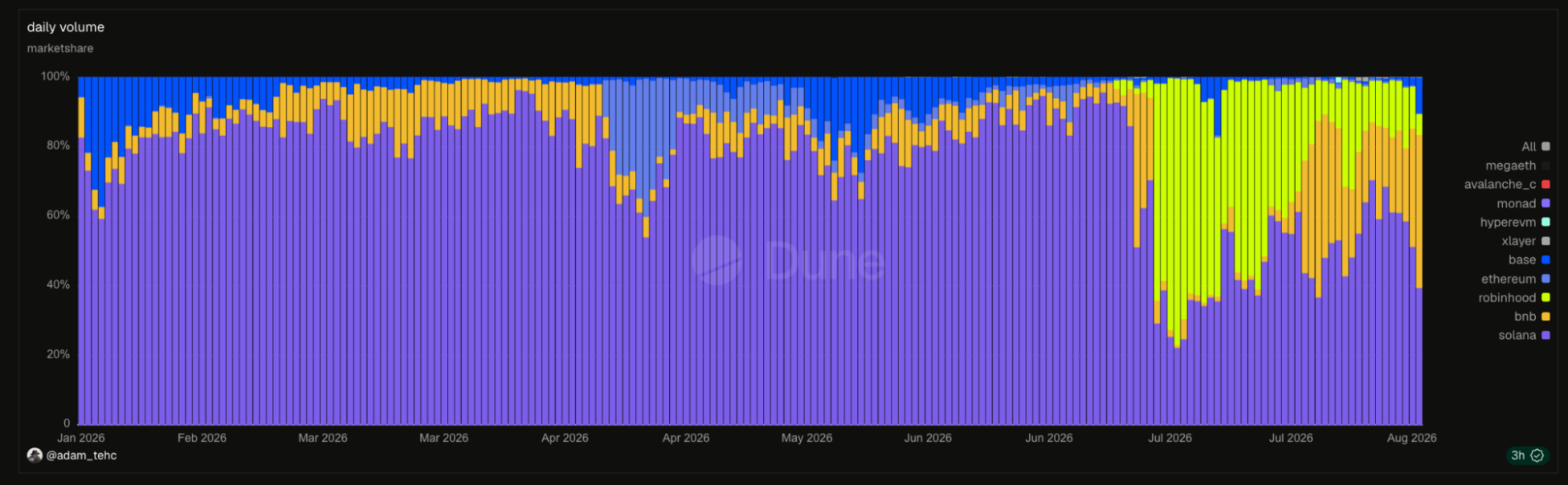
According to Dune Analytics data, Robinhood’s stint of dominance as crypto’s memecoin hub was relatively short-lived, lasting only a matter of weeks before being consumed by BNB Chain. Solana has since regained dominance, though BNB Chain has captured the lead following the success of $牛来.
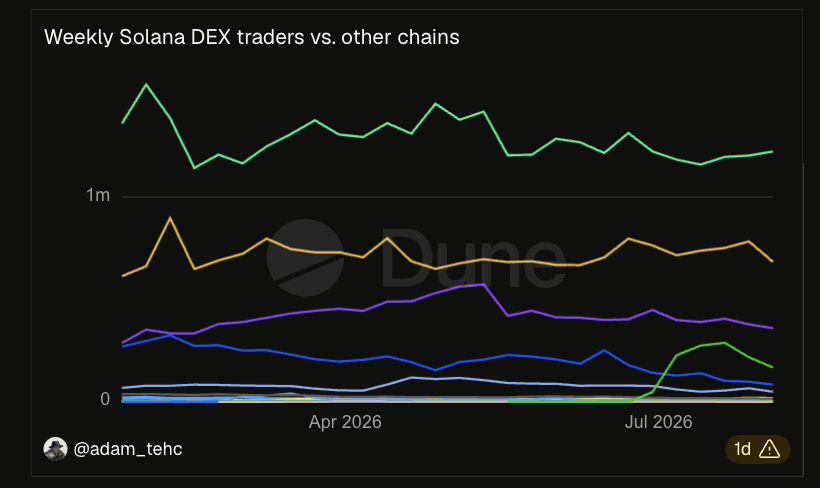
Additionally, Solana boasts a significantly higher number of onchain traders than rival networks, suggesting more widespread market activity. Blockworks data suggests that over 46% of Solana’s daily volume flows through memecoin pairs, reinforcing the belief that the memecoins still have a home on crypto’s most active network.
This is far from the first time that traders have called for the end of Solana’s memecoin dominance. A similar dynamic played out with a temporary migration to BNB Chain in October 2025. More recently, Robinhood chain’s initial liquidity boom in July has already rotated back to Solana, reaffirming a lindy-esque belief that the network will retain its memecoin crown.
Read More on SolanaFloor
Blockchain-based Trading Firms Welcome Better Data
DoubleZero Embraces Prediction Market Data, Adds Kalshi Orderbooks to Edge Dataset
How High Can Solana Go in 2027?