Top Breakout Solana Apps in 2025
DeFi ruled Solana’s app layer in 2025
- Published:
- Edited:
The Manlets and SOLadies were spoilt in 2025, with dozens of onchain apps across Solana tasting success in what was arguably the chain’s best year ever.
While we saw creative applications emerge at every layer of the stack across a wealth of sectors, it comes as no surprise that DeFi apps dominated attention and usage throughout the year.
It’s easy to celebrate established heavyweights like Jupiter, Kamino, and pump.fun, but who are the new kids on the block reinventing the onchain economy?
Looking back on an incredible 2025, which new Solana apps sparkled brightest?
Axiom
Could it really have been anyone else? Beyond being a brilliantly successful crypto company, Axiom has arguably enjoyed one of the greatest debuts in history across all sectors. In May, the Solana-based trading terminal became the fastest Y Combinator company to hit $100M in revenue, generating 9-figures in just 129 days after launching in January.
Axiom didn’t stop there. As its notoriety grew, Axiom became the default platform for traders exploring Solana’s memecoin circus, hitting $200M in generated revenue in 202 days, and then $300M in 263 days.
Loopscale
Since AAVE pioneered onchain lending markets in 2017, innovation in this field has been relatively subdued. Across virtually all apps and chains, lending markets replicated a simple pool-based model, with little deviation from the tried-and-true formula.
Loopscale, an emerging Solana-based app that launched to the public in Q2 2025, brought lending markets back to first principles. Steering away from pools, Loopscale matched lends and borrows using an orderbook, arguably bringing greater efficiency and composability to onchain credit markets.
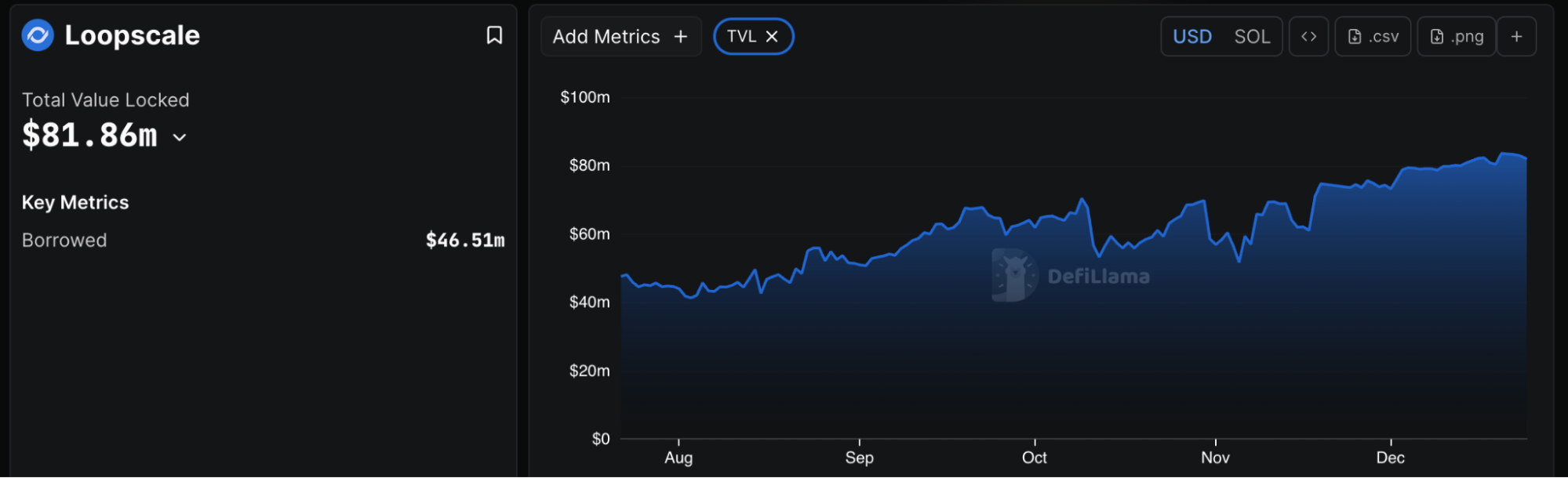
Aside from an unfortunate exploit in April, of which all funds were recovered and all depositors made whole, Loopscale’s TVL has trended upwards all year. Much of this growth arguably comes from Loopscale’s embrace of a broad range of RWA assets, which means that Loopscale’s USD-based TVL is largely unaffected by $SOL’s volatile price swings.
The optionality of orderbook-based credit markets is also arguably more favourable for institutions and RWA issuers. While traditional pool-based lending apps are subject to changing rates, Loopscale enables more specific terms, like fixed APYs and loan duration.
Hylo
When I first heard about Hylo, I will admit that even hearing the term “algorithmic stablecoin” gave me terrible flashbacks. But, after several months and one depeg-free $19B liquidation event later, Hylo’s native stablecoin, $hyUSD, has proven its resilience.
Hylo is a novel Solana DeFi application with several moving parts. Combining tokenized leverage on $SOL, a decentralized stablecoin, and LST-yield, Hylo is a veritable Solana DeFi Swiss Army knife.
After quietly launching its private beta in Q2, Hylo started taking off in July. Hylo’s TVL grew exponentially MoM, eventually cracking $100M in early November.
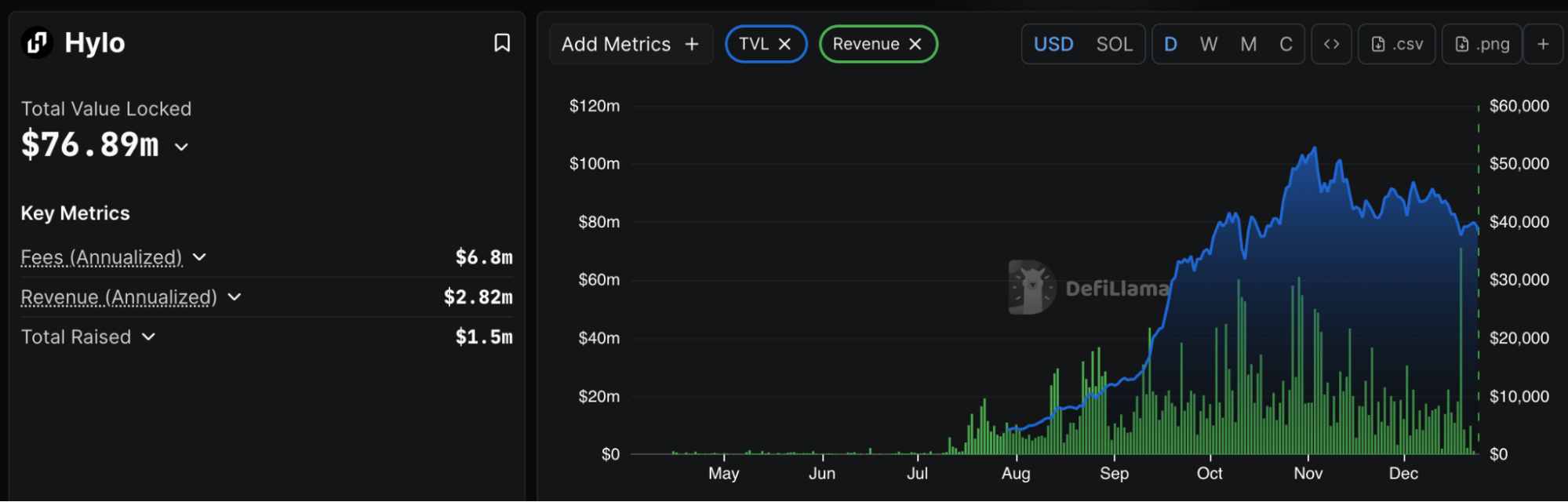
While Hylo’s TVL has retraced with declining $SOL prices, the application’s annualized revenue (based on the last 30 days) is still over $2.8M. More recently, the Hylo team has hinted at implementing tokenized leverage on a wider range of assets, which will help expand Hylo’s product offering and continue to grow TVL.
HumidiFi
There is no app that better illustrates the rise of Prop AMMs and affirms Solana’s position as the home of all onchain finance than HumidiFi. With only $7-9M in inventory, HumidiFi regularly witnesses over $1B in daily trade volume, eclipsing centralized exchanges like Binance and ByBit in SOL-USD pairs.
HumidiFi, and other Prop AMMs, have made Solana’s onchain economy the most liquid venue to trade all kinds of tokens. On the day of the $MON token launch, Solana DeFi processed more trading volume than Monad’s own network, largely due to the quoting efficiency of platforms like HumidiFi.
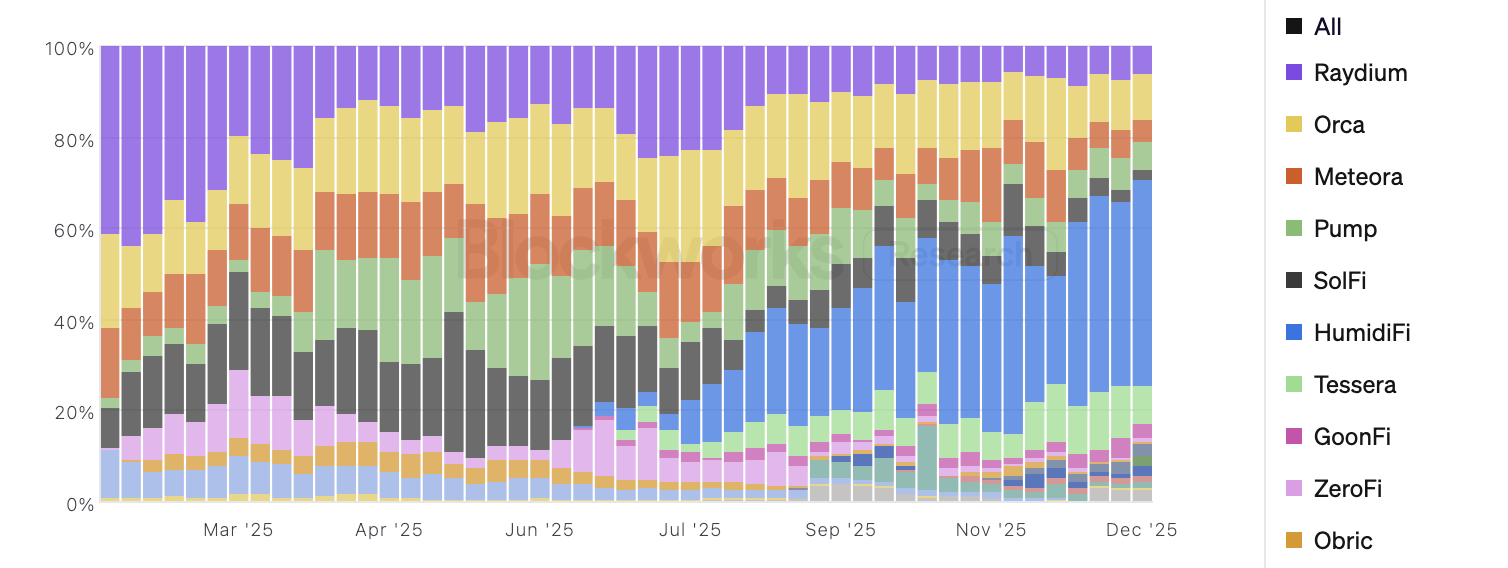
HumidiFi now commands 45% of DEX market share on Solana, and seems to be showing no sign of relinquishing its dominance of the network’s DeFi landscape.
Phygitals & Collector Crypt
On account of having more 0’s, institutional-scale TradFi RWAs like U.S. Treasury Funds have dominated headlines across crypto in 2025. However, for the average degen, the multi-million dollar onchain funds like BlackRock’s $BUIDL and Franklin Templeton’s $BENJI are hardly fun, speculative assets.
On the other hand, Exotic RWAs, like Pokémon cards, are much more palatable for the nostalgia-obsessed crypto-native trader. Tokenized trading cards have enjoyed an incredible year, and apps like Phygitals and Collector Crypt have successfully piggybacked off the dizzying demand for real-world collectibles.
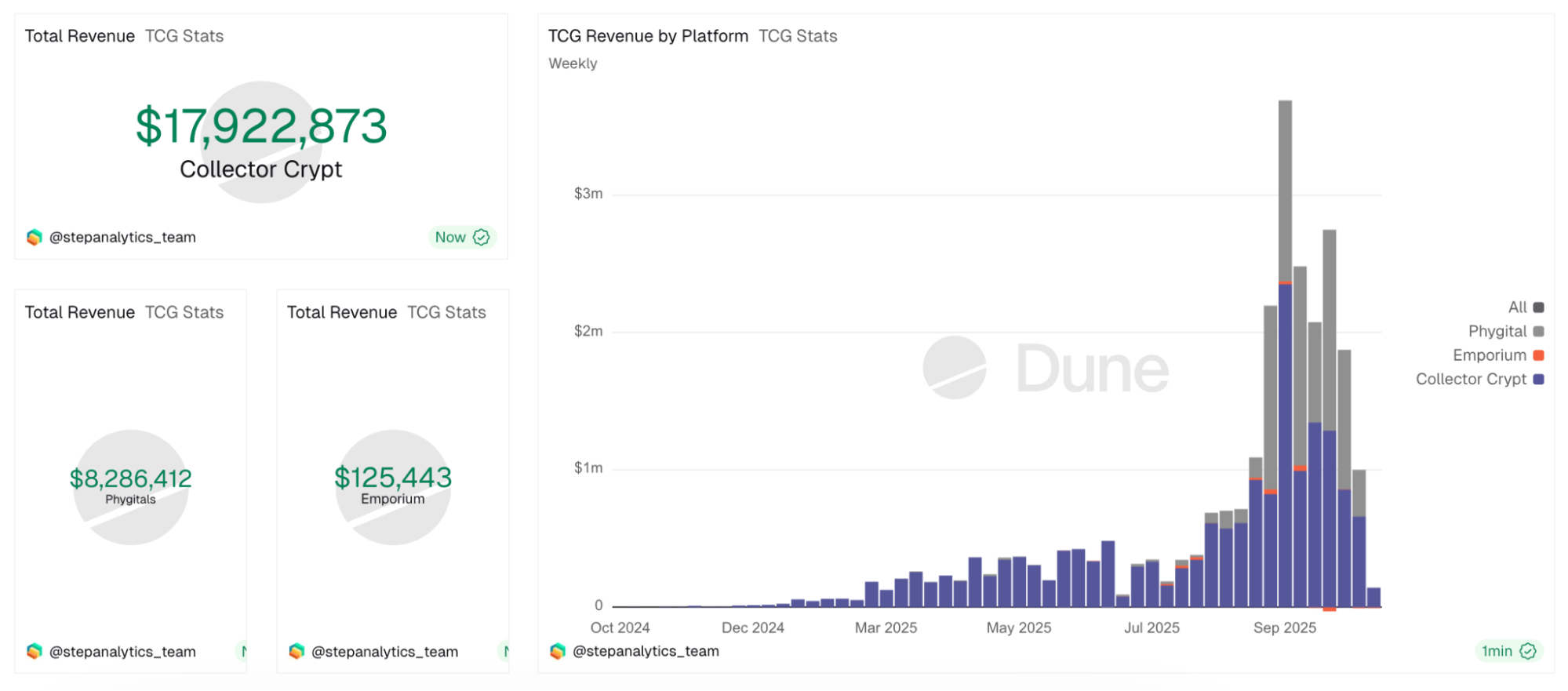
Collector Crypt may have technically launched in the tail end of 2024, but it wasn’t until around March 2025 that onchain collectors started taking notice. As the real-world Pokémon TCG market exploded, gacha spend volume soared, with Solana’s collectible RWA duopoly netting over $26M in revenue.
Privacy Cash
Simple, yet effective, Privacy Cash has quietly become one of Solana’s favorite applications. Allowing users to discreetly transfer funds from one wallet to another, without linking addresses, Privacy Cash now boasts over 11.7k unique depositors.
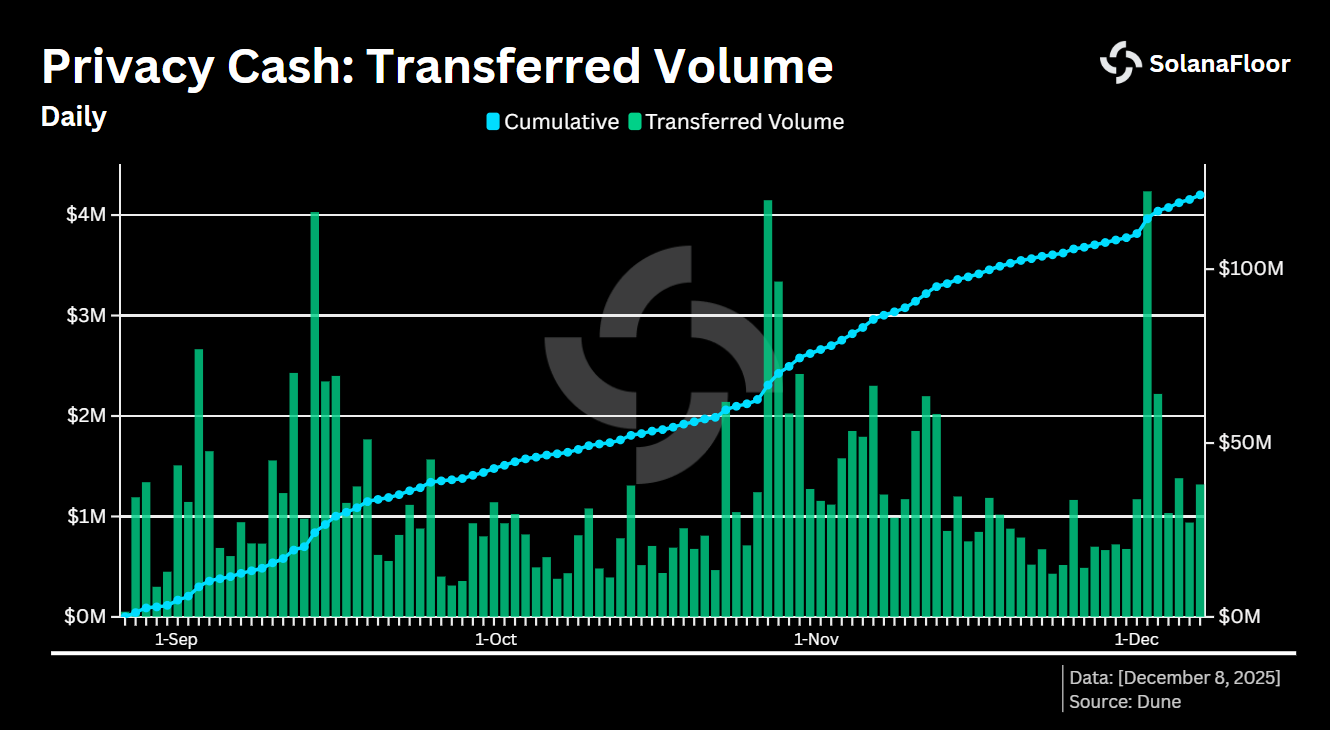
With privacy becoming a popular narrative in the wake of Zcash’s blistering 13x run, more Solana DeFi users are turning to mixing tools like Privacy Cash. A recent SolanaFloor data report indicated that over $121M had passed through Privacy Cash within its first 3 months, netting the protocol ~$241k in fees.
What Can We Look Forward to in 2026?
Solana’s languishing perps scene has been a dark spot on what was otherwise a brilliant year for onchain applications. While the Layer-1 has dominated spot markets, Solana’s perps traders have largely migrated over to rival chains like Hyperliquid in the hunt for an optimized perpetual trading experience.
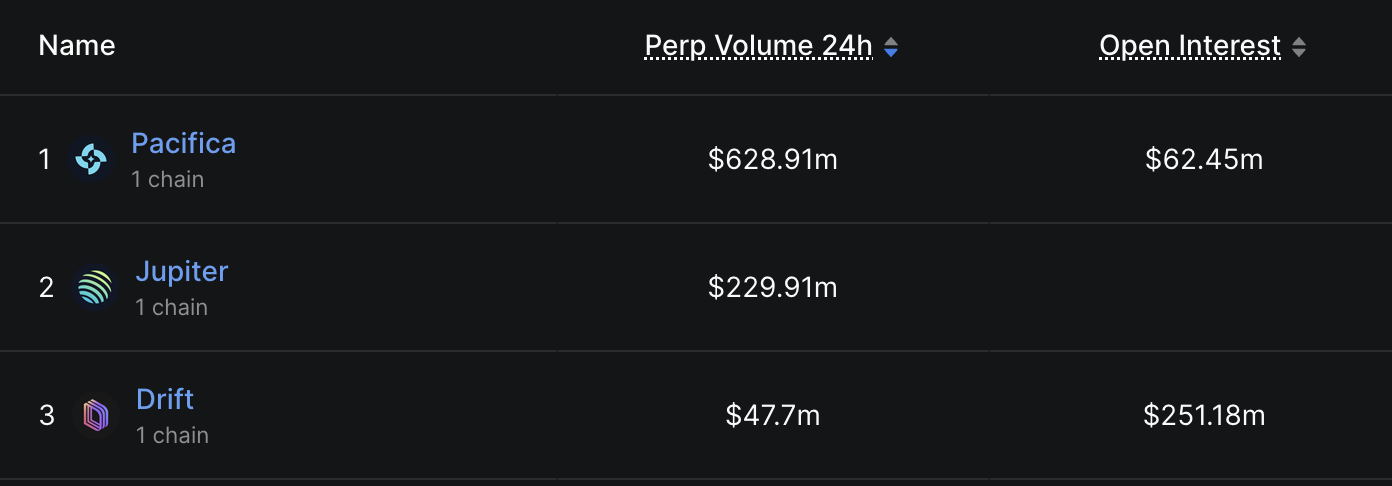
Granted, Pacifica has attracted over $79B in cumulative volume since launching in September to become Solana’s leading perps dex. However, a lopsided volume-to-OI ratio indicates that the majority of Pacifica’s volume probably comes from airdrop farmers and can be expected to decline when incentives end.
Upcoming improvements to Solana’s network infrastructure (ie. Jito’s BAM), and the launch (and relaunch) of new (and old) perps exchanges like Bulk (and Bullet, formerly Zeta Markets), may resolve these constraints and makes Solana’s perps scene competitive. But until these apps hit mainnet, nothing is certain.
Prediction Markets represent the other largely untapped vertical for Solana in 2025. While it will no doubt be exceptionally difficult to dethrone heavyweights like Kalshi and Polymarket from cornering the PredictiFi sector, there’s certainly room for adjacent apps to provide added value.
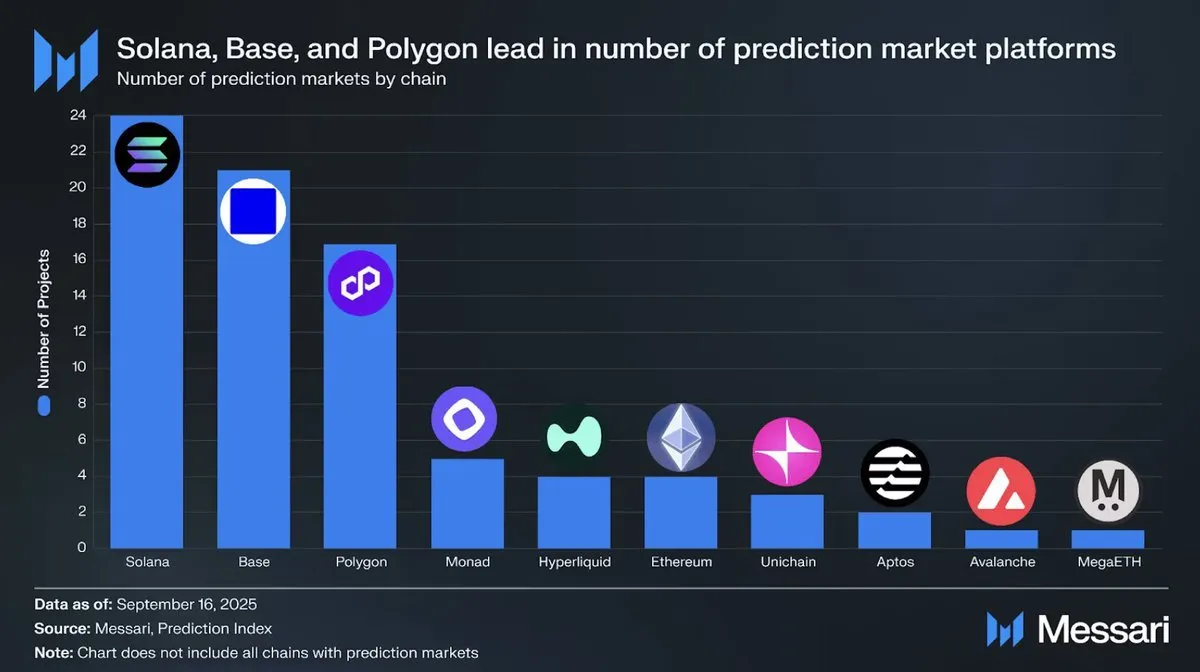
According to Messari, there are already as many as 24 fresh apps seeking to corral Solana’s Prediction Markets, suggesting we could be in for fiercely competitive battles as emerging apps fight for attention and usage.
Beyond the obvious, the beautiful thing about this industry is that we can never truly predict what will cause the next breakout meta or application that takes the world by storm. Even industry titans like pump.fun “failed” on Blast before becoming a unicorn on Solana.
Amidst the chaos, there are some things you can be certain of. Whether $SOL is $8 or $250, or the prevailing meta is perps, predictions, or something we haven’t even heard of yet, SolanaFloor will be on hand to report on it, providing objective and informed coverage of everything happening on Solana.
Read More on SolanaFloor
How Safe are Solana ETFs?
Certora Weighs in on Hidden Security Risks of Solana ETFs
The Banana Zone is Coming?