Squads, Solana’s leading multisig protocol, has successfully tested post-quantum signing for multisig voting members on Solana mainnet, marking a step toward protecting onchain asset management from potential advances in cryptography-breaking technology.
Sean Ganser, cofounder of Squads, announced the milestone on Tuesday, October 13, explaining that the team had tested Falcon-512 signatures for voting members of Squads multisig accounts. The company plans to introduce support in the next release of its SquadsX browser extension.
The development comes amid an intensifying debate over whether AI could accelerate breakthroughs that threaten cryptographic systems used by cryptocurrencies and the wider internet.
How Squads Brings Post-Quantum Signing to Solana
Falcon (Fast-Fourier Lattice-based Compact Signatures over NTRU) is a lattice-based digital signature scheme designed to withstand attacks from quantum computers. Researchers submitted Falcon to the National Institute of Standards and Technology's Post-Quantum Cryptography project in 2017.
Squads' implementation uses Vector, an offchain verification program developed by Blueshift. A voting member signs a transaction instruction with Falcon-512, then Vector verifies the signature against the expected digest and authorizes a Program Derived Address (PDA) to participate in the multisig approval process.
This approach allows Squads to introduce post-quantum authentication without replacing Solana's native Ed25519 signatures or rewriting its core multisig program.
Squads manages permissions, proposals, approvals, and transaction execution through its existing onchain program. Its account abstraction model allows voting members to include traditional wallets, PDAs controlled by other programs, and even nested multisigs.
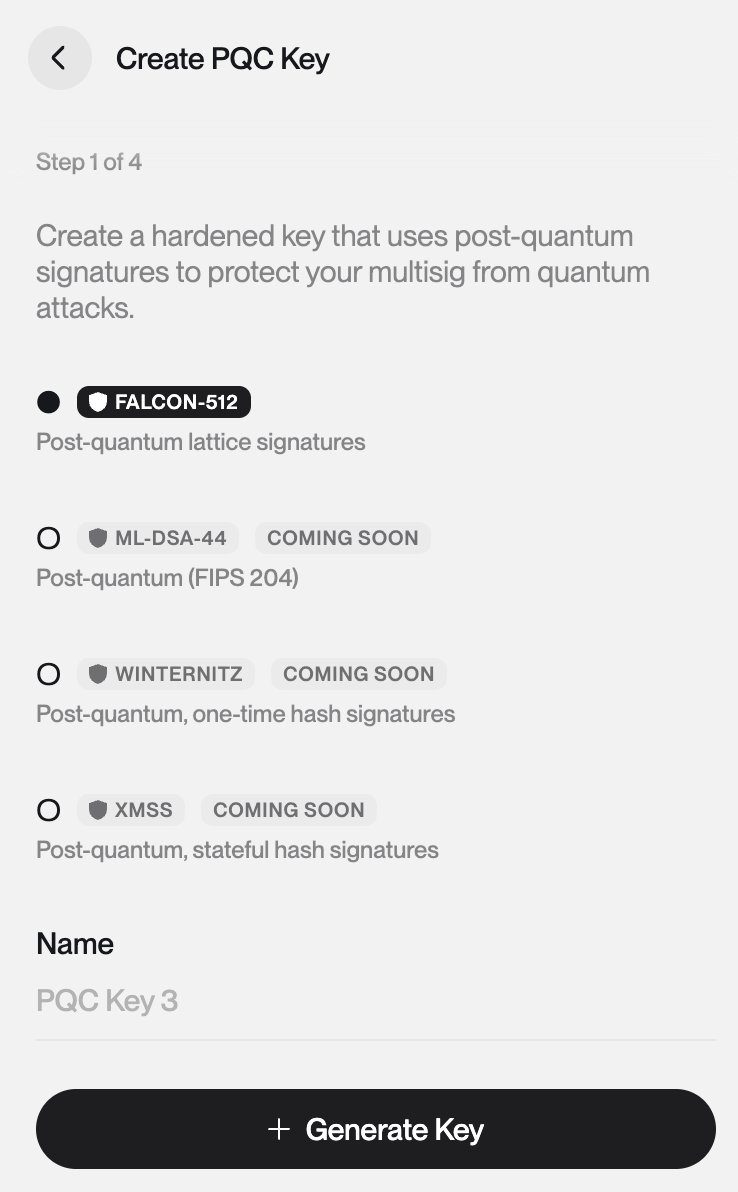
The team has added Falcon-512 to its key management interface, while other post-quantum options, including ML-DSA-44, Winternitz, and XMSS, remain marked as coming soon.
Mixed Signatures Could Strengthen Multisig Security
Squads says its approach allows multisig participants to use different signature schemes within the same approval structure. Consider a 2-of-3 multisig with 2 Falcon-512 signers and 1 traditional Ed25519 signer. Even if an attacker compromises Ed25519, the attacker would still need to compromise at least 1 Falcon-512 signer to reach the approval threshold. This configuration introduces cryptographic diversity without forcing every participant to migrate to a new signing method.
However, the implementation does not make every part of a Solana transaction post-quantum resistant. Solana still requires a native Ed25519 signature from the transaction's fee payer, even when Falcon-512 handles multisig authorization.
Squads proposes separating the fee payer from the account that controls the treasury. A rotating fee payer could hold only enough $SOL to cover transaction costs, limiting the assets exposed if its signing key becomes vulnerable.
Anatoly Yakovenko Urges Developers to Prepare
The milestone follows Solana cofounder Anatoly Yakovenko's October 8 call for wallet developers to begin implementing post-quantum cryptography and establish reliable processes for managing and rotating cryptographic secrets.
Yakovenko's comments followed warnings from Ethereum Foundation researcher Justin Drake, who urged the crypto industry to consider defensive measures against potential breakthroughs in AI-driven mathematics.
Drake argued that attackers could break existing cryptography sooner than expected. Other researchers have challenged the urgency of that scenario, noting that advances in AI mathematics do not demonstrate that attackers can solve the difficult mathematical problems underlying established signature schemes.
There is currently no public evidence that AI has broken the major cryptographic assumptions underpinning widely used digital signatures.
An Early Step, Not a Complete Solution
Squads' mainnet test shows how developers can add alternative signature schemes to existing blockchain applications without redesigning their core authorization systems.
The broader challenge extends beyond selecting a quantum-resistant algorithm. Developers must also establish secure key management, reliable migration procedures, and robust implementations that can withstand real-world use.
Read More on SolanaFloor
Alpenglow Mainnet Activation Set for October 21 - Here’s What You Need to Know
Uptober Canceled? Bitcoin Slips Below $81K & Solana Hits a 1-Month Low
Why Jito’s CEO Is Betting on Tokenized Stocks