Solana Transaction v1 Goes Live, Boosting Capacity by 232%
Developers can pack significantly more complex operations into a single transaction
- Published:
SIMD-0385, better known as Transaction v1, is now live on mainnet, raising the network’s max transaction size from 1,232 bytes to 4,096 bytes, a 232% increase.
Developed by Anza, the upgrade enables builders and engineers to pack complicated tasks into one transaction, rather than needing to split instructions across multiple transactions. Beyond scalability improvements, SIMD-0385 enables a world of new use cases for the network’s developers.
With Transaction v1 deployed on mainnet, Solana’s builders now turn their attention to a stacked Q4 upgrade calendar, which includes further implementations of slot time reductions, account rent reductions, and Alpenglow.
What is Solana Transaction v1?
As of epoch 1035, Transaction v1 is live on the Solana mainnet. The upgrade raises the maximum size of a transaction on the Solana blockchain to 4,096 bytes, a 232% increase from its previous capacity.
In practice, this means that individual transactions can be packed with over 3x more information and instructions, enabling a wealth of new verticals for onchain experimentation.
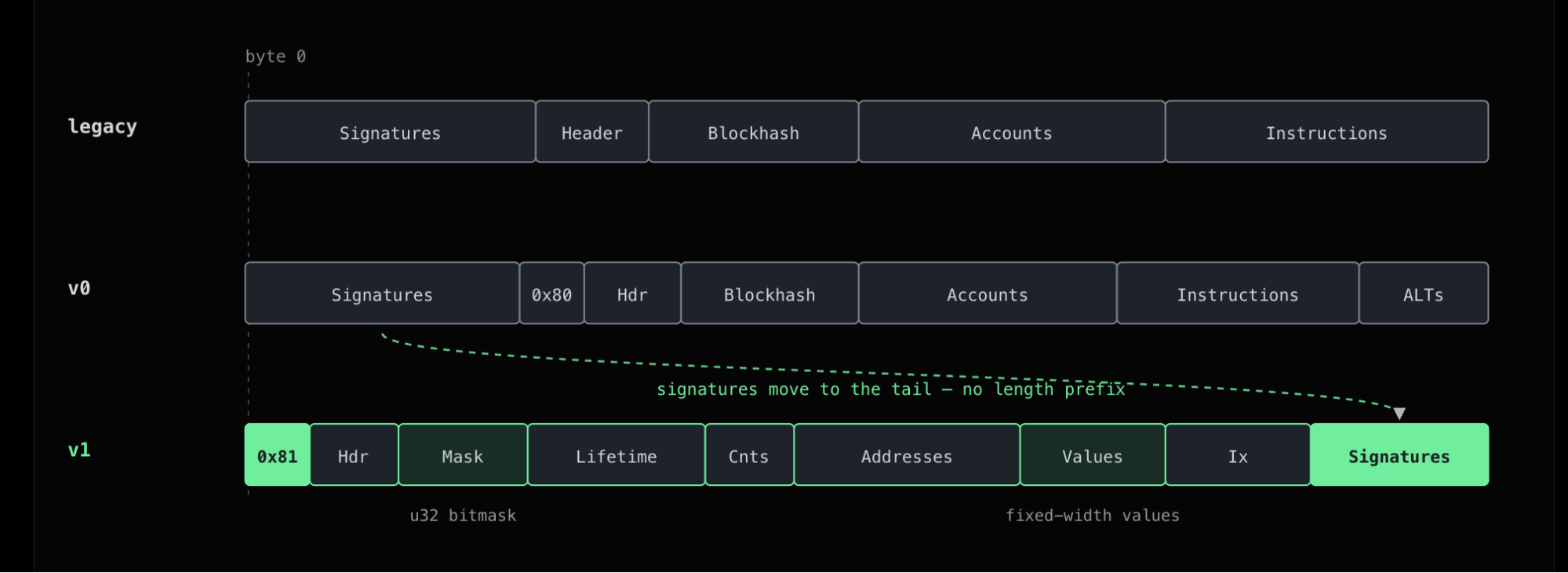
At a technical level, Transaction v1 reorders how components are organized within a transaction. Signatures have been moved to the end, while new configurations like mask and values, which track critical data like CU limits and priority fees live at new fixed positions. This way, the network can rank transactions by priority fee without needing to scan and deserialize the instruction list like it did under Legacy and v0.
What Does v1 Enable Onchain?
Raising the upper bounds of transaction sizes unlocks a wealth of new opportunities for Solana’s builders. Where developers previously needed to fracture instructions and workloads across various transactions and pull them together using address lockup tables or Jito bundles, v1 means that complex tasks can be packaged into a single atomic transaction.
The upgrade removes significant blockers that were inhibiting certain sectors. With maximum transaction sizes rising to 4,089 bytes, engineers are optimistic that new progress can be made in zk-proofs, confidential transfers, Winternitz signatures, nested multi-sigs, and BLS schemes.
At the other end of the risk curve, Solana’s more degenerate community has already embraced larger transactions.
With more bytes available per transaction, developers are now inscribing audio and video material into memecoins, spawning a new meta for the network’s trench-dwellers.
Solana’s Q4 Upgrade Calendar
Despite all the incredible strides taken to improve the network at a fundamental level so far this year, Solana is showing no signs of slowing down in Q4. Having already raised the block limit to 100 CUs and increased compute efficiency by 95% through the p-token standard, Solana still has a wealth of critical updates coming in 2026.
-
Slot time reductions - Rolled out in several phases, network slot times are steadily dropping from 400ms to 200ms, effectively doubling the chain’s potential throughput. Two phased reductions are already in place, dropping slot times to 300ms.
-
Account rent reductions - Cutting the costs of onchain storage, rent reductions will steadily release up to 3M $SOL tokens that were previously locked in accounts.
-
Alpenglow - The biggest network update in Solana history, Alpenglow reimagines the network’s consensus mechanism to bring transaction finality down to 150ms and reduce validator operation costs.
While slot time and account rent reductions are in the midst of being steadily rolled out, Alpenglow is expected to be implemented sometime in October, as part of Anza’s wider Agave 4.3 release.
Read More on SolanaFloor
What should be done about slot laggers?
“Nuke Them From Orbit”: Yakovenko Condemns Solana Slot Laggers
$ORE Founder Joins Solana Weekly News