Solana Commands 49% of x402 Market Share as the Race for Micropayment Dominance Intensifies
Onchain data reveals rapid growth and critical questions about organic demand in emerging micropayment infrastructure
- Published:
Micropayments have long been considered one of the most promising, yet elusive, use cases for blockchain technology. Traditional financial systems struggle to support high-frequency, low-value payments due to fixed transaction fees and settlement latency. The x402 protocol, an open framework built around the HTTP 402 “Payment Required” status code, attempts to address this limitation by enabling direct, programmable payments at the internet protocol level.
Solana’s Rapid Rise in x402 Transaction Share
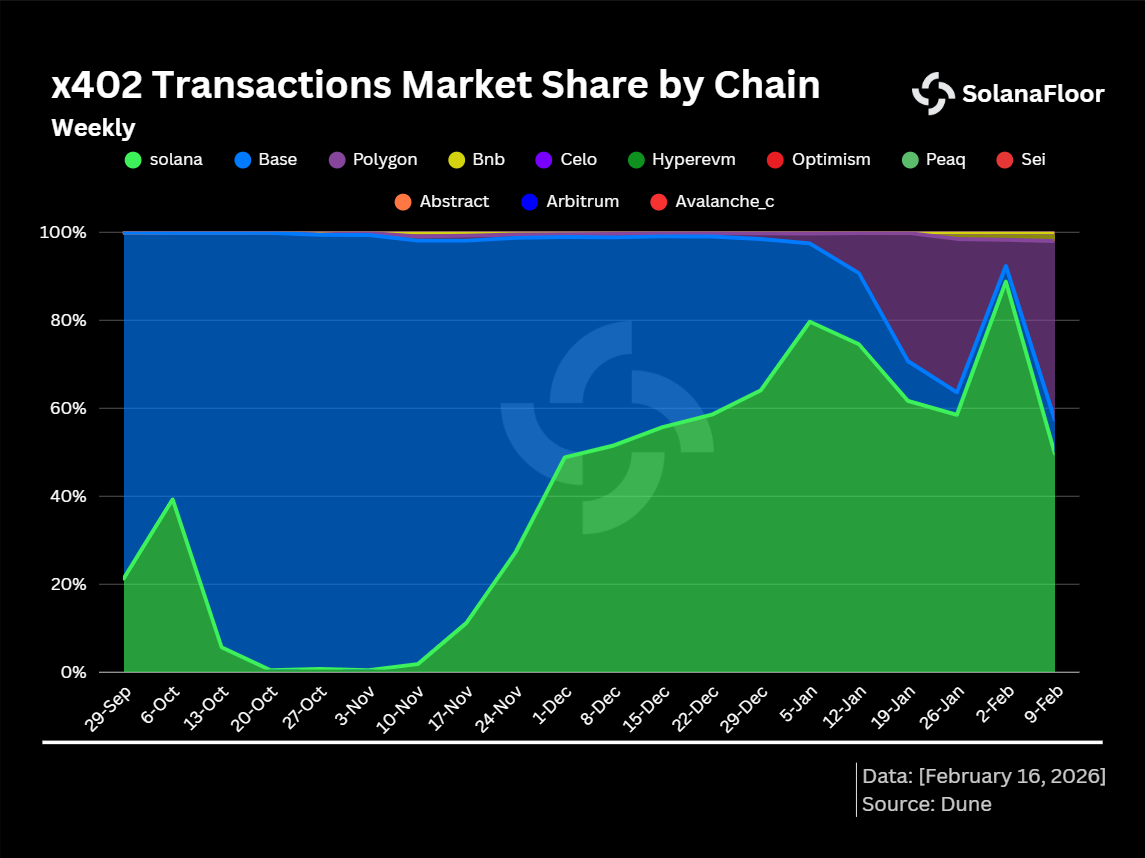 Since late 2025, x402 has generated significant transaction activity across several blockchain. According to Dune Analytics, total x402 transactions across all chains have surpassed 120M. Base currently holds the largest cumulative share with more than 70M transactions, while Solana follows with over 45M.
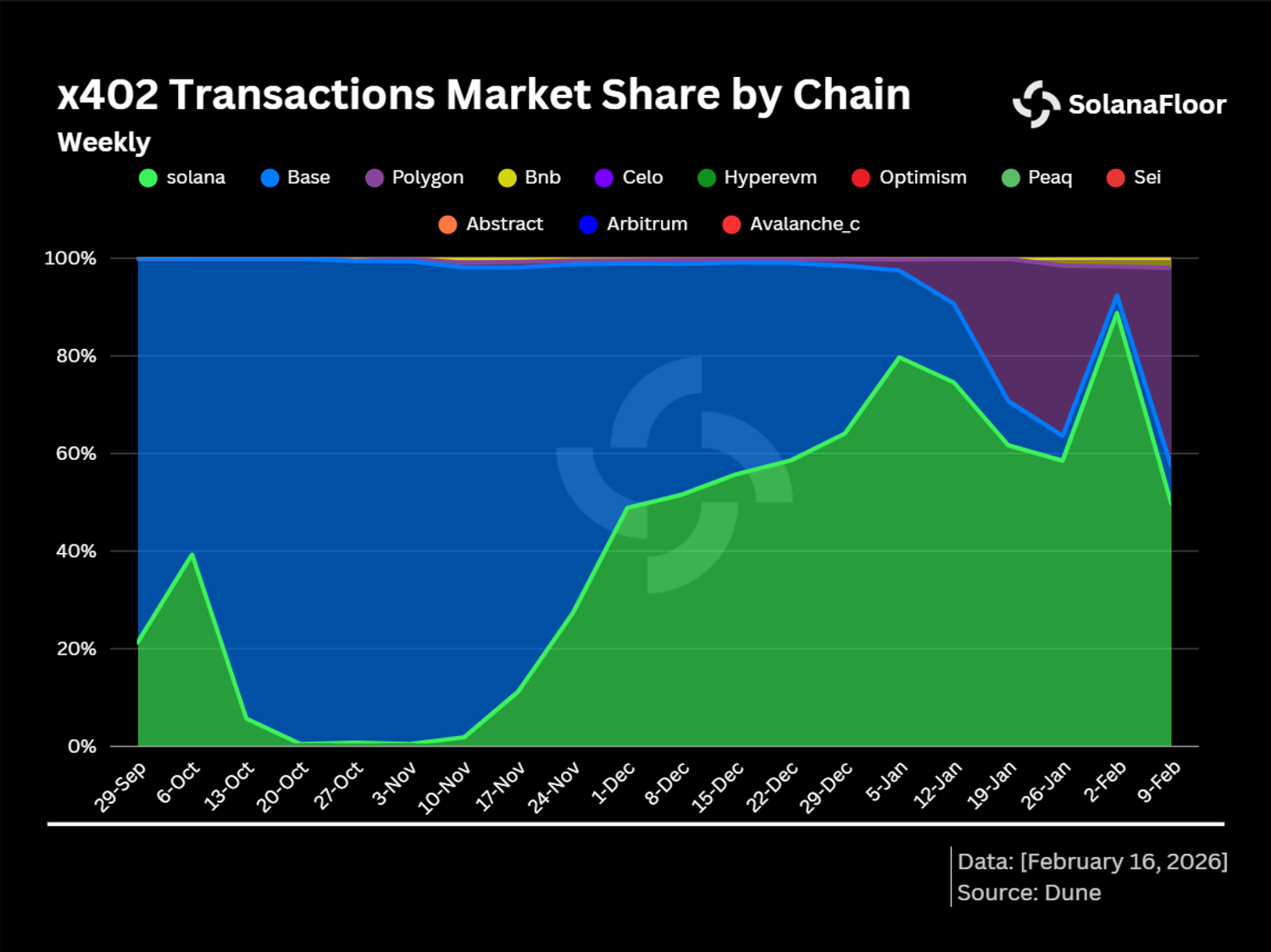
However, cumulative totals do not fully reflect recent momentum. Weekly data shows that Solana has steadily gained transaction share over time. During the week of December 8, 2025, Solana recorded approximately 5.8M x402 transactions, surpassing Base, which processed around 5.3M transactions during the same period.
This trend accelerated further in early 2026. By the week of February 2, Solana accounted for more than 88% of all x402 transactions across supported networks. However, recent data shows a shift in market structure. Following a sharp increase in Polygon activity over the past week, Solana’s share declined to 49.7%, highlighting growing competition among chains to establish themselves as the primary infrastructure for micropayment activity.
Transaction Volume Reflects Similar Network Concentration
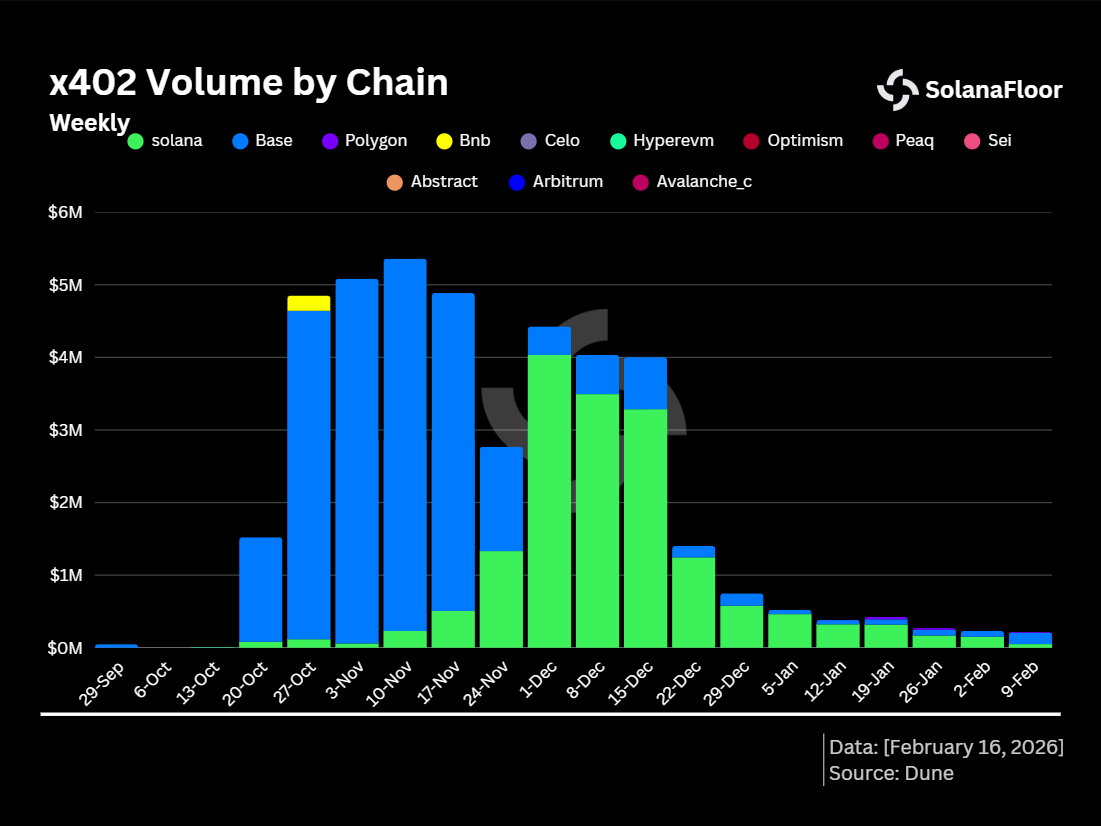 In addition to transaction counts, value transfer volume provides another perspective on network usage. Cumulative value transferred through x402 transactions has exceeded $41M across all chains.
Base currently leads in total volume, with approximately $21.5M transferred, while Solana ranks second with more than $16.4M. The peak weekly volume occurred during the week of November 10, 2025, when more than $5.3M was transferred.
Since then, weekly volume has declined substantially. In the most recent week, aggregate weekly volume across all chains fell below $220,000, representing a sharp decrease from prior highs.
Facilitators Play a Central Role in Transaction Processing
A key component of the x402 ecosystem is the facilitator layer, which handles transaction verification and submission. On Solana, two facilitators, Dexter and PayAI, have accounted for the vast majority of activity.
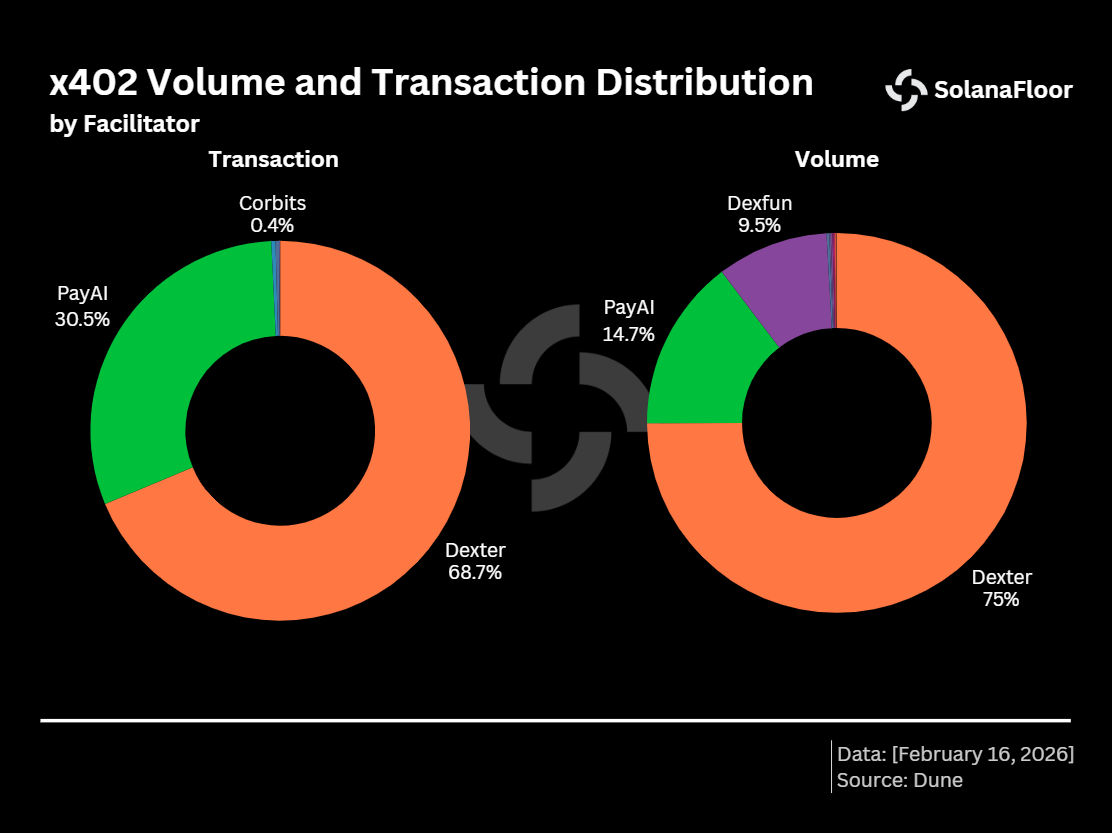 Onchain data shows that Dexter has facilitated approximately 68.7% of all x402 transactions on Solana, while PayAI accounts for 30.5%. Dexter also dominates in terms of volume throughput, facilitating more than 75% of total transferred volume. PayAI follows with roughly 14.7%, while smaller facilitators such as Dexfun account for the remaining share.
Weekly activity peaked during the week of December 22, 2025, when Solana recorded more than 6.8M x402 transactions. Dexter alone processed over 4.9M transactions that week, while PayAI’s highest weekly total exceeded 3M transactions during early December.
Wallet Participation Reveals Shifts in Network Usage
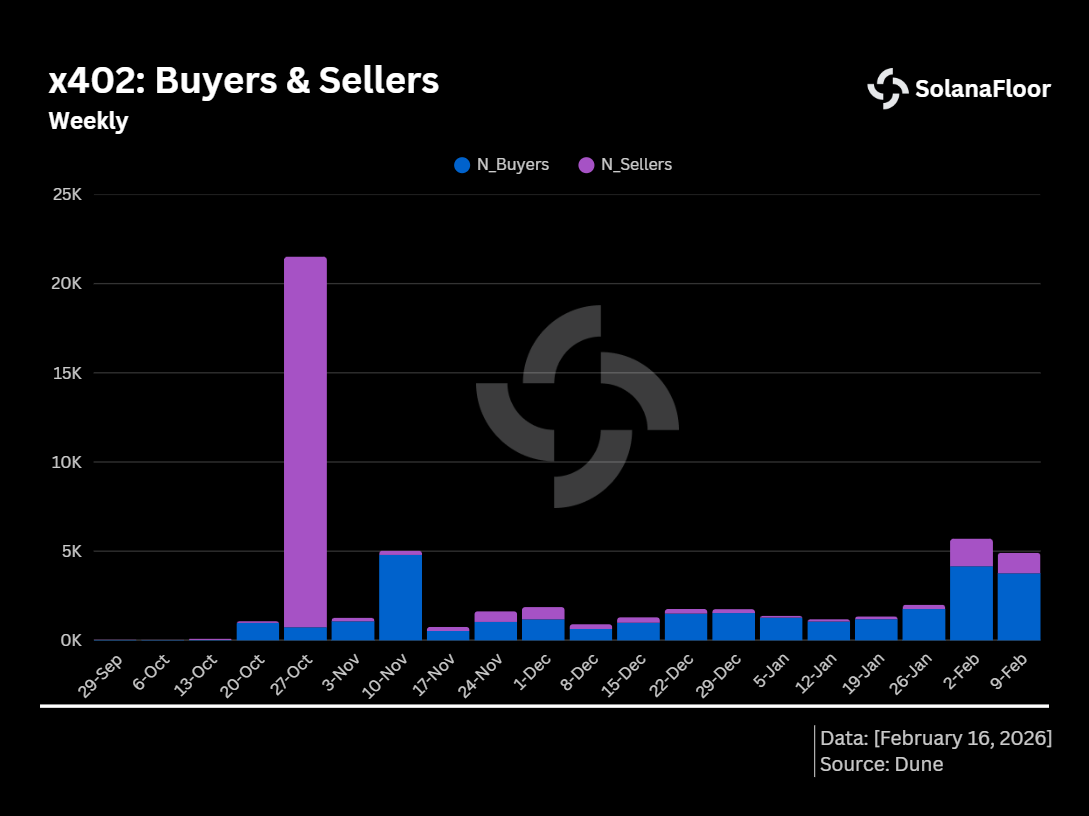 Since October 2025, more than 25,000 unique wallets have acted as service providers (sellers), while over 18,000 wallets (Human/Agent) have participated as buyers. The highest level of wallet participation occurred during the week of October 27, when more than 21,500 wallets were active. Notably, over 20,700 of these wallets were sellers, indicating strong early supply-side participation.
More recent activity shows a different pattern. During the week of February 9, approximately 4,900 wallets remained active, with buyers representing the majority at around 3,700 wallets.
Declining Activity Raises Questions About Organic Adoption
Despite early growth, both transaction counts and volume have declined significantly in recent weeks. On Solana, weekly x402 transactions fell from 6.8M during the week of December 22, 2025, to fewer than 510,000 by the week of February 9, representing a decline of more than 90%.
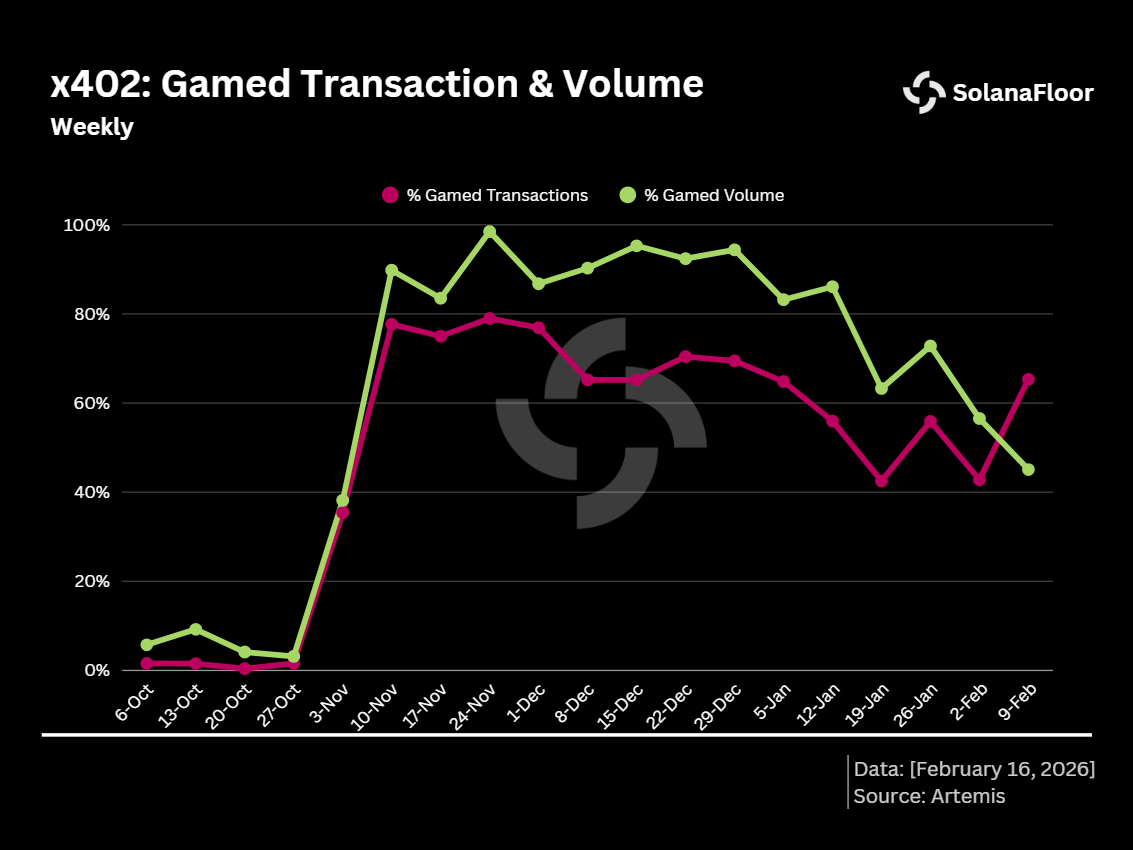 Data from Artemis suggests that a substantial portion of recorded activity may not represent organic economic demand. During the week of November 24, when transaction counts peaked across all networks, more than 78% of transactions were classified as non-organic. Even more notably, over 98% of recorded transaction volume during that same period was estimated to be non-organic.
Such patterns are not uncommon in early-stage network deployments, where automated transactions, testing infrastructure, or incentivized activity may temporarily inflate usage metrics.
Evaluating Solana’s Role in the Future of Micropayments
Despite recent declines and questions about organic demand, Solana has established itself as a primary infrastructure layer for x402 micropayments. Its ability to process high volumes of low-value transactions with minimal latency and cost provides a technical foundation that aligns with the requirements of internet-native payment systems.
However, long-term adoption will depend less on raw transaction counts and more on sustained, organic economic activity. Metrics such as consistent volume transfer, active buyer participation, and service-level demand will be more reliable indicators of real adoption.
This piece is part of our Solana Data Insights series. Make sure to subscribe to Solana Data Insights for weekly onchain analysis.
Read More on SolanaFloor
Nearly 70% of $SKR Supply Staked as 34,000 Wallets Lock Entire Holdings
OpenClaw Just Broke AI x Crypto Wide Open