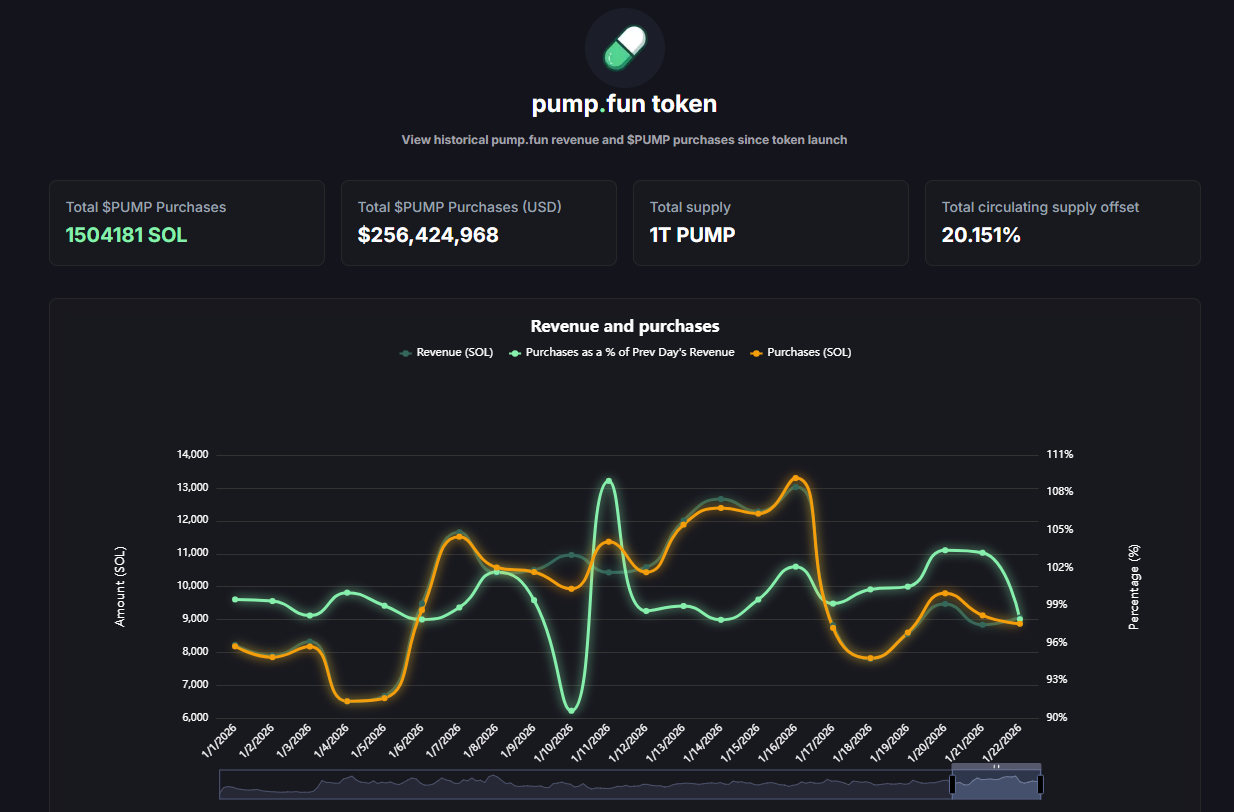
Yesterday, January 22, pump.fun executed another large buyback of its native $PUMP token, purchasing $1,148,649 worth of tokens. This single day of activity accounted for 103.2% of the protocol’s revenue from the prior day, extending a trend in which pump.fun consistently allocates nearly all of its earnings to $PUMP buybacks.
Data from the platform’s fee dashboard shows that pump.fun has spent 1,504,181 $SOL to repurchase tokens since the program began, equating to roughly $256.4 million at current prices. Given $PUMP’s fixed total supply of 1 trillion tokens, these buybacks have now absorbed more than 20% of the circulating supply, greatly reducing the amount of tokens available on the market.
Price Action Remains Subdued
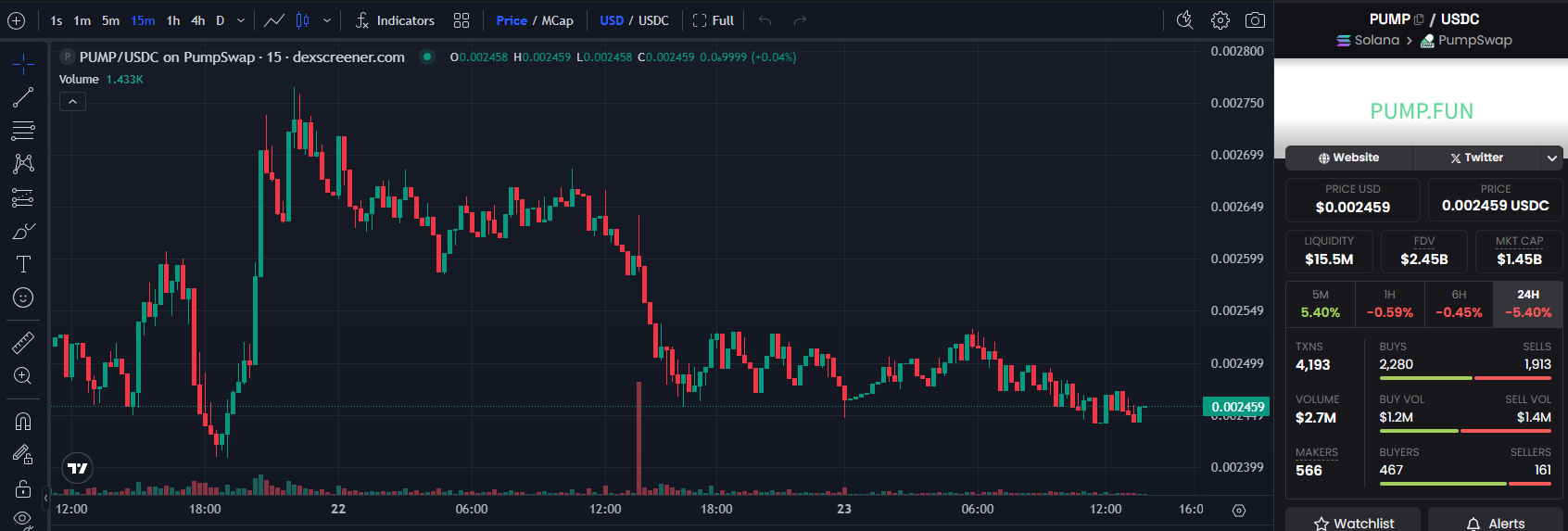
Despite the scale and consistency of these buybacks, the $PUMP token has shown little positive price response. Following the January 22 purchase, the token continued its downward trend, falling from approximately $0.00265 to around $0.00245 at the time of writing. Rather than acting as a catalyst for a rebound, the buyback appeared to coincide with continued selling pressure.
Pump.fun’s latest purchase once again exceeded its daily revenue, reinforcing that the buyback program functions as a core strategic priority rather than a residual use of funds. Over time, the protocol has frequently allocated nearly all of its earnings to token buybacks, effectively turning protocol revenue into a steady demand source for $PUMP.
$PUMP remains well below key historical benchmarks. The token still trades under its ICO price of $0.004 and remains far from its all-time high of $0.0088. This muted reaction underscores a growing pattern within the Solana ecosystem, where even sustained and sizable buyback programs have struggled to generate durable price appreciation.
What Has Pump.fun Been Up To?
The buyback activity arrives alongside a series of broader ecosystem initiatives from pump.fun. On January 20, the platform announced a $3 million Build in Public Hackathon designed to fund early-stage onchain startups. Twelve projects will each receive $250,000 in funding and gain access to a new accelerator and investment arm known as Pump Fund.
The initiative reflects pump.fun’s stated goal of shifting focus toward long-term ecosystem development. Pump.fun Co-founder alon has emphasized that distribution and instant liquidity played a critical role in the platform’s growth and that supporting founders is a key priority for 2026.
This declaration comes amid a broader period of instability across Solana’s narrative-driven markets, following the rapid collapse of the recent AI agent and vibe-coding meta, and renewed controversy around high-profile token sales.
At the same time, pump.fun has recently recorded an increase in trading activity. During the week of January 5 through January 11, the platform processed more than $6.6 billion in trading volume, marking a new all-time high since launch. This milestone followed several consecutive weeks of rising activity, with daily volumes repeatedly setting new highs, even as broader sentiment around memecoins remained cautious.
The surge in volume reignited debate over whether memecoins are experiencing a genuine resurgence or whether traders are positioning ahead of a potential $PUMP airdrop. While headline activity has clearly increased, underlying metrics around token creation and graduation suggest a more complex picture beneath the surface.
While the hackathon has generated optimism among builders, it has not materially changed sentiment toward the $PUMP token itself. Community frustration continues to linger over the absence of the long-promised $PUMP airdrop, which was initially described as “coming soon” during the token’s launch but has yet to materialize.
Are Buybacks Still the Way To Go?
In theory, reducing circulating supply should support price stability or appreciation. In practice, the data suggests that market participants remain unconvinced that buybacks alone can offset broader sentiment, liquidity conditions, and speculative behavior. Traders appear willing to sell into buyback demand, limiting any sustained upward movement.
Pump.fun’s experience highlights a broader question facing crypto protocols that rely on buybacks as a primary value accrual mechanism. Even after committing more than $255 million to repurchases and removing over 20% of supply from circulation, $PUMP continues to trade significantly below prior highs. As a result, an increasingly popular view within the ecosystem holds that projects may be better served by directing revenues toward long-term growth initiatives rather than continued token buybacks.
Earlier this month, Helium announced it would halt $HNT buybacks, with its leadership arguing that routing millions in protocol revenue into token purchases failed to produce durable price support. Jupiter has echoed similar concerns, disclosing that more than $70 million in $JUP buybacks delivered a limited impact despite sustained revenue.
This outcome suggests that buybacks, while mechanically reducing supply, do not guarantee price appreciation in isolation. Market confidence, perceived utility, and expectations around future incentives appear to play equally important roles in shaping price behavior.
Read More on SolanaFloor
Prop AMMs on Solana: BisonFi Ends HumidiFi’s Dominance With $11.5B Volume
Space Faces Scrutiny After $20M ICO, Keeping More Than 5X The Target Raise
Tokenized Metals Are About to Explode!