
$1B in 24 Hours: Is Jupiter’s YOLO Solana’s Answer To Papertrade?
Jupiter’s new Solana trading product offers up to 1,000x leverage on $SOL, $BTC, and $ETH, but its unaudited beta comes with a house-funded payout system and no guaranteed payment timeline.
- Published:
Jupiter Exchange’s new experimental trading product, YOLO, recorded $1 billion in trading volume less than 24 hours after launching in beta yesterday, October 15.
The product lets users speculate on $SOL, $BTC, and $ETH prices, offering leverage of up to 1,000x with a minimum collateral of $5.
“$1B in volume on Jupiter Yolo in less than 24 hours!” Jupiter wrote in an X post earlier today.
However, the milestone represents the notional value of positions opened and closed, meaning $5 in collateral can create a $5,000 position at 1,000x leverage.
How YOLO Works
Launched by Jupiter Labs, YOLO uses a simulated trading model instead of executing leveraged positions directly in the market.
“Positions aren’t actually executed in the market, but the profits and losses are real,” Jupiter co-founder Siong Ong explained in a post.
Unlike conventional peer-to-peer trading systems, YOLO places users against a single house pool shared across $SOL, $BTC, and $ETH. Settled trader losses replenish the pool, which funds winning traders’ profits. Users cannot deposit money to provide liquidity to the pool.
The model lets Jupiter offer leverage beyond the 250x maximum on its existing Jupiter Perps markets, which use the Jupiter Liquidity Pool (JLP) as their counterparty.
However, the higher leverage comes with substantial risks. At 1,000x leverage, a 0.1% price move can liquidate a position and consume its collateral. YOLO also offers only market orders without stop-loss or take-profit orders.
Winning Does Not Guarantee Immediate Payment
YOLO’s payout structure introduces a risk beyond losing a trade. When a trader closes a position, Jupiter returns their remaining collateral in $JupUSD. However, the platform pays profits immediately only when the house pool can cover the full amount and no earlier claims remain in the queue.
If the pool lacks sufficient funds, YOLO places all profits into a first-in, first-out payout queue. The platform then pays queued profits in full, one at a time, as subsequent trader losses replenish the pool.
New winning trades join the queue while outstanding claims remain, and Jupiter provides no guaranteed payout deadline. Its trading rules warn that profits may never be paid.
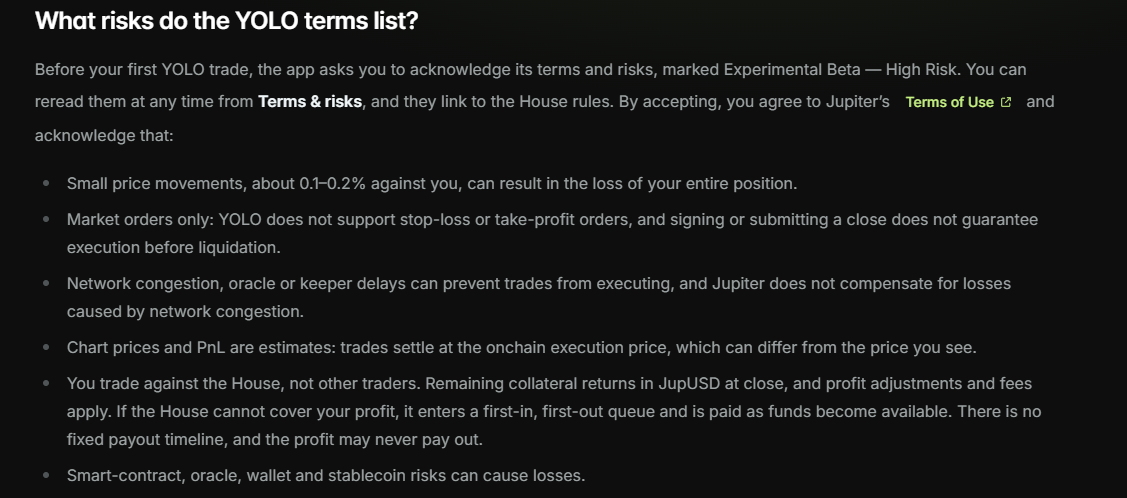
Jupiter also disclosed that YOLO remains unaudited, urging users to start small rather than risk their life savings.
Solana’s Answer to PaperTrade?
YOLO’s launch comes as PaperTrade, an onchain perpetual futures platform built on Hyperliquid, attracts attention with a similar house-based trading model. PaperTrade offers up to 1,000x leverage on $BTC and $ETH and rewards losing traders with $PAPER tokens. Its house pool receives traders’ losses, while the platform uses Hyperliquid prices as its market reference without executing orders on Hyperliquid’s order book.
Jupiter co-founder Siong Ong confirmed in an X post that the Jupiter team “took inspiration” from what PaperTrade has been building.
PaperTrade launched on October 10 and has reportedly generated more than $1.1 trillion in volume, with $67.8 million in TVL.
Some Solana community members have already framed YOLO as Solana’s answer to PaperTrade.
Meanwhile, Others have questioned the sustainability of products that combine extreme leverage with house-funded payouts.
Read More on SolanaFloor
Phoenix Launches 6X Anthropic Pre-IPO Perps as AI Giant Eyes a $100B IPO
Solana Opens Shanghai Office in a First for the Blockchain Industry, Leaving CZ Surprised
The Gold I Bought On Solana Had 4 Middlemen