
Third Time’s the Charm? - White House Hosts Third Stablecoin Meeting as CLARITY Act Odds Surge on Prediction Markets
Banks and Crypto Firms Clash Over Yields as Congress Weighs Market Structure Reform.
- Veröffentlicht:
The White House will host a third meeting today focused on stablecoin yield, as policymakers, banks, and crypto companies attempt to break a deadlock that has stalled federal crypto legislation.
The talks follow two earlier sessions that failed to resolve disagreements over whether stablecoin issuers and platforms should be allowed to offer yield or rewards to users. At the same time, optimism around the broader Digital Asset Market Clarity Act, known as the CLARITY Act, has intensified, with prediction markets sharply raising the odds that Congress will pass the bill in 2026.
A small group representing both the banking and crypto industries is expected to attend the latest meeting. Officials hope that a more focused discussion can narrow differences that have derailed progress in the Senate.
The Core Dispute Over Stablecoin Yield
The central issue concerns whether companies that issue or distribute stablecoins can pass along interest earned on underlying reserves, such as U.S. Treasuries, to customers. When interest rates rise, those reserves generate meaningful returns.
Crypto companies argue that allowing yield sharing aligns with market principles and benefits consumers. They say users should receive a share of the interest generated by the assets backing their digital dollars. Coinbase and other firms contend that yield-bearing stablecoins modernize payments and savings by reducing fees, improving access, and increasing competition.
Banks view the matter differently. Major institutions and trade groups have warned that yield-bearing stablecoins could draw deposits away from traditional banks. They argue that deposit flight could weaken community banks and limit lending capacity. During previous meetings, banking representatives reportedly pushed for strict prohibitions on both financial and non-financial benefits tied to holding stablecoins.
This divide has stalled progress on the CLARITY Act in the Senate. Although the House passed its version of the legislation in July 2025 by a vote of 294 to 134, the Senate has struggled to reconcile competing views, particularly within the Banking Committee.
What Happened at the Previous White House Meetings?
The first White House meeting on February 2 brought together crypto firms such as Coinbase, trade groups, and banking representatives. Participants reviewed policy proposals but did not reach an agreement. Officials described that session as the beginning of a series aimed at resolving the issue before the end of February.
A second meeting on February 10 included major banks such as JPMorgan, Goldman Sachs, and Citi, as well as crypto platforms and industry associations. Attendees characterized the discussion as productive, yet they acknowledged that it ended in an impasse. Banks reportedly presented broad prohibition principles on stablecoin rewards, going beyond the narrower restrictions outlined in a draft Senate bill. Crypto representatives pushed back, arguing that overly restrictive rules would stifle innovation.
Patrick Witt, executive director of the President’s Council of Advisors for Digital Assets, has encouraged both sides to find a compromise. He has argued that regulatory clarity would unlock significant institutional capital. Witt stated that “trillions of dollars in institutional capital” remain on the sidelines and await clearer rules before entering the digital asset market.
CLARITY Act Odds Jump on Polymarket
While negotiations continue in Washington, prediction markets have reacted swiftly. On Polymarket, the probability that the CLARITY Act will pass in 2026 surged early Thursday morning from around 60% to as high as 90% after Coinbase CEO Brian Armstrong said negotiations had made great progress.
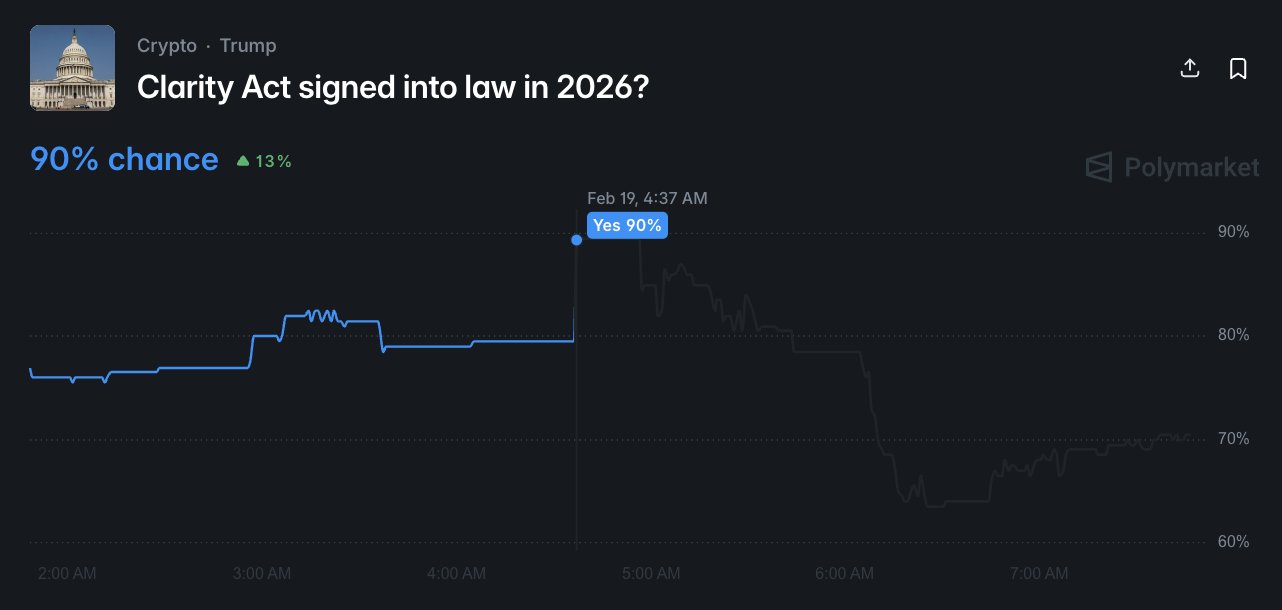
Those odds have since retraced to around 70%, reflecting renewed caution among traders as negotiations continue.
In a CNBC interview, Armstrong said lawmakers and industry participants have narrowed their disagreements to a few remaining issues. He noted that the Senate Banking Committee has met frequently to advance the bill. Senator Bernie Moreno, who also spoke, expressed hope that Congress could approve the legislation by April.
Armstrong previously withdrew support for a draft bill in January, citing concerns about restrictions on stablecoin rewards. His shift in tone suggests that negotiations have advanced since that setback. He described a potential outcome that benefits crypto companies, banks, and consumers alike.
What Passage Could Mean
If Congress passes the CLARITY Act, it would establish clearer boundaries for crypto oversight and provide a defined framework for stablecoin regulation. Supporters argue that such clarity could strengthen U.S. competitiveness and encourage innovation to remain onshore rather than migrate to less-regulated jurisdictions.
Banks and crypto firms both acknowledge that uncertainty has slowed investment and product development. A legislative breakthrough could reduce compliance ambiguity, attract institutional participation, and create more consistent consumer protections.
The third White House meeting represents another attempt to bridge a divide that has shaped the crypto policy debate for months.
Read More on SolanaFloor
Zora Launches ‘Attention Markets’ on Solana, Drawing Outrage From Base Community Over Chain Shift
Solana Validator Economics Abused by Universities and DATs Running “Malicious” Mod
Bitwise CIO Matt Hougan Explains Why Banks are Against Stablecoins