Internet Capital Markets: Das Handelsvolumen von SpaceX auf Solana erreicht am ersten Tag 37 Millionen Dollar
Während sich der größte Börsengang der Geschichte abspielte, sorgten die On-Chain-Spotmärkte innerhalb weniger Stunden für eine schnelle Preisbildung und ein Handelsvolumen in Millionenhöhe.
- Veröffentlicht:
Der lang erwartete Börsengang von SpaceX ist bereits zu einem der bedeutendsten Finanzereignisse des Jahrzehnts geworden. Nach dem Börsengang am Freitag, dem 12. Juni, wurde die Aktie des Unternehmens an der Nasdaq zu einem Kurs von 150 US-Dollar pro Aktie gehandelt. Der Börsengang brachte die Rekordsumme von 75 Milliarden US-Dollar ein, bewertete SpaceX mit rund 1,8 Billionen US-Dollar und trug dazu bei, dass das geschätzte Vermögen von Elon Musk erstmals die Marke von 1 Billion US-Dollar überschritt.
Doch während sich die traditionellen Märkte auf den historischen Börsengang selbst konzentrierten, entstand auf Solana ein Parallelmarkt. Innerhalb weniger Stunden nach dem Nasdaq-Debüt wurden mehrere tokenisierte Versionen der SpaceX-Aktie auf der Blockchain gehandelt. Backpack und Sunrise führten den einlösbaren $SPCX-Token ein, während xStocks $SPCXx und Ondo $SPCXon auf den Markt brachten. Zusammen ermöglichten diese Vermögenswerte den Solana-Nutzern einen sofortigen Zugang zu SpaceX-Aktien durch tokenisierte Repräsentationen, die rund um die Uhr gehandelt wurden.
Solana wird zum Live-Testfeld für tokenisierte Aktien
Die Einführung markierte einen der bislang ehrgeizigsten Versuche, börsennotierte Aktien in die Blockchain-Infrastruktur zu integrieren. Backpacks $SPCX debütierte als tokenisierte Darstellung der SpaceX-Aktie, die Nutzer rund um die Uhr über Solana-Handelsplätze handeln können. Der Token bietet eine 1:1-Deckung durch die zugrunde liegenden Aktien, unterstützt die Selbstverwahrung, ermöglicht Übertragungen auf Brokerkonten über Rückkaufmechanismen und beinhaltet Dividendenunterstützung.
Gleichzeitig traten konkurrierende Emittenten mit ihren eigenen Versionen auf den Markt. xStocks lancierte $SPCXx, während Ondo $SPCXon einführte. Die gleichzeitigen Markteinführungen schufen mehrere Plattformen, auf denen Marktteilnehmer ihre Einschätzungen zum Wert der neu börsennotierten SpaceX-Aktien äußern konnten.
IPO-Kampagnen an zentralisierten Börsen geraten ins Stocken
Der Kontrast zwischen zentralisierten und dezentralisierten Markteinführungen wurde fast sofort deutlich. Bybit gab bekannt, dass Teilnehmer an seinem SpaceX-IPO-Zeichnungsprogramm keine Zuteilungen erhalten würden, nachdem xStocks die für die Verteilung erforderlichen Basiswerte nicht liefern konnte.
Auch Binance sagte seine $SPCXx-IPO-Kampagne ab und verwies dabei auf Umstände, die außerhalb seiner Kontrolle lagen. Das Unternehmen kündigte vollständige Rückerstattungen für teilnehmende Nutzer an und versprach, $SPCXB-Token im Wert von 1 Million US-Dollar an die Teilnehmer zu verteilen.
Obwohl beide Börsen Maßnahmen ergriffen, um die Nutzer zu entschädigen, lieferte letztlich keine der beiden Kampagnen die erwarteten IPO-Zuteilungen. Unterdessen wurden tokenisierte SpaceX-Vermögenswerte bereits auf Solana gehandelt.
Die ersten Stunden des Spot-Handels generierten ein Volumen in Millionenhöhe
In den ersten zwei Handelsstunden kam es zu bedeutender Aktivität auf den tokenisierten SpaceX-Märkten von Solana. Laut Marktdaten, die etwa zwei Stunden nach Handelsbeginn erfasst wurden, verzeichnete $SPCX ein Volumen von etwa 5,78 Millionen US-Dollar, während $SPCXx Handelsaktivitäten im Wert von rund 1,79 Millionen US-Dollar generierte und $SPCXon ein Volumen von etwa 10.100 US-Dollar verzeichnete.
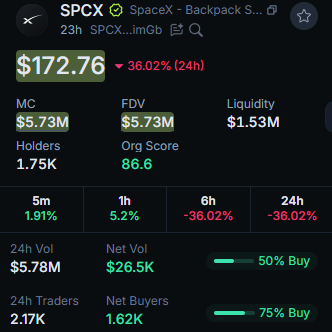
Zusammen erzielten die drei Märkte in den ersten zwei Betriebsstunden ein Spot-Handelsvolumen von rund 7,58 Millionen US-Dollar. Das Volumen ist seit dem Start weiter gewachsen. Allein Backpacks $SPCX erzielte in den ersten sieben Handelsstunden ein Volumen von 37 Millionen US-Dollar.
Preisfindung zeigt Unterschiede zwischen den Produkten
Nicht alle Produkte haben sich gleich verhalten. Monatelang bot PreStocks den Solana-DeFi-Nutzern die Möglichkeit, über $SPACEX, sein synthetisches Private-Equity-Instrument, ein Engagement aufzubauen. Nach dem Börsengang wurde der Vermögenswert jedoch schnell mit einem Abschlag von rund 41 % gegenüber dem Aktienkurs von SpaceX gehandelt.
Inhaber von PreStocks müssen eine Sperrfrist von 180 Tagen einhalten, bevor sie ihre Token in die zugrunde liegenden Aktien umwandeln können. Daher müssen Anleger entweder sechs Monate auf ihre Rückkaufrechte warten oder auf einem relativ illiquiden Sekundärmarkt verkaufen. Der Abschlag spiegelt die Kosten dieser Wartezeit und die mit dem Vermögenswert verbundenen Beschränkungen wider.
Der Börsengang von SpaceX löste zudem eine Diskussion über die Rolle von Spotmärkten im Vergleich zu Perpetual-Futures aus. Der $SPCX-Perpetual-Futures-Markt von Trade.xyz auf Hyperliquid überschritt ein 24-Stunden-Handelsvolumen von 1 Milliarde US-Dollar und war damit am Freitag der drittgrößte Markt der Plattform gemessen am Tagesvolumen.

Trotz dieser Schlagzeilen argumentieren einige Branchenvertreter, dass Spotmärkte nach wie vor ein direkterer Maßstab für die tatsächliche Nachfrage sind. In einem Livestream der „Solana Weekly News“ von SolanaFloor betonte Saeed Badreg, CEO von Wormhole Labs und Sunrise-Entwickler, dass der Spot-Handel tatsächliches Kapital und nicht gehebelte Engagements widerspiegele.
Laut Badreg können Perpetual-Futures ein deutlich höheres Handelsvolumen generieren, da Händler Hebel einsetzen, wodurch mit derselben Kapitalbasis ein wesentlich höherer Umsatz erzielt werden kann. Er argumentierte, dass Spotmärkte ein klareres Bild der Überzeugung der Anleger vermitteln, da die Teilnehmer vollständig finanziertes Kapital einsetzen und keine gehebelten Positionen.
Badreg merkte außerdem an, dass Spotmärkte ein stärkeres langfristiges Nutzerengagement fördern können, da Händler einem geringeren Liquidationsrisiko und weniger durch Hebelwirkung bedingter Volatilität ausgesetzt sind. „Die Kluft ist für mich nicht so groß“, sagte Badreg beim Vergleich von On-Chain-Spot- und Perpetual-Märkten. Er fügte hinzu, dass Spotmärkte weiterhin wichtig seien, da sie Nutzer anziehen, die ein Engagement ohne die mit Hebelwirkung verbundenen Risiken suchen.
Der Wettbewerb wird Teil der Geschichte
Die Einführung löste auch Kommentare von Branchenführern aus. Vibhu Norby, Chief Product Officer bei der Solana Foundation, argumentierte, dass Solana den Markt vor zentralisierten Börsen erreicht habe und die Nachfrage bewältigt habe, ohne die Ausfälle zu erleben, von denen einige große Handelsplattformen während hochkarätiger Veranstaltungen betroffen waren.
Vibhu verwies auf die Präsenz mehrerer Emittenten als Beweis dafür, dass Wettbewerb bessere Ergebnisse für die Nutzer schaffen kann. Anstatt sich auf einen einzigen Anbieter zu verlassen, erhielten die Marktteilnehmer Zugang zu mehreren konkurrierenden tokenisierten Produkten, die jeweils um Liquidität und Marktanteile konkurrierten. „Einige haben es geschafft, andere nicht, aber die Nutzer hatten die Wahl“, schrieb Norby. „Das ist Wettbewerb.“
Tokenisierte Aktien gewinnen an Beliebtheit, da immer mehr Menschen eine neue Art der Teilnahme an den weltweiten Märkten begrüßen. Der erste Handelstag von SpaceX bot einen ersten Einblick, wie die Kapitalmärkte der Zukunft aussehen könnten, wenn börsennotierte Aktien und Blockchain-Infrastruktur zusammenwachsen.
Weiterlesen auf SolanaFloor
Die Solana Foundation startet „Frontier Traders“, eine neue Plattform für den hochvolumigen On-Chain-Handel„
“ sammelt vor dem Mainnet-Start 25,9 Millionen US-Dollar an TVL aus Vorab-Einzahlungen
WSOP-Spieler können jetzt Preise in SOL gewinnen?