Jump Crypto, Anza Tip FALCON as Solana's Solution to the Quantum Threat
Will Solana be ready for Q-Day?
- Published:
Quantum computers capable of breaking today's cryptography are probably still years away. However, that hasn’t stopped Jump Crypto and Anza from preparing Solana for a quantum future, working to set proactive solutions in place long before the Q-Day deadline.
Two of the biggest names in Solana, Anza and Jump have published independent research suggesting how the protocol should approach a post-quantum transition.
Both landed on the same leading candidate in FALCON, a lattice-based signature scheme now completing NISTs’ (National Institute of Science and Technology) standardization process.
What exactly is Solana’s quantum threat, why do ecosystem leaders believe FALCON is the solution, and when can we expect the network to implement meaningful protections ahead of the quantum deadline?
Solana's Quantum Threat
While the technicalities of the quantum threat are profoundly complex, the potential impact is relatively straightforward. Every transaction on Solana is authorized by an Ed25519 signature, a scheme whose security rests on the assumption that deriving a private key from a public key is computationally infeasible.
However, a quantum computer running Shor's algorithm could theoretically shatter that assumption, letting an attacker forge signatures and drain any wallet on the network.
According to a Google whitepaper published in March, the Tech Giant described new quantum circuits that dramatically compress the resources required to pull off that attack, putting the requirement at fewer than 500,000 physical qubits. A subsequent result from Oratomic pushed the estimate lower still, to somewhere between 10,000 and 20,000 qubits on a neutral-atom architecture.
Current quantum hardware is nowhere near those numbers, but the trajectory is moving in one direction. Anza's paper now assigns a 3 to 5% probability of a cryptographically relevant quantum computer arriving within five years. Jump's framing is more conservative, but the practical conclusion is identical: the window to prepare is open now.
While the wallet threat is enough cause for alarm on its own, the scope of the problem extends even further. Anza identifies four distinct attack surfaces: the account model, block propagation via Turbine and rotor, Alpenglow consensus, and user-defined programs that rely on elliptic curve primitives for authorization logic. A quantum attacker could target any of them.
The FALCON Scheme
FALCON, formally designated FN-DSA by NIST, is a lattice-based signature scheme that solves hard mathematical problems in structures called lattices, rather than relying on the elliptic curve assumptions that Shor's algorithm breaks.
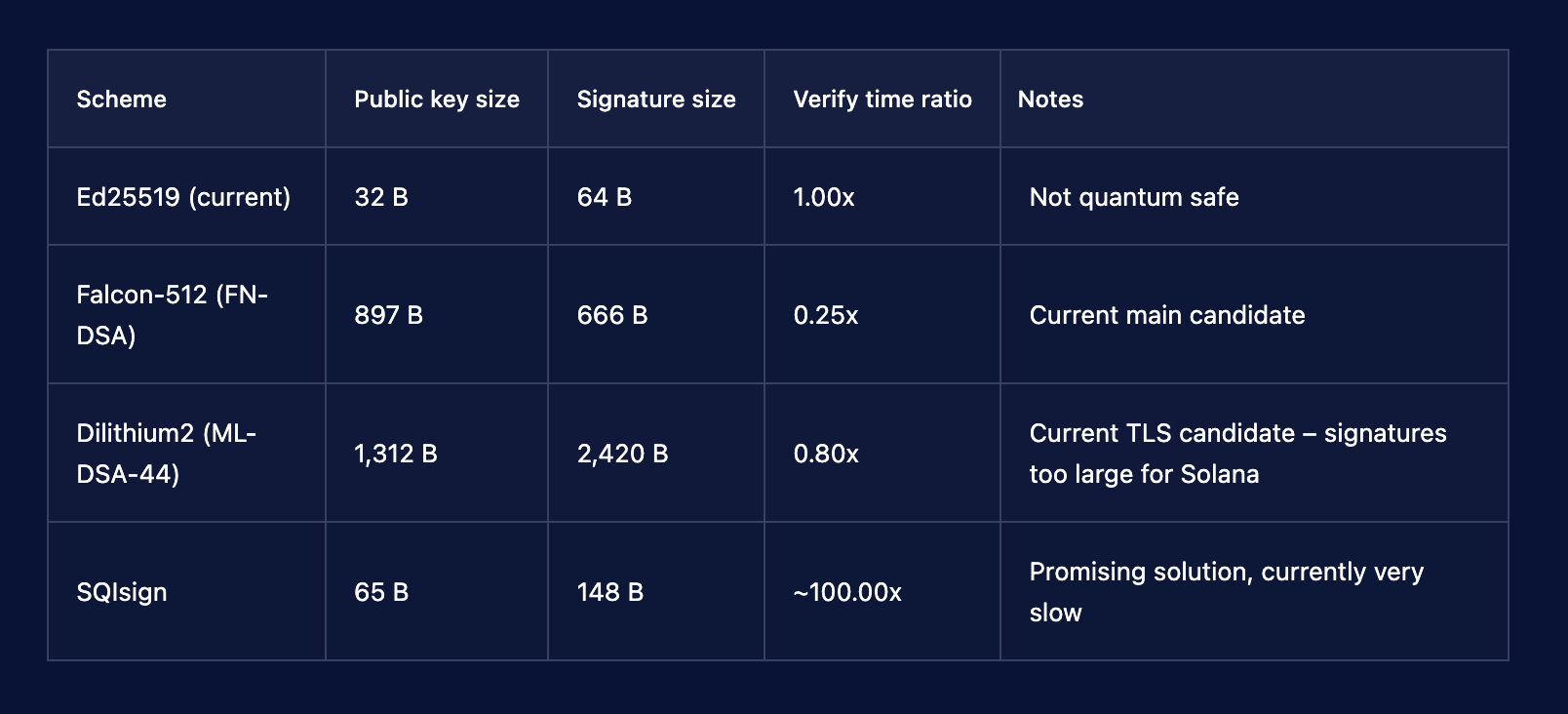
For Solana, FALCON is appealing due to the size of its signatures. FALCON-512 signatures come in at 666 bytes, roughly ten times larger than Ed25519, but still the smallest option among NIST's finalized post-quantum standards.
Comparatively, NIST's other lattice-based standard, ML-DSA (Dilithium), produces signatures of 2,420 bytes, which Jump judges too large for Solana's bandwidth requirements. SQISign offers signatures of just 148 bytes, but its verification time is around 100 times slower than current schemes, ruling it out for now.
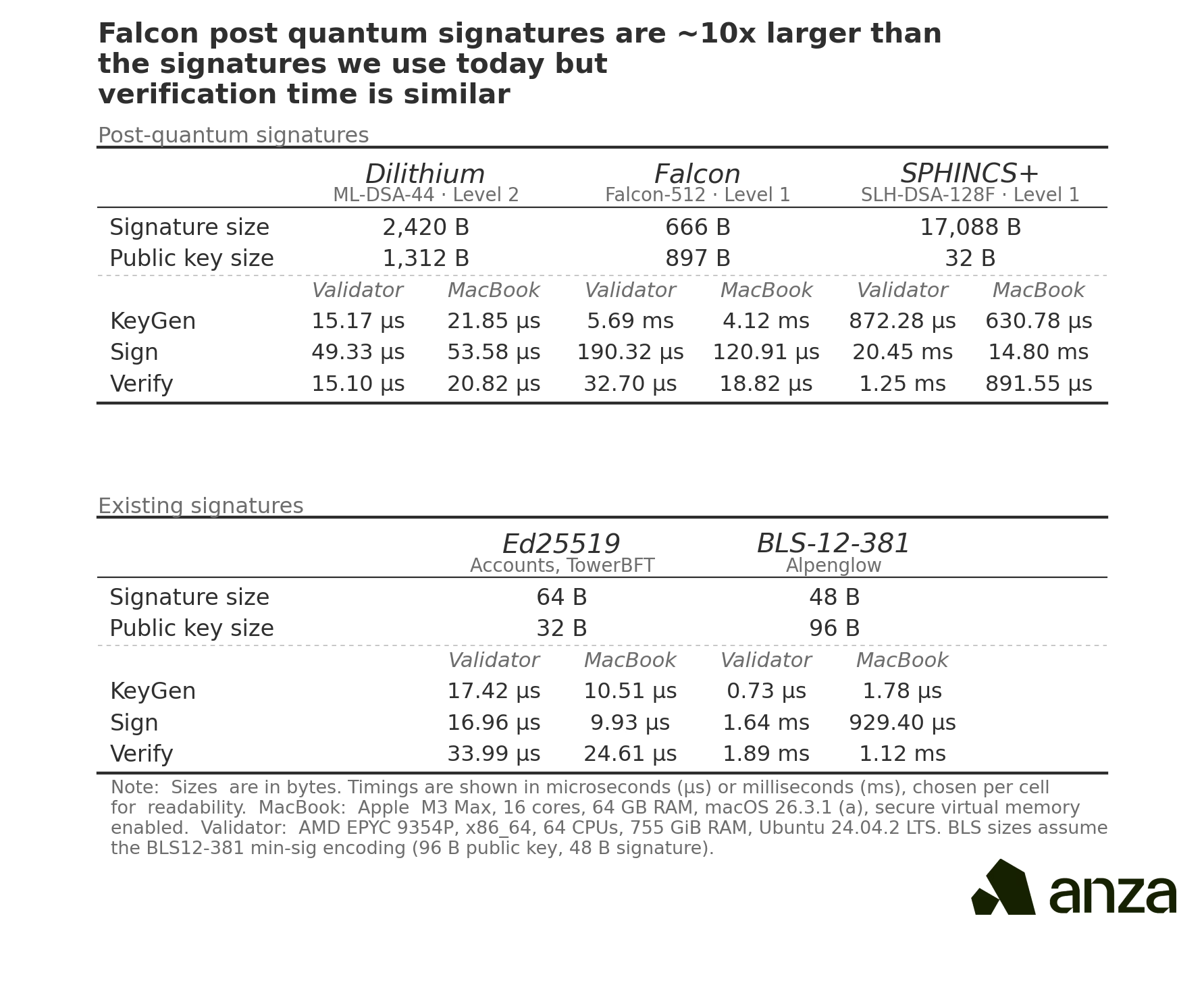
Consistent with Solana’s vision of hyper-performant throughput, FALCON's verification speed makes it a better fit than alternatives. Jump's data shows it verifies signatures roughly four times faster than Ed25519, a necessity for validator clients checking millions of signatures. Jump reports that Firedancer has already shipped a FALCON verification implementation, which is currently awaiting audit.
For existing wallets, the migration path is more elegant than it might first appear. Solana derives Ed25519 private keys from a 32-byte seed via SHA-512, which is itself quantum-resistant, meaning the underlying seed stays protected even if Ed25519 is broken. A user who holds their seed phrase retains something a quantum adversary cannot recover.
Jump and Anza both propose exploiting that property to authorize account migrations. Users would submit a zero-knowledge proof demonstrating knowledge of the Ed25519 seed, paired with a new FALCON public key, binding the old account to the new scheme. According to its recent blog article, Anza has already shipped a prototype that generates that proof in approximately 55 milliseconds.
The Quantum Roadmap
Neither Jump nor Anza is calling for an immediate protocol overhaul. The near-term focus is on enabling FALCON at the application layer, primarily through SIMD-0416, which proposes allowing smart contracts to verify post-quantum signatures on-chain. If approved, developers could begin building quantum-resistant vaults and custody schemes today, without waiting for a full protocol migration.
Transaction size is the other prerequisite. SIMDs 0296 and 0385 propose increasing Solana's transaction size limit from 1,232 bytes to 4,096 bytes. FALCON signatures simply do not fit in today's transaction envelope.
Meanwhile, the Solana Foundation is also committed to getting its hands dirty. The non-profit has been building out the research foundation in parallel through its collaboration with Project Eleven, a post-quantum security firm that raised a $20 million Series A in January at a $120 million valuation.
Project Eleven conducted a full threat assessment of Solana's security stack and deployed a working post-quantum testnet. The proactive approach is encouraging, but the results highlighted an unfortunate trade-off. Quantum-safe signatures were 20 to 40 times larger than today's, and the network ran approximately 90% slower under those conditions.
Both papers indicate that Solana is better positioned to navigate this transition than most networks. It has the validator coordination to move quickly when decisions are made, and an active SIMD process for protocol changes.
All things considered, Solana users can rest assured that the chain’s leaders are actively monitoring the quantum threat, and making necessary preparations ahead of an eventual quantum deadline.
Read More on SolanaFloor
A CEX is Winning the Solana LST race
$BNSOL Claims Solana’s LST Crown Amidst DeFi Deposit Flight
What’s the Biggest Threat to DeFi in 2026?